
Chicken Egg Color Chart: 30 Breeds by Shell Color
Which chicken breeds lay white, cream, brown, dark brown, blue and green eggs: a chart of 30 breeds, why shells differ, and a free printable.
Shell color follows the breed. Of the 30 breeds on this chart, 4 lay white eggs (Leghorn, Polish, Hamburg and the Blue Andalusian, a blue bird that lays white), 3 lay cream or tinted eggs, 16 lay brown, 3 lay dark brown (Marans darkest), 2 lay blue (Ameraucana and Cream Legbar), and the Olive Egger and Easter Egger lay green or mixed colors. Every shell starts white: brown pigment is laid on the outside late in shell formation, while in the Ameraucana the blue goes right through the shell. A hen's earlobes are a useful but imperfect clue, and shell color makes no major difference to taste or nutrition (Texas A&M AgriLife).
Not sure which breed fits your flock? The breed selector quiz matches breeds to your climate and goals, egg color included.
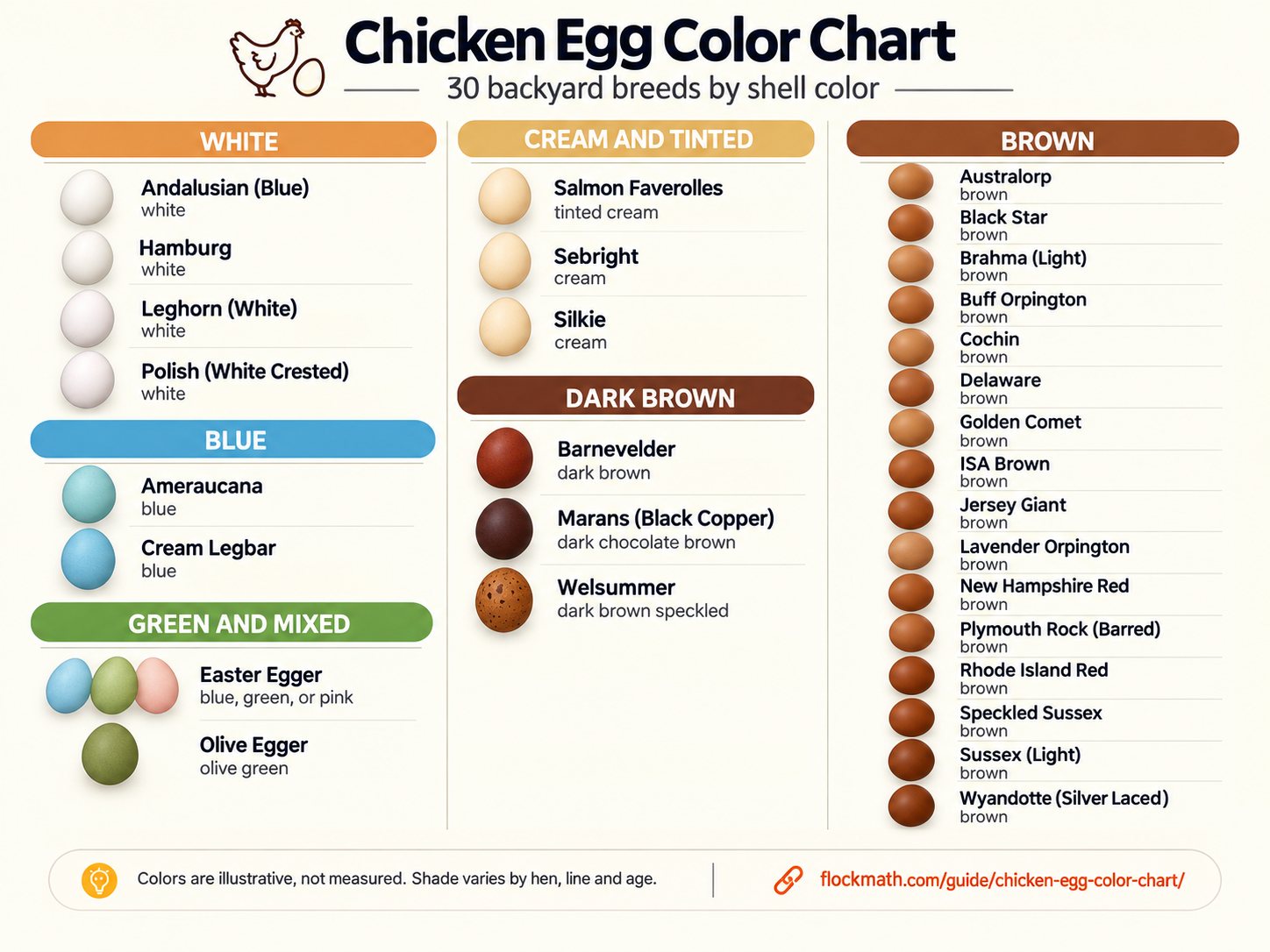
Download the egg color chart as a printable PDF: one letter-size page, with all 30 breeds and their shell color, egg size and eggs a year.
Egg color chart by breed
Each breed links to its full profile, and to its eggs-per-year guide where there is one. Shell color, egg size and eggs a year are the figures used on every breed page on this site; the profiles give the sources behind each one.
White (4 breeds)
| Breed | Shell color | Egg size | Eggs a year | Egg guide |
|---|---|---|---|---|
| Andalusian (Blue) | white | large | 165 | Eggs per year |
| Hamburg | white | medium | 200 | Eggs per year |
| Leghorn (White) | white | large | 290 | Eggs per year |
| Polish (White Crested) | white | medium | 150 | Eggs per year |
Cream and tinted (3 breeds)
| Breed | Shell color | Egg size | Eggs a year | Egg guide |
|---|---|---|---|---|
| Salmon Faverolles | tinted cream | medium | 180 | Eggs per year |
| Sebright | cream | small | 80 | Eggs per year |
| Silkie | cream | small | 100 | Eggs per year |
Brown (16 breeds)
| Breed | Shell color | Egg size | Eggs a year | Egg guide |
|---|---|---|---|---|
| Australorp | brown | large | 280 | Eggs per year |
| Black Star | brown | large | 280 | Eggs per year |
| Brahma (Light) | brown | medium | 180 | Eggs per year |
| Buff Orpington | brown | large | 220 | Eggs per year |
| Cochin | brown | large | 160 | Eggs per year |
| Delaware | brown | large | 200 | Eggs per year |
| Golden Comet | brown | large | 280 | Eggs per year |
| ISA Brown | brown | large | 300 | Eggs per year |
| Jersey Giant | brown | large | 180 | Eggs per year |
| Lavender Orpington | brown | large | 220 | Eggs per year |
| New Hampshire Red | brown | large | 220 | Eggs per year |
| Plymouth Rock (Barred) | brown | large | 220 | Eggs per year |
| Rhode Island Red | brown | large | 260 | Eggs per year |
| Speckled Sussex | brown | large | 240 | Eggs per year |
| Sussex (Light) | brown | large | 240 | Eggs per year |
| Wyandotte (Silver Laced) | brown | large | 200 | Eggs per year |
Dark brown (3 breeds)
| Breed | Shell color | Egg size | Eggs a year | Egg guide |
|---|---|---|---|---|
| Barnevelder | dark brown | large | 180 | Eggs per year |
| Marans (Black Copper) | dark chocolate brown | large | 180 | Eggs per year |
| Welsummer | dark brown speckled | large | 180 | Eggs per year |
Blue (2 breeds)
| Breed | Shell color | Egg size | Eggs a year | Egg guide |
|---|---|---|---|---|
| Ameraucana | blue | medium | 180 | Eggs per year |
| Cream Legbar | blue | medium | 200 | Eggs per year |
Green and mixed (2 breeds)
| Breed | Shell color | Egg size | Eggs a year | Egg guide |
|---|---|---|---|---|
| Easter Egger | blue, green, or pink | large | 240 | Eggs per year |
| Olive Egger | olive green | large | 200 | Eggs per year |
A few things the chart shows at a glance:
- Brown is the default. 19 of the 30 breeds lay brown or dark brown eggs, from the everyday brown of a Rhode Island Red to the dark chocolate of a Marans.
- A blue bird does not mean a blue egg. The Blue Andalusian lays white eggs. Its name describes its feathers.
- Only two breeds here lay blue. The Ameraucana and the Cream Legbar. The Olive Egger and Easter Egger get their green, and sometimes pink, from crosses with blue-egg birds.
Why chicken eggs are different colors
Egg color is mostly genetic, and the breed usually tells you what color to expect. Gregory Archer, a poultry specialist with Texas A&M AgriLife Extension, puts it plainly: “all eggs start out white because the shells are made from calcium carbonate. They get their color from the hen’s genetics as the egg forms.”
The color goes on in the shell gland, near the end of a process that takes a little over 24 hours from start to laid egg. The pigment, and when it is laid down, decides the color:
- Brown shells get a pigment called protoporphyrin. It goes on late in shell formation, so it rarely reaches the inside. Crack a brown egg and the inside of the shell is usually white.
- Blue shells get a pigment called oocyanin. In the Ameraucana it colors both the outside and the inside of the shell, so a blue egg is blue inside as well.
- Olive shells come from a cross. An Olive Egger is bred from a brown-egg breed and a blue-egg breed, and the hen’s brown pigment blends into the blue shell to give a greenish egg. The darker the brown, the more olive the egg.
- Speckles are extra calcium deposits. One possible cause is a disturbance while the shell is being formed.
Blue shells sometimes cause worry, so one point is worth stating directly. The blue trait traces back to a gene a virus left in the chicken genome many generations ago. Jacquie Jacob of the University of Kentucky, writing for the Poultry Extension network, explains that this does not mean blue-egg hens are sick or genetically modified. The virus is simply “a harmless part of their genetic story.” A 2014 National Geographic article notes that the blue-shell gene in Araucanas is dominant, so crossing them with a breed that lays another color can give blue, pink or even green eggs. That would explain why the Easter Egger, a blue-egg cross, has no single egg color, though no source here says so about Easter Eggers directly.
Can you tell egg color from a hen’s earlobes?
Often, but not always. “Generally, hens with white earlobes will produce white eggs,” Archer says, and hens with darker earlobes and colored feathers are likely to lay colored eggs. Texas A&M’s own publication on breeds and egg colors calls the earlobe a generally accurate predictor.
It is a rule of thumb, not a law. Jacob points to the Lamona, a breed with red earlobes that lays white eggs. If you need to know for certain, go by the breed, or by the hen’s first eggs.
Why the same hen’s eggs change shade
A hen keeps the same basic egg color all her life: a blue-egg hen goes on laying blue eggs, according to Texas A&M. The shade can still move. As hens of brown-egg breeds age, they may lay larger, lighter brown eggs. Diet, environment and stress can also affect the shell, and disease, heat or overcrowding can change its size, shape and quality. On age, Archer is explicit: it can make the shade lighter or darker, but “it will not alter the egg’s basic color.”
Does egg color change taste or nutrition?
No. According to Archer, all chicken eggs have no major differences in taste or nutritional composition. Shell color also has nothing to do with yolk color, which comes from the hen’s diet. Hens that eat plants with yellow-orange pigments lay deeper orange yolks; a mostly corn or grain diet gives paler ones.
Frequently asked questions
What colors do chicken eggs come in?
Most are white or brown, but eggs also come in cream, pink, blue and green, and some are speckled, according to Texas A&M AgriLife. On this chart that works out as six groups: white, cream and tinted, brown, dark brown, blue, and green or mixed.
Which chicken breeds lay blue eggs?
On this chart, the Ameraucana and the Cream Legbar, and the Easter Egger sometimes does. Texas A&M AgriLife also names the Araucana, Dongxiang and Lushi as breeds that lay blue or blue-green eggs.
Which chickens lay which color eggs?
On this chart, Leghorn, Polish, Hamburg and Blue Andalusian lay white eggs. Silkie and Sebright lay cream eggs and Salmon Faverolles lay tinted cream. Marans, Welsummer and Barnevelder lay dark brown, and 16 more breeds, from Rhode Island Red to Black Star, lay brown. Ameraucana and Cream Legbar lay blue, the Olive Egger lays olive green, and the Easter Egger lays blue, green or pink.
Which chicken lays the darkest eggs?
Of the 30 breeds here, the Black Copper Marans. Its eggs are listed as dark chocolate brown, and the Marans Chicken Club USA describes the breed’s shells as “very dark reddish brown” and calls its large, russet brown eggs “a defining characteristic of the Marans breed”. The Welsummer and Barnevelder also lay dark brown eggs.
How can you tell what color eggs a chicken will lay?
Start with the breed, which usually decides it. The hen’s earlobes are a rough guide: white earlobes generally go with white eggs, and darker earlobes with colored eggs, according to Texas A&M AgriLife. There are exceptions, such as the red-earlobed Lamona, which lays white eggs.
Do brown eggs taste different from white eggs?
No. Texas A&M AgriLife reports no major difference in taste or nutrition between eggs of different shell colors. Yolk color comes from what the hen eats, not from the shell.
Can a hen change the color of her eggs?
Not the basic color. A hen lays one egg color for life, but the shade can drift. Brown-egg hens may lay lighter brown eggs as they age, and diet, environment and stress can affect the shell.
Is a brown egg brown on the inside?
Usually not. The brown pigment goes on late in shell formation and rarely reaches the inside, so most brown shells are white inside. Blue eggs are different: in the Ameraucana the blue pigment colors the inside of the shell too.
Sources
- Why shells differ, earlobes, age and nutrition: Texas A&M AgriLife Today, “Cracking the mystery on chicken eggs” (June 3, 2024) and “Why are eggs different colors?” (April 1, 2025). Both quote Gregory Archer, Ph.D., poultry specialist with Texas A&M AgriLife Extension, Department of Poultry Science. The 2024 article is the source for “a hen will only lay one color egg her entire life”.
- Earlobe color as a predictor: Texas A&M AgriLife Extension, “Chicken Breeds and the Colors of Their Eggs” (publication summary).
- Blue shells are genetic and harmless: Poultry Extension, “Colored Eggs and Food Safety,” Jacquie Jacob, University of Kentucky.
- The Lamona exception (quoting Jacquie Jacob) and the dominant blue-shell gene in Araucanas (the article’s own statement): National Geographic, December 2014.
- Marans egg color: Marans Chicken Club USA, General Description.
- Shell color, egg size and eggs a year by breed: this site’s breed data, the same figures each breed profile shows with its own sources.
Published October 2026.