
heavy breed · United Kingdom
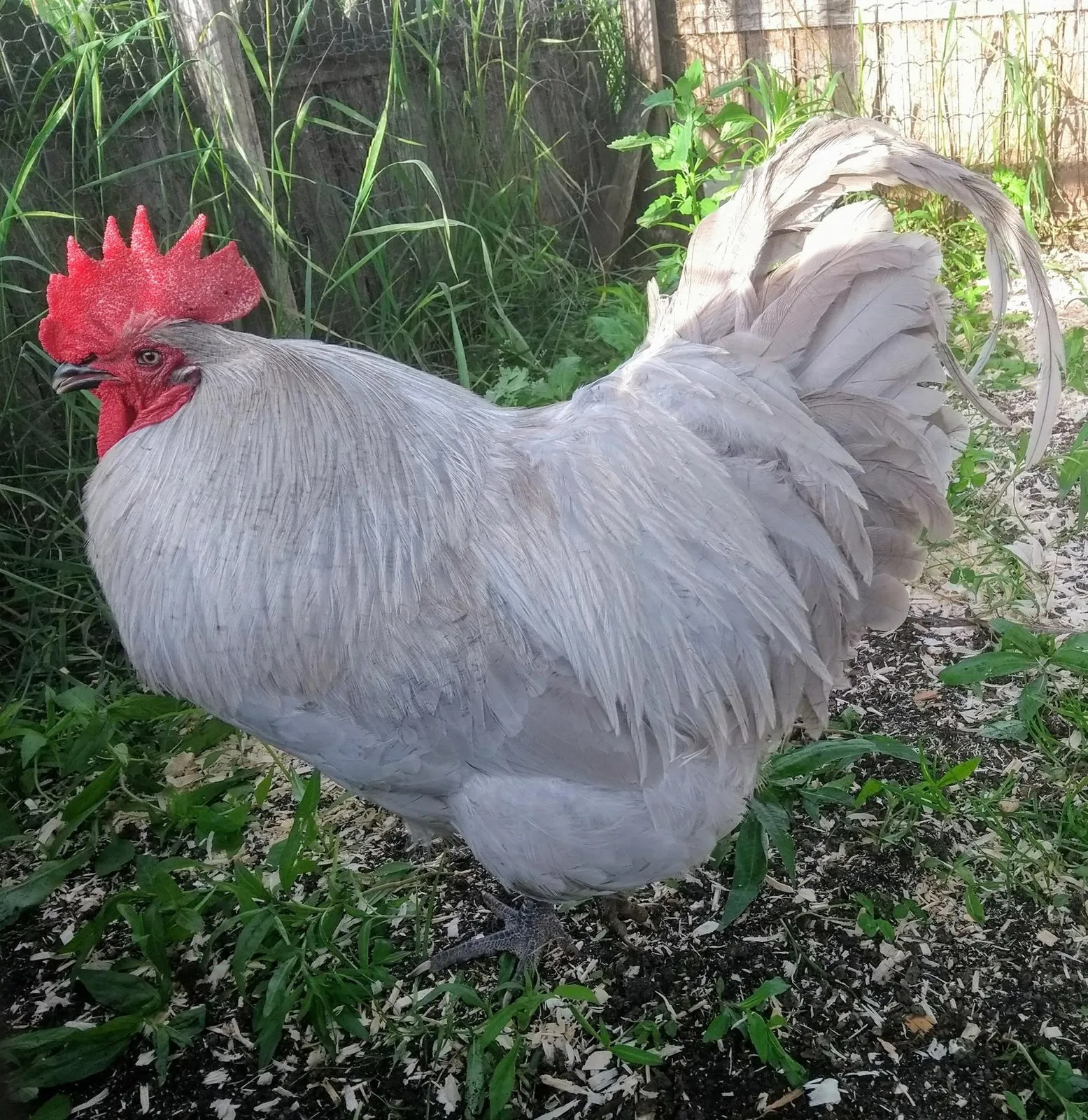
Lavender Orpington
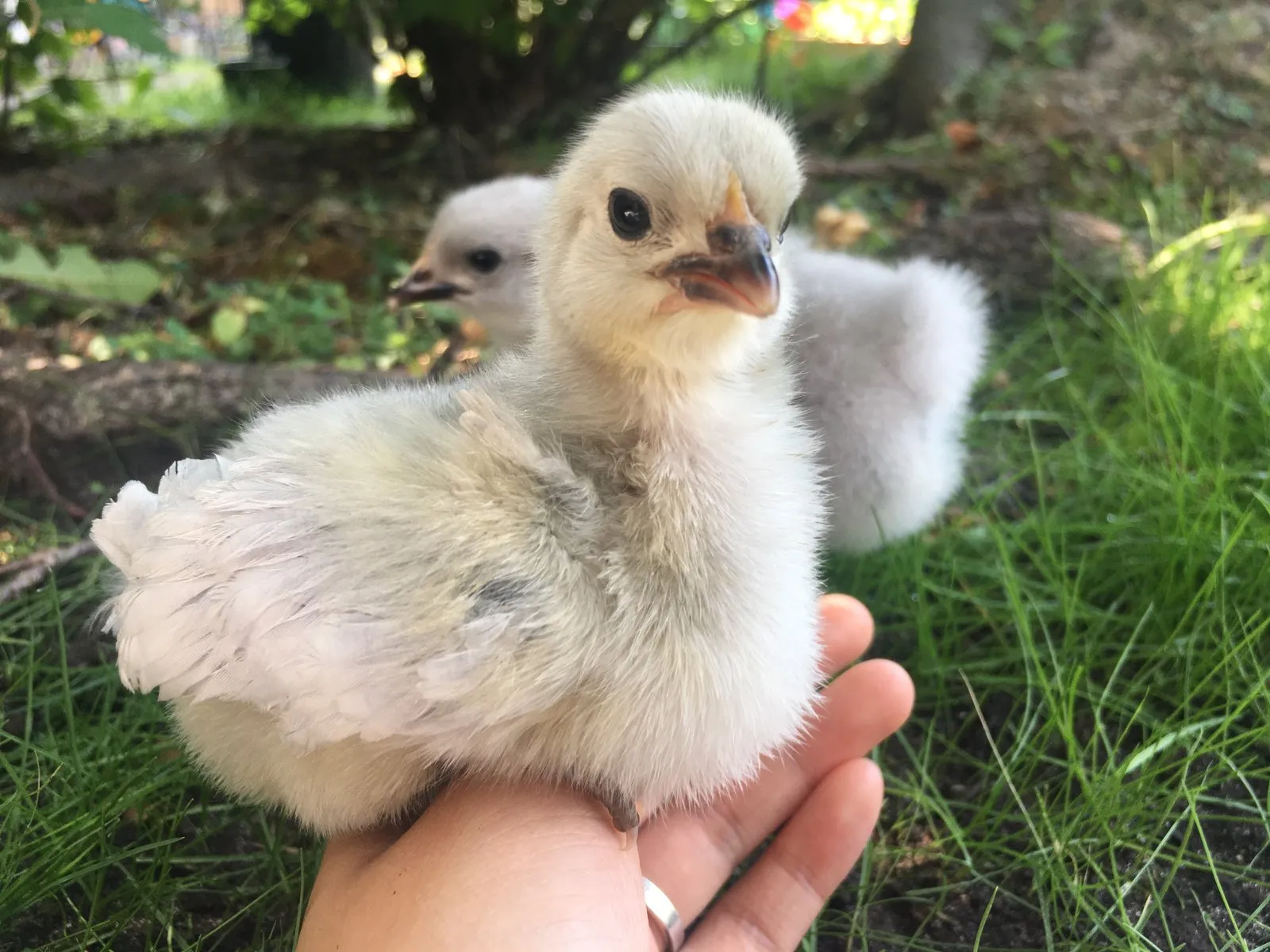
All the Orpington personality with a soft self-blue (lavender) color. Note: lavender is a recessive trait, so hatching from a single-color flock yields all lavender chicks.
| Size class | heavy |
|---|---|
| Weight (hen) | 8 lb (3.63 kg) |
| Weight (rooster) | 10 lb (4.54 kg) |
| Eggs per year | 220 |
| Egg color | brown |
| Egg size | large |
| Climate tolerance | cold |
| Temperament | gentle |
| Goes broody | often |
| Noise level | quiet |
| Beginner-friendly | Yes |
| Origin | United Kingdom |
Is the Lavender Orpington right for your flock?
The Lavender Orpington is a heavy breed that's well-suited to first-time keepers. Hens lay around 220 brown eggs per year and tolerate cold climates well.
Temperament: gentle. Broodiness: often. Noise level: quiet. A reasonable choice for suburban yards.
What this breed needs
- Coop space: about 5 sq ft per bird inside the coop. Run the numbers for your specific flock size in the coop size calculator.
- Climate fit: particularly comfortable in cold climates with good winter laying.
- Eggs: a steady, reliable producer — a good general-purpose layer. For a month-by-month breakdown, see Lavender Orpington Egg Production: How Many Eggs Per Year?.


What is reused vs freshly fetched
Stated up front, per the Speckled/Light Sussex discipline:
Reused from the Buff Orpington research (breed-level Orpington history, not re-derived): William Cook of Orpington, Kent; the Minorca × Black Plymouth Rock × Langshan cross; the 1886 public introduction; the Orpington Club (UK, 1887) and Buff Orpington Club (1898); Joseph Partington’s show-type era; the 1975 club amalgamation; arrival in America by 1891 and Cook’s 1903 importation; the Conservancy’s “first-rate layers” language with no annual egg integer; graduation from the Conservation Priority List in 2016 and the consequent absence of an Orpington row on the 2026 Pick-a-Breed chart; and the temperament/climate/broodiness findings from OSU, Skinner A2880, Mississippi State, UMN, Lafeber, Hoover’s and Cackle.
Freshly fetched this pass (everything colour-specific): the APA’s own accepted-breeds-and-varieties table; The Orpington Club (UK) breed-standards colour list and its Blue standard; the United Orpington Club’s variety list; Vaez et al. (2008) in BMC Genetics on the lavender mutation; Poultry Extension’s genetics primer; the Livestock Conservancy’s Andalusian page for blue inheritance; PoultryKeeper’s lavender-gene article; and Hoover’s Hatchery’s Lavender Orpington product page.
History
Lavender Orpington is not a separate breed and, in the United States, not a separate recognised variety either. It is the Orpington breed carrying a recessive colour gene, and the honest way to write its history is to say where the breed history stops and the colour history begins.
The breed half is settled and covered on the Buff Orpington page: William Cook, a coachman in Orpington, Kent, crossed Minorca roosters onto Black Plymouth Rock hens and bred the offspring to clean-legged Langshans, aiming at a hardy, white-skinned table bird that laid through an English winter. He introduced the result publicly in 1886. The Orpington Club formed in 1887; Buff got its own club in 1898; the clubs amalgamated in 1975. The Livestock Conservancy records the breed reaching America by 1891, and graduating from its Conservation Priority List in 2016.
The colour half is where Lavender parts company from that paper trail, and the parting is total. The American Poultry Association’s accepted breeds and varieties table lists exactly four Orpington varieties, in both Large Fowl and Bantam: Black, Blue, Buff, and White. Large Fowl Orpingtons sit in the English class. Lavender does not appear. Nor is this a case of the APA lacking a name for the colour — the same table recognises “Self Blue”, which is the standard term for lavender, as an accepted variety in six other breeds: Ameraucana (large fowl and bantam), Belgian Bearded d’Uccle, Belgian Bearded d’Anver, Booted, Old English Game (large fowl and bantam), and Silkie (as “Bearded Self Blue”). It also lists Lavender for the Helmeted Guinea. The APA knows the colour and standardises it elsewhere; it has simply not accepted it in Orpington.
The clubs agree by omission. The United Orpington Club’s breed standard names Black, Buff, Blue, White, Diamond Jubilee, Spangled and Cuckoo, and gives APA dates of Buff 1902, Black 1905, White 1905, Blue 1923 — the list stops at 1923 and Lavender is never mentioned. The Orpington Club (UK) publishes standards for Blue, Black, White, Jubilee, Spangled and Cuckoo; Lavender is absent there too. The Livestock Conservancy’s colour history — Cook’s Black, White, Buff, Jubilee and Spangled, with Blue and Cuckoo credited to his son-in-law A.C. Gilbert — likewise has no Lavender in it.
This matters commercially, and it is the same situation the Easter Egger page describes for a different reason: when a bird is sold under a name no standard governs, nothing polices what you receive. A bird advertised as a Lavender Orpington may be a genuine Orpington carrying the lavender gene, or a lavender-coloured bird of looser type sold under a popular name. Ask the seller what they select for. Our Lavender Orpington egg guide reaches the same conclusion from a different set of sources.
One UK footnote, because it prevents an over-broad claim: PoultryKeeper’s lavender article notes that lavender “is now standardised (Jan. 2014) by the Poultry Club of G.B.” — in the context of Lavender Wyandottes. Lavender as a colour has UK standing in some breeds. That is not the same as a standardised Lavender Orpington, which neither UK club list we fetched contains.
Care
The data first, and a caveat about it. Flockmath’s Lavender Orpington entry is field-for-field identical to its Buff Orpington entry: 10 lb and 8 lb, 220 eggs, large brown, cold, gentle, quiet, beginner-friendly. That is defensible, because no institutional source we fetched splits Lavender from Buff on any production or physical trait — the Conservancy, both clubs, Skinner and OSU all write at breed level. Sharing the Buff figures is the honest default rather than inventing a colour-specific number. But it should be read as “no evidence of a difference,” not as “evidence of no difference.”
Weights. APA/Conservancy standard is cock 10 lb, hen 8 lb, matching our table; the UK club’s large-fowl minima are ~4.5 kg (9.9 lb) and 3.6 kg (7.94 lb). Hoover’s Hatchery lists its Lavender Orpington mature weight at 7–8 lb — below standard, the same hatchery-versus-standard gap recorded on Buff (6–7 lb there) and on the Light Brahma. Use the coop size calculator and feed consumption calculator for a bird at the size you actually receive.
Eggs. There is no Conservancy annual integer for Orpington in any colour — only “excellent egg production” and “first-rate layers” — and since the breed graduated in 2016 there is no Pick-a-Breed chart row either. Hoover’s Lavender Orpington page lists 220 medium brown eggs/year, which is exactly our planning figure and exactly what its Buff page lists. So our 220 is hatchery-anchored, not institution-anchored, and we say so. Model with the egg production calculator.
Climate. Reused and unchanged from the Buff research: UMN Extension names Orpington among heavier breeds that over-winter well; Skinner and OSU attribute cold tolerance to the soft, profuse feathering; Lafeber prefers cooler climates. Our cold field follows those. Hoover’s rates the Lavender “Cold and Heat Hardy” — the same equal-heat claim its Buff page makes, and we treat it the same way: plan shade and airflow for a heavily feathered bird regardless. The single comb (confirmed on Hoover’s Lavender page) still needs the ordinary damp-cold frostbite care that Poultry Extension and UMN describe.
One colour-specific care point. The UK club’s Blue standard requires that each feather “show lacing of darker shade.” Lavender does the opposite — it dilutes evenly, with no lacing — which is how you tell a Lavender bird from a Blue one in a photo or a sale pen. Sun-bleaching and wear show more readily on an evenly dilute pastel than on a laced slate, which is a cosmetic issue rather than a welfare one, and is ours as an observation rather than a sourced claim.
Temperament
Everything here is reused from the breed-level Buff research, because no source we fetched describes a Lavender-specific temperament: the Conservancy’s “calm, friendly disposition”; OSU’s “calm and gentle” with the caution that docile birds may be bullied by assertive breeds; Skinner’s “docile” plus the note that Orpington chicks are often underdogs in mixed brooders; Mississippi State’s “calm and docile” and “good-natured.” Our gentle temperament, quiet noise and good_for_beginners: true all sit comfortably on that.
Hoover’s Lavender Orpington page adds hatchery language in the same direction — “Docile, Calm, Gentle, Friendly, Good with Children,” and “one of the best breeds for newcomers to chickens, and for families with young children.”
Broodiness is the one field where a Lavender-specific source disagrees with us. Our table says often, inherited from the Buff entry, and the breed-level institutional picture supports it: OSU says the hen “tends to go broody” and is a good sitter and mother, Skinner says hens exhibit broodiness and generally make good mothers, Mississippi State reports very good mothering. But Hoover’s Hatchery rates its Lavender Orpington “Occasionally” — while rating its Buff “Often.” That is the same hatchery drawing a distinction between the two colours that no institutional source draws. We are not adopting it: one hatchery’s product field is thin evidence against four breed-level sources, and it may simply reflect the stock Hoover’s keeps. But it is the only Lavender-versus-Buff difference any source we fetched asserts, so it is recorded here rather than smoothed away.
Broodiness costs eggs either way. If chicks are the goal, the recessive genetics below make this breed unusually predictable to hatch from.
Health
No Conservancy, extension, or club page names an Orpington-specific infectious disease, in any colour. That gap is unchanged from the Buff research.
The sourced management risks carry over: bullying in mixed flocks (OSU, Skinner, Lafeber — docile birds lose ground to assertive breeds); damp-cold frostbite on the single comb (UMN, Poultry Extension); and heat load on heavy feathering, where we follow Lafeber’s cooler-climate preference over Hoover’s equal-heat claim.
One risk is specific to this colour, and it is a feather-quality issue rather than a disease. PoultryKeeper’s lavender-gene article (a UK keeper publication, labelled — not an institutional source) reports that “for some reason, the lavender gene has an unexplained linkage to an effect that makes the tail ‘ragged’ in some specimens. This has been nicknamed the ‘tail shredder’ gene by some breeders.” The same article says the problem is not inherent to the colour: “the link can be broken and it is possible to produce lavenders with normal-feathered tails,” and points to UK Pekins and Araucanas where selection has done exactly that.
Two limits on that, stated plainly. First, the peer-reviewed work on the lavender mutation — Vaez et al., BMC Genetics, 2008 — describes a pigment-transport defect in the MLPH gene and makes no claim about feather structure at all; the shredding link is breeder-reported, not established in the literature we fetched. Second, it affects some lines, not the variety as a whole. If plumage quality matters to you, ask a seller about tail feathering in their line; do not treat ragged tails as inevitable.
Because Lavender is unstandardised in the US, there is also no show-ring mechanism filtering for type or feather quality the way there is for Buff or Black — which is a reason to buy from someone who can describe their breeding programme.
Self-Blue on an English Dual-Purpose Frame: The Bottom Line
If you want the Orpington temperament in a soft dilute grey and you understand you are buying an unstandardised colour, Lavender delivers exactly the bird the Buff Orpington page describes — calm, cold-leaning, broody, dual-purpose — in a colour the American Poultry Association has not accepted.
The genetics claim in our own breed data is correct, and it is worth understanding rather than just repeating. breeds.json says “lavender is a recessive trait, so hatching from a single-color flock yields all lavender chicks.” Both halves check out. Vaez et al. establish that “Lavender (LAV*L) is an autosomal recessive mutation of the chicken,” caused by a single C103T point mutation in the MLPH gene producing an R35W amino-acid change, and that it “causes the dilution of both eumelanin and phaeomelanin to a light grey or buff, respectively.” Poultry Extension’s genetics primer (Dr. Jacquie Jacob, University of Kentucky) supplies the general rule: “a gene that can express itself only in the homozygous state is referred to as a recessive factor.” PoultryKeeper states the practical consequence directly — “lavender fowl breed true,” and “being a recessive gene, lavender has to be present in pure form (2 doses) in a fowl to be visually observable.”
Put together: every visually lavender bird carries two copies, so a flock of lavender birds can only produce lavender chicks. That deduction is ours, but it follows necessarily from the sourced premises, and it is one of the few breeds.json description claims in this series that survives verification intact — alongside the Cochin’s foster-mothering.
The contrast that makes it useful is Blue. The Livestock Conservancy’s Andalusian page records that when two blue birds are mated, “25% of the chicks will have black plumage, 50% blue, and the remaining 25% white or splash.” Blue never breeds true; lavender always does. PoultryKeeper warns that the two “shouldn’t be confused… so confusing or crossing the two varieties is not a good idea.” So the APA-recognised Blue Orpington and the unrecognised Lavender behave in opposite ways in an incubator, and only one of them is showable. See Blue Andalusian for the other side of that coin.
One trap worth carrying away: black birds can hide the gene. PoultryKeeper notes that “black birds can carry the lavender gene without showing any traces of it.” A lavender flock breeds true; a black bird from lavender lines may be a carrier and give you a surprise. Plan with the incubation calendar.
Expect, then, the same gentle English dual-purpose bird as Buff, at the same 220-egg hatchery-anchored planning figure, with a colour that hatches predictably, no APA standing behind it, and a feather-quality question worth asking your breeder.
Sources
Colour-specific, fetched this pass
- APA accepted varieties (primary): American Poultry Association — Accepted Breeds & Varieties (534-row table; fetched with a browser user-agent after the newer URLs returned 404). Orpington rows: Large Fowl (English) Black, Blue, Buff, White; Bantam (SCCL) Black, Blue, Buff, White. No Lavender or Self Blue row for Orpington. The same table accepts Self Blue for Ameraucana (LF + bantam), Belgian Bearded d’Uccle, Belgian Bearded d’Anver, Booted, Old English Game (LF + bantam), and Silkie (“Bearded Self Blue”), plus Lavender for Helmeted Guinea.
- UK club colour list and the Blue standard (each feather “to show lacing of darker shade”), large-fowl minima 4.5 kg / 3.6 kg: The Orpington Club (UK) — Breed Standards. Colours published: Blue, Black, White, Jubilee, Spangled, Cuckoo. No Lavender.
- US club variety list and APA dates (Buff 1902, Black 1905, White 1905, Blue 1923); Lavender absent: United Orpington Club — Breed Standard
- Lavender is an autosomal recessive MLPH mutation (C103T / R35W) diluting eumelanin and phaeomelanin: Vaez et al., “A single point-mutation within the melanophilin gene causes the lavender plumage colour dilution phenotype in the chicken,” BMC Genetics, 2008 — PMC2253553
- Definition of a recessive factor (“expresses itself only in the homozygous state”); blue gene dilutes black: Poultry Extension — Poultry Genetics: An Introduction, Dr. Jacquie Jacob, University of Kentucky. Does not mention lavender or self-blue.
- Blue does not breed true — blue × blue gives 25% black / 50% blue / 25% splash: The Livestock Conservancy — Andalusian Chicken. Uses neither “lavender” nor “self-blue.”
- Keeper publication (labelled, non-institutional): PoultryKeeper — The Lavender Gene (fetched with a browser user-agent after a plain fetch returned HTTP 402). “Lavender fowl breed true”; “being a recessive gene, lavender has to be present in pure form (2 doses)”; “black birds can carry the lavender gene without showing any traces of it”; the “tail shredder” ragged-tail linkage and that “the link can be broken”; lavender also dilutes red pigment to “straw”; lavender standardised by the Poultry Club of G.B. in January 2014 in the context of Lavender Wyandottes.
- Hatchery (labelled): Hoover’s Hatchery — Lavender Orpington — Production 220 medium brown eggs/year; Temperament Docile, Calm, Gentle, Friendly, Good with Children; Mature Weight 7–8 lb; Hardiness “Cold and Heat Hardy”; Broodiness “Occasionally”; Comb Type Single Comb.
Breed-level, reused from the Buff Orpington profile’s research (not re-fetched this pass; see that page’s Sources block for the full citations)
- The Livestock Conservancy — Orpington Chicken: Cook / Kent; Minorca × Black Plymouth Rock × Langshan; 1886 introduction; US 1891 and Cook’s 1903 importation; APA Buff 1902 / Black & White 1905 / Blue 1923; weights 10/8; “first-rate layers” with no annual integer; Graduated 2016; calm, friendly.
- The Orpington Club (UK) — History (Will Burdett MBE): club 1887; Buff Club 1898; Partington show type; 1975 amalgamation.
- Oklahoma State University — Orpington Chickens: calm and gentle; may be bullied; broody and a good mother; weights; no annual egg count.
- UW–Madison Extension — Skinner A2880: docile; broody good mothers; cold tolerance from loose feathering; no annual count.
- Mississippi State University Extension — P3036: calm and docile; very good mothering.
- UMN Extension — Caring for Chickens in Cold Weather: Orpington among heavier breeds that over-winter well; frostbite moisture and ventilation.
- Poultry Extension — Frostbite in Chickens (Jacquie Jacob, UKY).
- Lafeber — Orpington (commercial, labelled): cooler climates; docile; may be bullied.
Ours: stating plainly which claims are reused from the Buff research and which were fetched fresh; the deduction that a visually lavender flock must breed true, which follows necessarily from Vaez’s “autosomal recessive” plus Poultry Extension’s definition of a recessive factor plus PoultryKeeper’s “2 doses,” but is not stated as such by any single source; treating the identical Buff/Lavender field set as “no evidence of a difference” rather than evidence of none; recording Hoover’s Lavender “Occasionally” against its own Buff “Often” as the only colour-split any source asserts, while declining to adopt it over four breed-level sources; framing the unlaced dilution versus the UK club’s laced Blue standard as the practical way to tell the two colours apart in a sale pen; the observation about bleaching showing more on an even pastel; treating the tail-shredder linkage as breeder-reported and line-specific rather than an institutional health finding, and noting the MLPH paper makes no feather-structure claim; and leaving breeds.json unchanged in this pass.