
heavy breed · United Kingdom
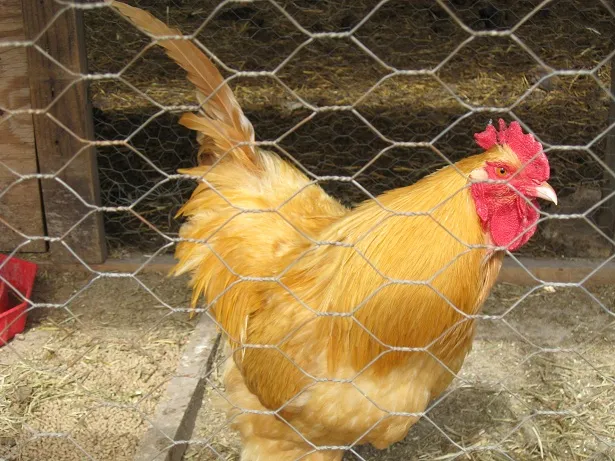
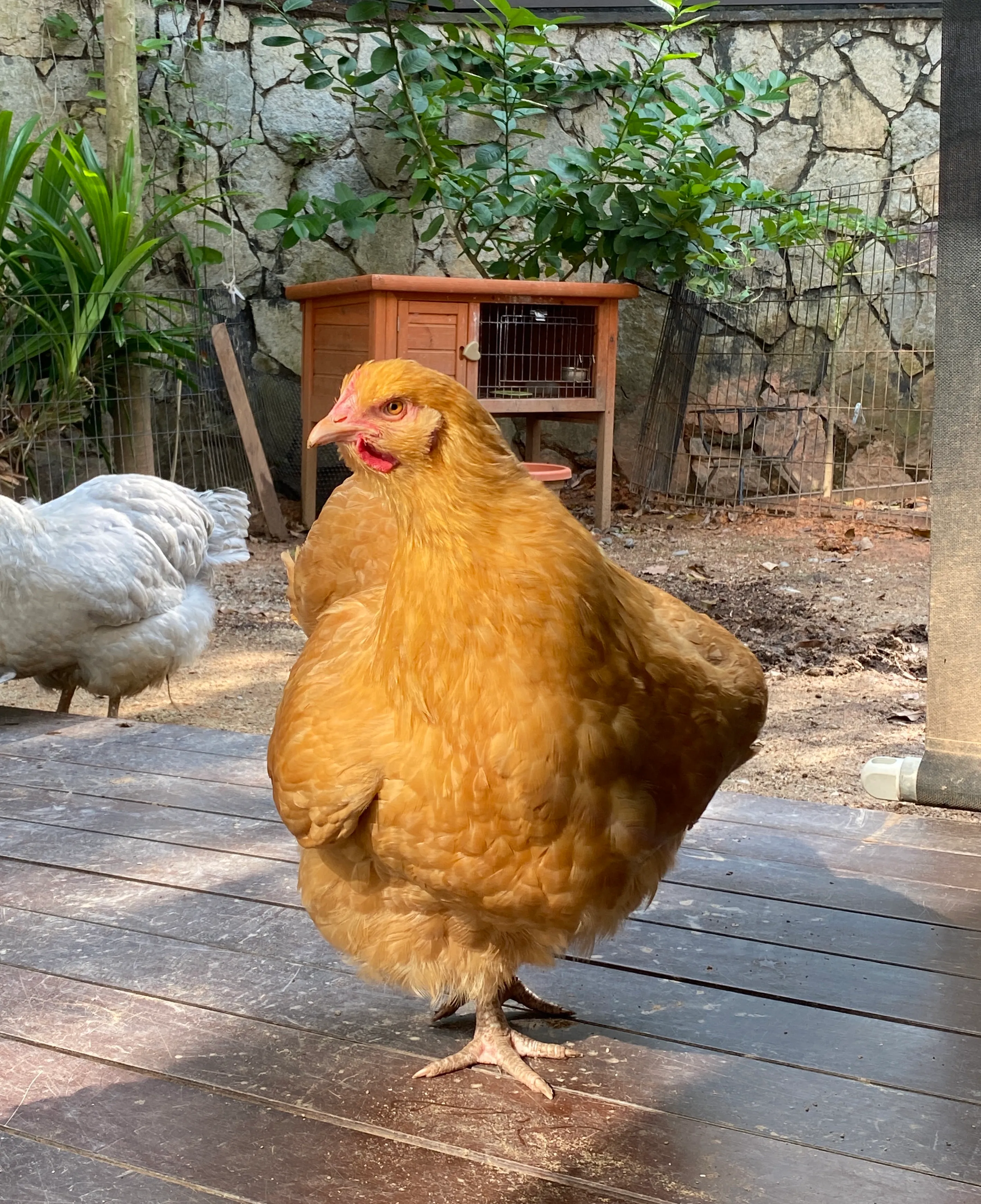
Buff Orpington
Big, fluffy, and famously docile — calm, friendly, and great with children. Tolerates handling well and goes broody often, which makes it a popular choice for keepers who want chicks.
| Size class | heavy |
|---|---|
| Weight (hen) | 8 lb (3.63 kg) |
| Weight (rooster) | 10 lb (4.54 kg) |
| Eggs per year | 220 |
| Egg color | brown |
| Egg size | large |
| Climate tolerance | cold |
| Temperament | gentle |
| Goes broody | often |
| Noise level | quiet |
| Beginner-friendly | Yes |
| Origin | United Kingdom |
Is the Buff Orpington right for your flock?
The Buff Orpington is a heavy breed that's well-suited to first-time keepers. Hens lay around 220 brown eggs per year and tolerate cold climates well.
Temperament: gentle. Broodiness: often. Noise level: quiet. A reasonable choice for suburban yards.
What this breed needs
- Coop space: about 5 sq ft per bird inside the coop. Run the numbers for your specific flock size in the coop size calculator.
- Climate fit: particularly comfortable in cold climates with good winter laying.
- Eggs: a steady, reliable producer — a good general-purpose layer. For a month-by-month breakdown, see Buff Orpington Egg Production: How Many Eggs Per Year?.


History
The Buff Orpington is the golden-buff variety of England’s classic heavy dual-purpose chicken — soft, loose feathering, white skin, a small single comb, and a broad, “cobby” body that looks bigger than the frame underneath. Most institutional history is written for Orpington as a breed; Buff is called out where sources name it.
Origin-country club. The Orpington Club (UK) publishes Will Burdett MBE’s breed history (fetched). William Cook of Orpington, Kent, began blending breeds about 1880 for a black fowl of “handsome appearance and a good winter layer.” Blacks appeared at the Dairy, Crystal Palace, and Birmingham shows by 1886; separate Black classes followed at the 1888 Dairy Show. The Orpington Club formed in 1887. Burdett notes it was not until about 1900 that Blacks approached a settled type — Joseph Partington and allies increased bulk and feather into the show silhouette still associated with the breed. On Buff specifically: original work “first commenced in 1886,” with first public appearance at the 1894 Dairy Show; Buff “caught the public fancy even more completely than the Black,” and for years was both a leading exhibition fowl and “by far the most popular heavy breed for utility purposes.” The Buff Orpington Club, founded 1898, is credited with continuous show presence. Rose-comb Buff appeared 1891. In 1975, large-fowl and bantam clubs amalgamated as today’s Orpington Club. The club’s current breed standard (fetched) sets large-fowl minimums near male 4.5 kg (~9.9 lb) / female 3.6 kg (~7.94 lb) and describes plumage as “profuse, soft, loose and not fluffy” — a useful corrective to marketing that treats Orpingtons as Cochin-soft puffballs.
Livestock Conservancy (fetched). Dual-purpose American breeds were reaching England with yellow skin the British market disliked. Cook, a coachman in Orpington, crossed Minorca roosters × Black Plymouth Rock hens, then offspring to clean-legged Langshans, aiming for hardy growth, laying, and white-skinned table quality. He introduced the breed publicly in 1886. Conservancy lists Cook’s colours as Black first, then White, Buff, Jubilee [Speckled], and Spangled [Mottled]; son-in-law A.C. Gilbert created Blue and Cuckoo. Orpingtons reached America by 1891; Cook brought a large importation in 1903. Midwestern farmers favoured the Buff for table quality and uncommon colour. APA recognition: Buff 1902; Black 1905; White 1905; Blue 1923. Standard weights: males 10 lb, females 8 lb. Conservancy calls them “first-rate layers of large light to dark brown eggs” and notes historical broiler/roaster ages — without an annual egg integer. Status: Graduated from the Conservancy priority list in 2016. Soft finding: the 2026 Pick-a-Breed chart PDF extracted this pass has no Orpington row (expected after graduation), so there is no Conservancy chart egg/climate cell to cite.
United Orpington Club (U.S., fetched). Same Cook / Minorca–Black Plymouth Rock–Langshan frame; Buff first exhibited Madison Square Garden 1899; APA years match Conservancy; Buff “quickly became the more popular variety in the states.” Bantams credited to Herman Kuhn (Germany), APA bantams 1960.
Oklahoma State University Extension (Wayback 5 March 2026 capture after live fetch timed out): same Cook cross narrative; soft feathering masks true size and aids cold endurance; active; free-range or confined; calm and gentle but may be bullied; single or rose comb by country standard; hen tends to brood and is a good mother/sitter; APA weights 10 / 8; varieties Black, Blue, Buff, White; dual-purpose. No annual egg count.
UW–Madison Skinner A2880 (fetched): same weights and varieties; brown to dark brown shells; heavy dual-purpose; brought to U.S. in the 1890s; lost commercial broiler share partly because of white skin; heavily but loosely feathered; cold-tolerant; free range or confined; docile; hens broody and generally good mothers; chicks often underdogs when mixed-brooded. No annual egg count.
Exhibition vs utility soft note. UK club’s Partington story (show bulk/feather) and Conservancy’s utility framing both belong on the page; they are not mutually exclusive — Cook launched utility birds, and later show selection changed type. Cackle (labelled hatchery) sells separate production-type and exhibition-type Buff lines for that reason.
Lavender Orpington is a separate colour project on this site’s roadmap — this profile stays on Buff and APA’s four colours (Buff, Black, White, Blue). Australorp derives from Black Orpington stock (Skinner; Conservancy context) — cross-link, do not conflate.
Care
There is no Conservancy closed annual egg figure. Planning numbers:
- Conservancy: qualitative “excellent egg production” / “first-rate layers”; eggs large to extra-large brown; market weight band 7–8.5 lb in facts box vs typical male/female 10 / 8 in body copy.
- Lafeber (commercial, labelled): about 180–220/year; large light to dark brown; best in cooler climates.
- Hoover’s (labelled): Production 220 medium brown eggs/year; body copy “about 200.”
- Cackle Buff (labelled): 150–280 (estimates only); light brown; large; APA 1902; weights hen 8 / rooster 10.
Flockmath’s 220 matches Hoover’s Production field and the sibling Buff Orpington egg guide Normal, sits at Lafeber’s ceiling, and inside Cackle’s wide band. Ours: do not invent a Conservancy integer where none exists.
Weights. Conservancy / OSU / Skinner / United Orpington Club / Cackle: cock 10 / hen 8. UK club minima ≈ 9.9 / 7.9. Hoover mature 6–7. Flockmath 10.0 / 8.0. Named Hoover mismatch — APA/Conservancy side is the closed standard.
Climate & housing. University of Minnesota Extension names Orpington among heavier breeds that over-winter well. Skinner/OSU: soft feathering aids cold. Lafeber: best in cooler climates. Hoover: cold and heat hardy. Flockmath cold aligns with UMN/Skinner/Lafeber cooler-climate language more than Hoover’s equal heat claim. MSU (fetched): Orpingtons are large-framed (7–10 lb), very loose-feathered / “fluffy,” calm and docile, very good mothering, brown eggs light to dark — and “do not forage well,” which disagrees with Skinner/OSU free-range suitability. Name both. Single comb still needs damp-cold frostbite care (Poultry Extension / UMN). Dense plumage + heat: plan shade and airflow even if Hoover prints heat hardy.
For modeling: egg production calculator, coop size calculator, feed consumption calculator. English-heritage peers: Light Sussex; Black-Orpington descendant: Australorp.
Temperament
Institutional language is consistently gentle — marketing mythology is what needs scrutiny.
- Conservancy: Calm, friendly disposition.
- OSU: calm and gentle; docile birds may be bullied by assertive breeds.
- Skinner: docile; chicks often underdogs in mixed brooders.
- MSU: temperament calm and docile; Table 1 Good-natured (spelled “Oprington” on that table); dual-purpose section adds mothering and “do not forage well.”
- Lafeber: Docile, friendly, and great with families; noise Moderate; may be bullied by dominant breeds.
- Hoover: Docile, Calm, Gentle, Friendly; “one of the best breeds for newcomers… and families with young children.”
- Cackle: Docile; calm/gentle/friendly; children’s poultry projects; beginners.
Flockmath gentle / beginners true / noise quiet fits Conservancy/OSU/Skinner/MSU. Soft findings: (1) “golden retriever of the chicken world” was not verified on any fetched institutional or club page — do not repeat as fact; (2) “excellent with children” and “tolerates handling well” are fair paraphrases of hatchery/family language (Hoover/Cackle/Lafeber) plus Conservancy “friendly,” but they are not Conservancy/OSU closed phrases — keep labelled; (3) Lafeber Moderate noise vs Flockmath quiet — named spread. Update, commit 33e30b3: breeds.json’s description dropped the “golden retriever” metaphor entirely and reworded the children/handling claim to draw from Conservancy “calm, friendly” and OSU “calm and gentle” instead.
Broodiness. Conservancy history implies utility mothers; OSU hen “tends to go broody” / good mother / sitter; Skinner hens exhibit broodiness and generally make good mothers; MSU very good mothering; Cackle Setter; Hoover Often. Flockmath often matches. Broodiness cuts annual eggs — plan for it if the basket is the goal.
Health
Neither Conservancy nor OSU flags an Orpington-specific infectious disease. Honest gap.
Management points that are sourced:
- Bullying / mixed flocks: OSU, Skinner (chicks), Lafeber — docile birds lose to assertive breeds; watch mixed coops.
- Cold moisture / single comb: UMN + Poultry Extension frostbite guidance (combs, wattles, toes; damp bedding; ventilation).
- Heat + heavy feathering: heavier dual-purpose birds still need shade/airflow; Lafeber cooler-climate preference outweighs Hoover’s equal heat claim for planning caution.
- Production vs exhibition type: Cackle’s split — show selection can change utility (egg guide already models lower exhibition bands; do not invent Conservancy percentages).
- Nutrition: hard dual-purpose layers need correct layer rations; Conservancy Heritage FAQ notes many store feeds target commercial hybrids.
If egg binding, prolapse, frostbite, or injury occurs, consult a licensed poultry veterinarian or local extension.
Gentle English Dual-Purpose: The Bottom Line
If you want a calm, cold-leaning English heritage hen with soft buff plumage, brown eggs, and a real sitting instinct — and you can live with dual-purpose numbers instead of hybrid ceilings — Buff Orpington remains one of the clearest Conservancy-and-extension recommendations in the heavy class. Flockmath’s 220 eggs/year is a planning Normal anchored to Hoover’s 220 (and Lafeber’s 180–220 ceiling), not a Conservancy integer — Conservancy only says “first-rate layers,” and the Pick-a-Breed chart no longer lists the breed after 2016 graduation.
Expect gentle manners (Conservancy; OSU; Skinner; MSU), broodiness often, white skin and APA Buff since 1902, and a bird Midwestern farmers once favoured for the table (Conservancy). Ask whether you are buying production-type or exhibition-type stock (Cackle’s labelled split). Treat “golden retriever” copy as unverified marketing, not institutional temperament science — breeds.json’s description was corrected accordingly in commit 33e30b3. You are buying a Graduated Conservancy success story and a UK-club breed with Buff’s own 1894 / 1898 paper trail — sibling in English utility spirit to Light Sussex, ancestor-line cousin to Australorp, not a sex-link and not a Lavender Orpington.
Sources
- Cook / Kent origin; Minorca × Black Plymouth Rock × Langshan; 1886 introduction; U.S. by 1891 / Cook 1903; Midwest Buff table favour; APA Buff 1902 / Black & White 1905 / Blue 1923; weights 10/8; first-rate layers (no annual count); Graduated 2016; calm friendly: The Livestock Conservancy — Orpington Chicken (same content also at conservation-successes URL)
- Buff 1886 work / 1894 Dairy Show debut; Buff Club 1898; Black 1886–88; Partington show type; 1975 club amalgamation; large-fowl weight minima ~4.5/3.6 kg; plumage “not fluffy”: The Orpington Club (UK) — History of the Orpington (Will Burdett MBE); Breed Standards
- U.S. club: Buff MSG 1899; APA years; Buff most popular in U.S.; APA weights; economic qualities meat + eggs; light–dark brown shells: United Orpington Club — Breed Standard
- Characteristics, broodiness, bullying caveat, weights, varieties, free-range/confined; no annual egg count: Oklahoma State University — Orpington Chickens (Wayback 5 March 2026, timestamp
20260305142557, after live fetch timed out) - Dual-purpose; cold feathering; docile; broody good mothers; white-skin broiler note; weights; no annual count: UW–Madison Extension — Skinner A2880
- Orpington among heavier winter-hardy breeds; frostbite moisture/ventilation: University of Minnesota Extension — Caring for Chickens in Cold Weather
- Comb frostbite (general): Poultry Extension — Frostbite in Chickens (Jacquie Jacob, UKY)
- Calm/docile; Good-natured table; dual-purpose; mothering; “do not forage well” (disagrees with Skinner/OSU): Mississippi State University Extension — P3036
- Commercial (labelled): Lafeber — Orpington — 180–220 eggs; cooler climates; family/docile; noise Moderate; Graduated 2016
- Hatchery (labelled): Hoover’s — Buff Orpington — 220 eggs (prose ~200); Often broody; Docile/Calm/Gentle/Friendly; newcomers/children; mature 6–7 lb; cold and heat hardy
- Hatchery (labelled): Cackle — Buff Orpington — 150–280 eggs; Docile; Setter; APA 1902; weights 8/10; production vs exhibition types; TLC No (expected post-graduation)
Ours: placing Flockmath 220 as hatchery-anchored planning Normal while stating Conservancy/OSU/Skinner publish no annual integer; naming Hoover 6–7 lb vs APA 10/8; naming MSU “do not forage well” vs Skinner/OSU free-range language; naming Lafeber Moderate noise vs site quiet; treating “golden retriever” / absolute children-handling claims as unverified marketing relative to Conservancy “calm, friendly” and extension “calm and gentle”; keeping Buff history (1894/1898) distinct from Black’s 1886 debut; and leaving breeds.json numbers unchanged this pass while flagging the description for a later audit. (Update, commit 33e30b3: the description was reworded — “golden retriever” dropped, children/handling claim rescoped to Conservancy/OSU language.)