
heavy breed · USA
Brahma (Light)
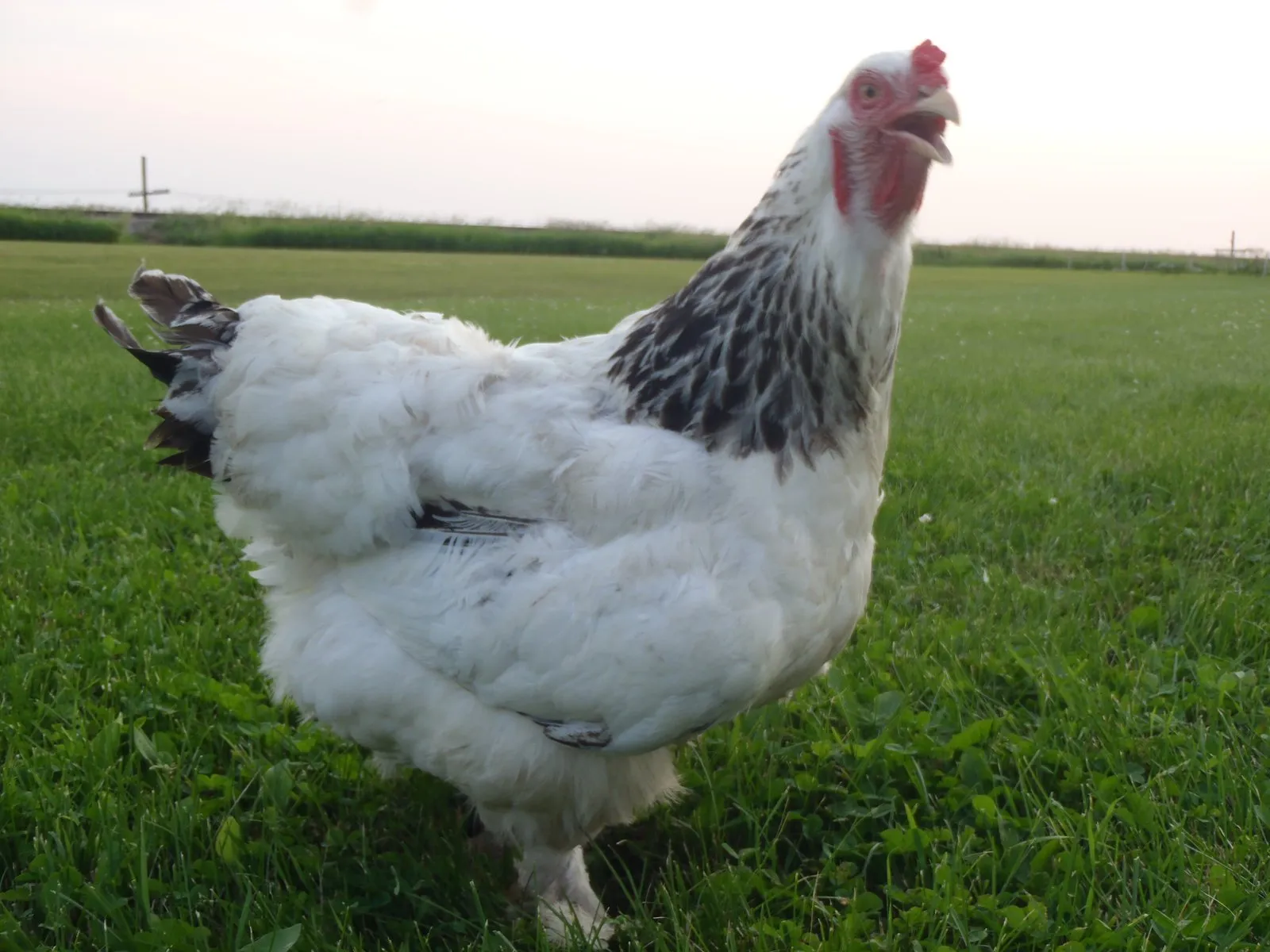
A gentle giant with feathered legs and a pea comb that resists frostbite. Slow-growing but exceptionally hardy in cold weather, with a famously easy-going personality.
| Size class | heavy |
|---|---|
| Weight (hen) | 9.5 lb (4.31 kg) |
| Weight (rooster) | 12 lb (5.44 kg) |
| Eggs per year | 180 |
| Egg color | brown |
| Egg size | medium |
| Climate tolerance | cold |
| Temperament | docile |
| Goes broody | often |
| Noise level | quiet |
| Beginner-friendly | Yes |
| Origin | USA |
Is the Brahma (Light) right for your flock?
The Brahma (Light) is a heavy breed that's well-suited to first-time keepers. Hens lay around 180 brown eggs per year and tolerate cold climates well.
Temperament: docile. Broodiness: often. Noise level: quiet. A reasonable choice for suburban yards.
What this breed needs
- Coop space: about 5 sq ft per bird inside the coop. Run the numbers for your specific flock size in the coop size calculator.
- Climate fit: particularly comfortable in cold climates with good winter laying.
- Eggs: a steady, reliable producer — a good general-purpose layer. For a month-by-month breakdown, see Brahma Egg Production: How Many Eggs Per Year?.

History
The Brahma is an American breed built out of Chinese imports, and almost every institutional source agrees on that much while disagreeing on the details. The Livestock Conservancy states the breed was “developed in America from very large fowls imported from China via the port of Shanghai,” with the trade opening around 1843. Oklahoma State University puts it as “the ancestry of the Brahma traces back to China although much of their development took place in the U.S. between 1850 and 1890.” The Poultry Club of Great Britain agrees the birds “were created in America from large feather-legged birds imported from China in the 1840s known as Shanghais.”
Where the sources genuinely part company is the Chittagong question — and it matters, because that is where this breed’s defining feature is supposed to have come from. The Conservancy says “Chittigong fowls from India (now Bangladesh) were used to a very small degree” to develop the breed’s distinguishing characteristics. The American Brahma Club tells a fuller story: Malay chickens crossed with Cochins (Shanghai fowl) in India, that stock then crossed with Gray Chittagongs, and it was “this final cross” that “introduced the breed’s distinctive pea comb and prominent brow.” The Poultry Club of Great Britain lands with the club, stating that Grey Chittagongs “introduced the pea comb and the beetle brow.” So the Conservancy minimises a contribution that the breed club and the British club treat as the origin of the pea comb itself. We have not resolved this, and a keeper does not need it resolved — but nobody should read “developed in America from Chinese imports” as the whole story.
The naming is a third disagreement. The name is taken from the Brahmaputra River in India (Conservancy, OSU, Poultry Club of Great Britain all agree). The Conservancy credits T.B. Miner, publisher of The Northern Farmer, with shortening the name to “Brahma” in 1853 or 1854. The Poultry Club of Great Britain says the breed was officially named in 1852 at a judges’ panel in Boston. The American Brahma Club says only “the early 1850s,” and records the earlier names the birds went under — Chittagongs, Gray Shanghais, and Brahma Pootras. Two institutional sources, two different years, one deliberately vague club.
Light was the original variety — the Conservancy states this plainly, and it is the reason this page exists separately from Dark and Buff. In December 1852 George Burnham sent nine birds to Queen Victoria, after which prices ran from $12–15 to $100–150 per pair (Conservancy; the Poultry Club of Great Britain records the same consignment of nine birds in 1852). The Dark variety was developed afterwards in England and shipped back to America. National timelines then split: both Light and Dark entered the American Poultry Association’s first Standard of Excellence in 1874, with Buff following in 1924 (Conservancy and American Brahma Club agree on all three dates), while in Britain “both light and pencilled Brahmas were included in the Poultry Club’s first Book of Standards in 1865” — nine years earlier.
The breed’s commercial career ended for a reason both extension sources state in identical words: “the relatively slow rate of growth and long time required to reach maturity have caused Brahmas to be passed by as a commercial fowl.” The American Brahma Club was founded in Boston in 1954 and today runs five districts across the United States and Canada. In 2023 the Brahma graduated from the Livestock Conservancy’s Conservation Priority List alongside Australorp, Rhode Island Red, and Plymouth Rock — the Conservancy credits the Murray McMurray Poultry Census and “the growing popularity of keeping chickens” for populations now “large enough.”
Care
Weights, and a three-way disagreement. Oklahoma State is the only source that publishes the weight table split by variety, and its Light column matches Flockmath’s breed data exactly: cock 12 lb, hen 9.5 lb, cockerel 10 lb, pullet 8 lb. Dark and Buff run a pound lighter across the board (cock 11, hen 8.5, cockerel 9, pullet 7) — which independently confirms the Conservancy’s remark that Dark Brahmas weigh “about one pound less” than Light. UW–Madison Extension’s Skinner (A2880) gives the same figures as OSU’s Light column. The Livestock Conservancy, however, states males 12 lb and females 10 lb — half a pound above the standard weight OSU and Skinner publish for Light hens. And the Brahma and Cochin Club of Australia’s standard is lower again: males 4.55–5.45 kg (10–12 lb), females 3.20–4.10 kg (7–9 lb). Flockmath’s 9.5 lb follows OSU and Skinner; the Conservancy’s 10 and the Australian 7–9 band are both named here rather than averaged away.
Worth knowing before you buy: the standard weight is not what arrives in the box. Hoover’s Hatchery (labelled hatchery source) lists its Light Brahma mature weight as 5–6 lb — roughly 40% below the APA standard hen. Historical records at the other extreme, cited by the Conservancy, document exhibition males of 17–18.25 lb and females of 13–14 lb by 1901. Plan housing on the bird you actually receive. For flock-size numbers use the coop size calculator rather than a single square-footage claim.
Cold. This is the breed’s documented strength, and the mechanism is stated the same way by three sources. OSU: “their pea combs with red wattles and earlobes, together with profuse feathering and well feathered shanks and toes enable them to stand cold temperatures very well.” Skinner’s A2880 says the same of the “small comb and wattles.” The Conservancy calls them “extremely hardy chickens” and attributes it to “pea comb and tight feathering with down through all sections.”
The pea comb claim in Flockmath’s breed description holds up independently. Poultry Extension (Dr. Jacquie Jacob, University of Kentucky) states that “the incidence of frostbite in chickens with the smaller comb types, such as pea and strawberry, is much less.” That is a real institutional finding, not breed marketing — and it is less, not none: the same page notes that combs, wattles, and toes remain the parts most vulnerable to freezing. Frostbite is still a housing problem. University of Minnesota Extension ties it to moisture, recommending wooden roosts over metal or plastic “that retain the cold,” and Poultry Extension advises increasing ventilation if there is condensation on windows or walls in the morning. One honest gap: UMN’s cold-weather page names Plymouth Rock, Wyandotte, Ameraucana, and Orpington as heavy breeds that over-winter well — it does not name Brahma.
Heat, where the sources split. The Conservancy states Brahmas “do not tolerate the heat well.” Hoover’s Hatchery rates the same bird “Cold and Heat Hardy.” We follow the Conservancy — Flockmath’s climate field is cold, and the heat caution is the one to act on for a 9.5 lb bird under dense feathering. No source we fetched gives Brahma-specific heat thresholds, so the numbers here are general: UMN Extension puts the poultry thermoneutral zone at 60–75°F, notes birds cut feed intake and production as temperatures climb toward 85°F, warns that core temperatures reach lethal levels toward 100°F without relief, and reports water intake rising 2–4× during heat stress. Airflow at bird level is its first priority, not misting.
Wet ground. The Conservancy is specific that feathered feet require “dry, well-drained soils,” because damp conditions damage them. A muddy winter run is a Brahma-specific problem in a way it is not for a clean-legged breed — the same husbandry point that applies to Salmon Faverolles and Cochin.
Temperament
Institutional language is consistent and unusually warm. The Livestock Conservancy: Brahmas have “calm and docile personalities, and are not flighty or skittish,” stand confinement well, and are not aggressive toward other breeds. Oklahoma State and Skinner both describe “beautiful, stately birds” whose “large size and gentle nature combined with intricate color patterns” made them country-estate favourites. The American Brahma Club promotes “the breed’s impressive size paired with its docile and curious temperament.” Flockmath’s docile field is as well supported as any temperament field on this site.
The description’s “gentle giant” framing needs a smaller correction than it might look like. The phrase appears in no institutional source we fetched — but unlike the Buff Orpington’s “golden retriever of the chicken world,” both halves of it are documented: OSU and Skinner explicitly pair large size with gentle nature, and the breed club pairs impressive size with docility. The sense is sourced; the slogan is ours.
Two fields rest on thinner ground, and should be read that way. Noise: no institutional source we fetched rates Brahma noise at all. Flockmath’s quiet traces to Hoover’s Hatchery, whose page describes a “docile, gentle, and quiet temperament.” Beginner suitability: because Brahma graduated off the Conservation Priority List in 2023, it has no row on the Conservancy’s 2026 Heritage Chicken Breed Comparison Chart — so there is no institutional owner-experience rating for this breed at all, the way there is for Light Sussex or Faverolles. Flockmath’s good_for_beginners: true rests on documented docility plus Hoover’s claim that they are “one of the best breeds around children.” Defensible, not institutionally rated.
Broodiness is corrected here. The Conservancy says hens “tend to go broody in early summer and will sit devotedly on their nests.” OSU says “Brahmas do go broody and are fairly good mothers.” Only the hatchery ever agreed with Flockmath’s old occasionally field: Hoover’s rates broodiness “Occasionally.” Both institutional sources describe a bird more likely to sit than “occasionally” implied, so broody now reads often. The Conservancy adds a practical warning that follows from the size: sitting hens of this weight risk trampling their own chicks.
Health
No Conservancy, extension, or club page we fetched names a disease or genetic condition specific to Brahmas. Saying so is better than inventing a breed-health narrative, and it matches what we found for Plymouth Rock and Faverolles.
The two management risks that are documented both follow from anatomy rather than pathology. The first is frostbite — reduced by the pea comb but not eliminated, and driven by coop moisture and ventilation rather than by the breed (Poultry Extension; UMN Extension). If it occurs, Poultry Extension advises soaking frostbitten feet in slightly warm water to bring the temperature back slowly.
The second is the feathered shanks and toes. Poultry Extension’s external-parasites page describes scaly-leg mites (Knemidokoptes mutans) living “under the scales on birds’ legs and feet,” making the legs “thick and crusty,” and notes that in severe cases “the blood supply to the toes may be cut off, and the bird may lose toes.” Treatment is coating the leg with petroleum jelly or dipping in linseed oil to suffocate the mites, plus treating the house, nesting area, roosts, and crevices. Important limit on that citation: the page does not say feather-legged breeds are at higher risk, and we found no institutional source that does. The reason to check a Brahma’s legs more often is that heavy foot feathering makes early crusting harder to see, and that the Conservancy already flags damp ground as damaging to feathered feet — not a documented breed predisposition.
The third risk is heat, covered under Care because prevention is shade, water, and airflow rather than anything Brahma-specific.
Cold-Hardy Asiatic Heavyweight: The Bottom Line
If you want a very large, genuinely calm, cold-weather bird and you are not in a hurry, the Light Brahma is the original variety of the breed and the heavier of the three — a pound above Dark and Buff on every line of Oklahoma State’s standard weight table.
On eggs, be clear about what the number is. The Livestock Conservancy publishes “up to 200 large, medium-brown eggs per year” — a ceiling, not an average — and describes the breed as a “superior winter-layer” producing the bulk of its eggs from October to May. Hoover’s Hatchery (hatchery source) lists 200 medium brown eggs/year for its Light Brahma. Oklahoma State and Skinner publish no annual figure at all, calling them only “fair egg layers” and “a very heavy fowl for the production of heavy roasters or capons.” Flockmath’s planning figure of 180 therefore sits deliberately below both published numbers, because both are ceilings from a single institutional source and one hatchery. It matches our own Brahma egg guide at ~180 Normal. Model your own flock with the egg production calculator.
The winter-layer claim is the real selling point and it is properly sourced: this is a bird whose production curve dips in high summer, not midwinter — the opposite shape from most breeds on this site. Buy accordingly. Expect slow maturity as a documented feature, not a fault: both extension sources say the long road to maturity is precisely why industry dropped the breed.
Expect, then, a docile and curious heavyweight that stands confinement well, wants dry ground under its feathered feet, is likely to go broody, and will cost you eggs in August rather than January. What you should not expect is a hot-climate bird — the Conservancy is explicit that they do not tolerate heat well, whatever the hatchery listing says.
Sources
- Breed history (Shanghai imports, ~1843 trade opening, Chittagong “very small degree,” Miner naming 1853/54, Burnham’s nine birds to Queen Victoria December 1852 and the price surge, Light as the original variety, Dark developed in England); APA 1874 Light and Dark / Buff 1924; weights male 12 / female 10 and the 1901 exhibition figures; “up to 200” medium-brown eggs and superior winter laying October–May; calm and docile / not flighty or skittish; confinement; extremely hardy via pea comb and tight feathering; does not tolerate heat well; dry well-drained soils for feathered feet; broody in early summer and trampling risk; 2023 CPL graduation: The Livestock Conservancy — Brahma Chicken
- 2023 CPL graduation naming Brahma: The Livestock Conservancy — 2023 Conservation Priority List Released — “Australorp, Rhode Island Red, Plymouth Rock, and Brahma chickens have large enough global populations they are graduating off the Conservation Priority List.”
- Absence of a chart row (checked, not assumed): Heritage Chicken Breed Comparison Chart (2026) — Brahma appears nowhere in the document, consistent with its 2023 graduation. No Conservancy chart temperament, climate, brooding, or owner-experience rating exists for this breed.
- Variety-split standard weights (Light 12 / 9.5 / 10 / 8; Dark and Buff 11 / 8.5 / 9 / 7); varieties Light, Dark, Buff; brown eggshell; yellow skin; gentle nature and stately type; “Brahmas do go broody and are fairly good mothers”; pea comb + profuse feathering for cold; slow growth ending the commercial career; “fair egg layers”: Oklahoma State University — Brahma Chickens (fetched directly with a browser user-agent; the page 403s to a plain fetch). Note: this page lists Skinner’s A2880 among its own references and its characteristics text is near-identical to it — OSU and Skinner are not independent sources here.
- Asiatic class; varieties; weights cock 12 / hen 9½ / cockerel 10 / pullet 8; brown eggs; “fair egg layers”; heavy roasters or capons; small comb and wattles plus feathering for cold; slow maturity: UW–Madison Extension — Chicken Breeds and Varieties (A2880), John L. Skinner
- Breed club (US) — founded Boston 1954; five districts US and Canada; “impressive size paired with its docile and curious temperament”; Malay × Cochin in India then × Gray Chittagong introducing the pea comb and prominent brow; early names Chittagongs / Gray Shanghais / Brahma Pootras; APA 1874 and 1924; historical value as a food source; laying well in colder months: The American Brahma Club — About
- Breed club (UK) — Brahmaputra naming; “created in America from large feather-legged birds imported from China in the 1840s known as Shanghais”; officially named 1852 at a Boston judges’ panel; nine birds to Queen Victoria 1852; Grey Chittagongs introduced the pea comb and beetle brow; light and pencilled in the Poultry Club’s first Book of Standards 1865: The Poultry Club of Great Britain — Brahma
- Breed club (Australia) — Light colour description (silvery white head and back, greenish-black hackle and saddle laced silvery white, black tail); “Pea comb, small, firmly fastened”; weights males 4.55–5.45 kg (10–12 lb), females 3.20–4.10 kg (7–9 lb): The Brahma and Cochin Club of Australia — Brahma Standards Australia
- Pea/small comb frostbite incidence “much less”; combs, wattles and toes most vulnerable; ventilation and condensation; warm-water soaking for frostbitten feet: Poultry Extension — Frostbite in Chickens, Dr. Jacquie Jacob, University of Kentucky.
- Scaly-leg mites (under the leg scales, thick and crusty legs, possible loss of toes, petroleum jelly / linseed oil, treating the house): Poultry Extension — External Parasites of Poultry. Contains no feathered-leg or breed-predisposition claim.
- Cold-weather moisture and frostbite; wooden roosts over cold-retaining metal or plastic; heavy breeds that over-winter well (Brahma not among them): University of Minnesota Extension — Caring for Chickens in Cold Weather
- Heat stress: thermoneutral zone 60–75°F, behavioural change and reduced intake toward 85°F, lethal core temperatures toward 100°F, water intake 2–4×, airflow as first priority: University of Minnesota Extension — Preventing Heat Stress in Poultry. General poultry guidance; does not name Brahma or heavy/feathered breeds.
- Hatchery (labelled): Hoover’s Hatchery — Light Brahma — Production 200 medium brown eggs/year; Temperament Calm, Friendly, Docile; Mature Weight 5–6 lb; Hardiness “Cold and Heat Hardy”; Broodiness Occasionally; Comb Type Pea Comb; “docile, gentle, and quiet temperament makes them one of the best breeds around children.”
Ours: treating Flockmath’s 180 as a deliberately conservative planning figure below the Conservancy’s “up to 200” ceiling and Hoover’s 200, while recording that OSU and Skinner publish no annual number; following OSU/Skinner’s 9.5 lb Light hen over the Conservancy’s 10 lb and the Australian club’s 7–9 lb band; following the Conservancy’s heat intolerance over Hoover’s “Heat Hardy” rating; naming the Conservancy-vs-club disagreement over how much the Chittagong contributed and whether the pea comb came from it; naming the 1852-vs-1853/54 naming-date split; judging “gentle giant” to be our slogan over a sourced sense rather than an unverified claim; flagging noise_level: quiet and good_for_beginners: true as resting on hatchery language plus documented docility with no institutional rating available; naming the broodiness tension between Conservancy/OSU and our occasionally field; observing that heavy foot feathering hides early scaly-leg crusting without claiming a sourced breed predisposition; and leaving breeds.json unchanged in this pass.