
standard breed · USA
Plymouth Rock (Barred)
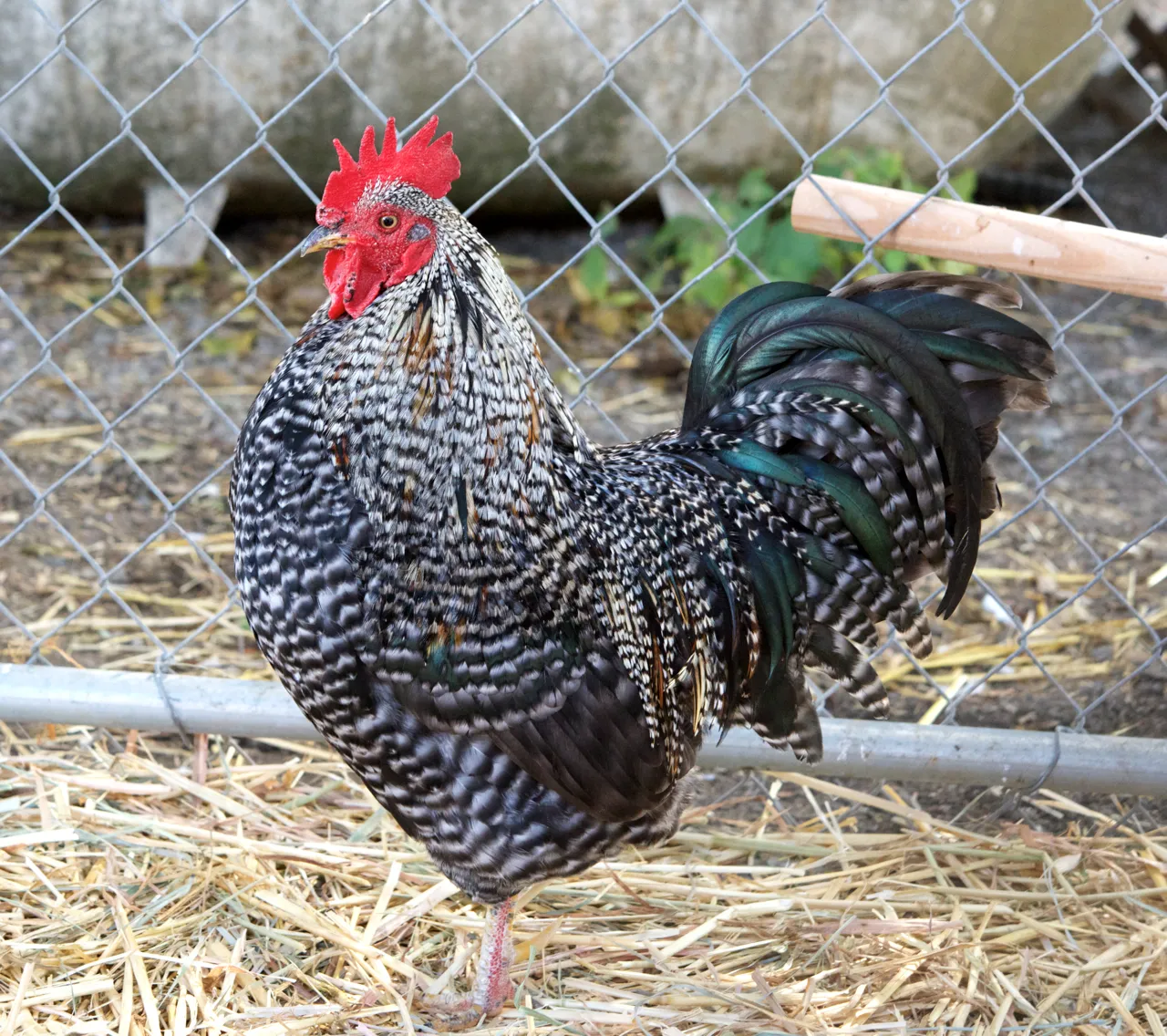
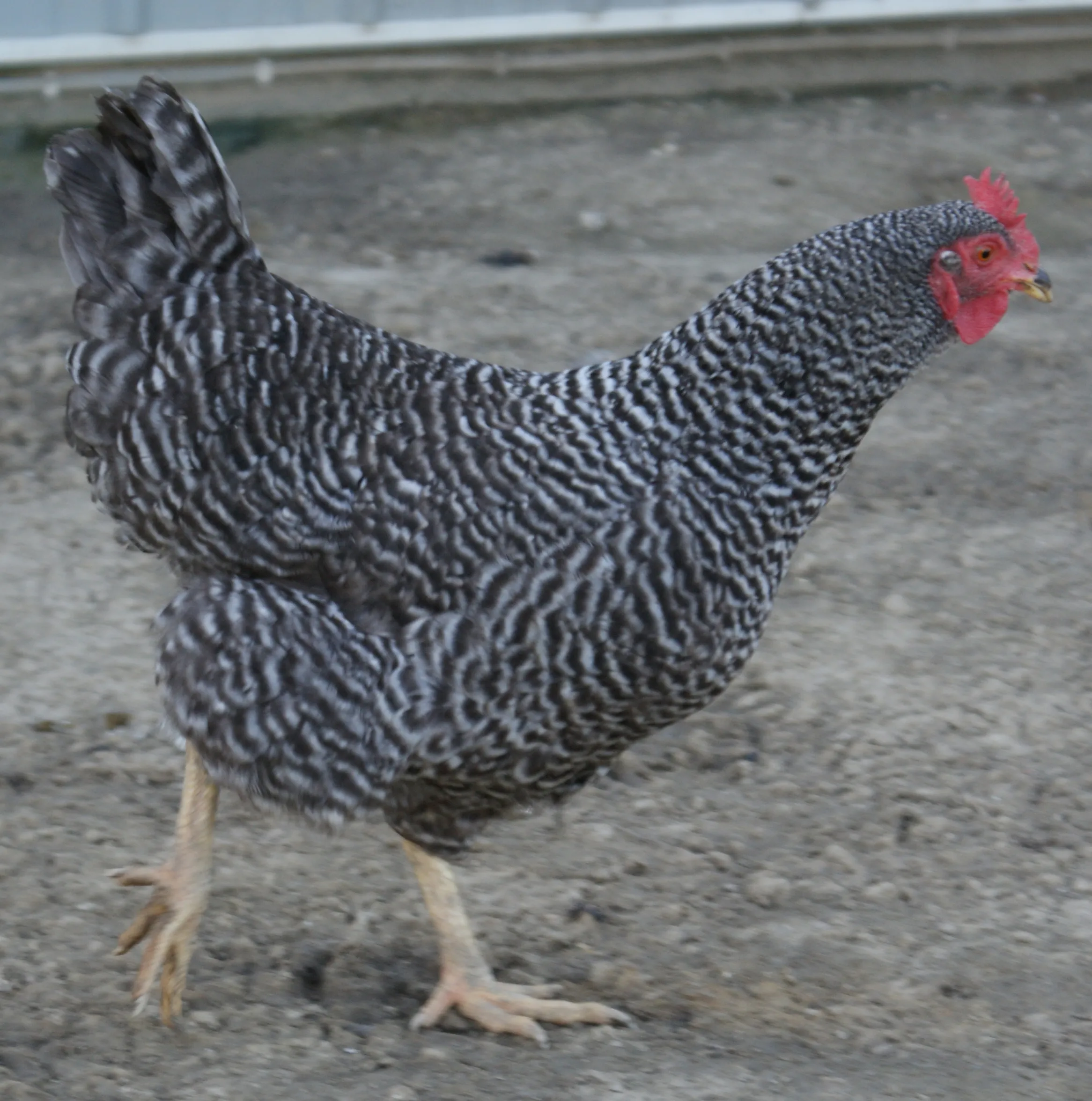
An American heritage breed with the iconic black-and-white barred plumage. Calm, sociable, and a steady layer through cold winters — a backyard classic.
| Size class | standard |
|---|---|
| Weight (hen) | 7.5 lb (3.40 kg) |
| Weight (rooster) | 9.5 lb (4.31 kg) |
| Eggs per year | 220 |
| Egg color | brown |
| Egg size | large |
| Climate tolerance | All climates |
| Temperament | friendly |
| Goes broody | occasionally |
| Noise level | moderate |
| Beginner-friendly | Yes |
| Origin | USA |
Is the Plymouth Rock (Barred) right for your flock?
The Plymouth Rock (Barred) is a standard breed that's well-suited to first-time keepers. Hens lay around 220 brown eggs per year and tolerate most climates well.
Temperament: friendly. Broodiness: occasionally. Noise level: moderate.
What this breed needs
- Coop space: about 4 sq ft per bird inside the coop. Run the numbers for your specific flock size in the coop size calculator.
- Climate fit: adapts to a wide range of climates with no special accommodations.
- Eggs: a steady, reliable producer — a good general-purpose layer. For a month-by-month breakdown, see How Many Eggs Does a Barred Rock Lay Per Year?.


History
The barred Plymouth Rock — still commonly called the Barred Rock — is the original color of America’s classic dual-purpose farm chicken. The Livestock Conservancy places the breed’s development in the middle of the nineteenth century and records an early Boston exhibition in 1849, after which those first birds “seemed to lose their identity” for about two decades. The modern line is generally traced to a Worcester, Massachusetts show in 1869. Oklahoma State University Extension’s breed page frames the first exhibition of the breed as 1869 and does not mention the 1849 Boston showing. The Conservancy and OSU therefore disagree on how to date the breed’s public debut: Conservancy treats 1849 as a first (then interrupted) appearance and 1869 as the lasting foundation; OSU treats 1869 as the start. Both pages are cited below; we have not resolved which framing is correct.
The Plymouth Rock Fanciers Club of America’s breed history credits D.A. Upham of Worcester with setting the modern type in motion: Black Java–ancestry pullets crossed to a single-combed dunghill cock with rudimentary barring, then culled hard for clean yellow legs and the barred feather. The club notes that the breed name was borrowed from an earlier, unsuccessful attempt, and that other breeders (including Spaulding and Drake) were working on similar birds, but that Upham received the greatest credit and unveiled his strain at Worcester in 1869. Several people later claimed authorship. The Conservancy lists crosses involving Spanish, White Cochin, Dominique, Buff Cochin, Black Java, and Brahma; OSU names Dominique, Java, Cochin, and Brahma. The lists overlap without matching exactly — another soft disagreement worth leaving visible rather than forcing into one pedigree story.
Barred was the first Plymouth Rock variety. Other colors came later: White, Buff, Silver Penciled, Partridge, Columbian, and Blue on the Conservancy list (OSU’s variety list matches those seven). The Conservancy records acceptance into the American Poultry Association’s “Standard of Excellence” in 1874 — the same year the APA’s first Standard is generally dated. Until World War II, Conservancy and OSU both describe the Barred Plymouth Rock as kept and bred as extensively as any breed in the country, prized as an outstanding farm chicken for hardiness, docility, broodiness, brown-egg production, and meat quality. Both also name the Barred Rock as one of the foundation breeds behind the broiler industry in the 1920s. After industrial hybrids took over commercial meat production, the purebred dual-purpose Rock lost market share but never left the American backyard.
The Plymouth Rock Fanciers Club of America was founded in 1973 to promote breeding and showing of large fowl and bantam Rocks and to keep breeders aligned on true type and color. As of the club’s current site, eight APA-accepted varieties are listed: Barred, Black (bantam only), Blue, Buff, Partridge, Silver Penciled, Columbian, and White.
In 2023 the Plymouth Rock graduated from the Livestock Conservancy’s Conservation Priority List — the same graduation year as Rhode Island Red, Australorp, and Brahma, driven in part by improved census numbers and backyard popularity. The breed is no longer treated as at meaningful population risk on that list.
Care
Standard weights on both the Conservancy and OSU pages match Flockmath’s breed table: hens 7.5 lb, males 9.5 lb (OSU also lists cockerel 8 lb and pullet 6 lb). For coop-space numbers by flock size, use the coop size calculator; those figures already reflect this breed’s standard size class.
Cold hardiness is the management trait institutional sources emphasize most clearly. The Conservancy ties it to early feathering and lists cold hardiness among breed characteristics. University of Minnesota Extension names Plymouth Rock among heavier breeds that “over-winter well,” alongside Wyandotte, Ameraucana, and Orpington. Colorado State University’s 4-H Poultry Resource Handbook goes further and states that Plymouth Rocks “handle both hot and cold weather well.” Flockmath’s climate rating of “all” sits with that Colorado framing; the Conservancy page itself is more specific about cold than about heat, and we have not found a Conservancy claim that they are poor in summer — only that cold hardiness is a named strength.
The breed carries a bright red single comb of moderate size (Conservancy; OSU). Extension guidance on frostbite is consistent across breeds with larger single combs: Poultry Extension (Dr. Jacquie Jacob, University of Kentucky) notes that combs, wattles, and toes are most vulnerable, that roosters are hit hardest because their combs run larger, and that damp bedding plus a cold, poorly ventilated coop is the usual setup for trouble. University of Minnesota Extension likewise flags moisture plus cold as the main frostbite drivers and recommends wooden roosts rather than metal or plastic that hold cold. Plymouth Rock cold hardiness does not cancel comb risk — it is a housing problem more than a breed failure. Keep the coop dry and ventilated, and watch roosters on hard-freeze nights.
Conservancy notes that Rocks tolerate confinement if they have enough room, prefer to free-range, do not fly, and are “chatty but quiet.” Colorado 4-H describes generally aggressive foraging and the barred “hawk color” pattern as harder for aerial predators to see. For actual run and coop sizing, again use the calculator rather than a single fixed square-footage claim copied from a breed blurb.
One honest gap: Oklahoma State’s Plymouth Rock page does not publish an annual egg-count figure at all. It only notes that some strains are good layers while others are bred principally for meat. Egg numbers are taken from other institutional sources below, not from OSU.
Temperament
Institutional language on temperament is strongly positive. The Conservancy lists temperament as calm and docile, describes males and females as generally sweet and docile, says they get along with other breeds, are friendly with people and good with children, like attention, will follow their keepers around, and make good pets and 4-H projects — and calls them a good choice for a first-time chicken owner. OSU calls them a good general farm chicken, docile, generally not extremely aggressive, and easy to tame. Utah State University Extension’s breed table tags Plymouth Rock temperament as “curious, calm” and lists the breed among beginner-friendly options.
There is a soft edge case worth naming rather than sanding off. OSU also warns that some males and hens are big and active enough to become “quite a problem if they become aggressive.” The Conservancy page does not echo that caution for Plymouth Rocks (unlike its Rhode Island Red page, which does flag aggressive males). We are not treating occasional aggressiveness as a breed-defining trait — only recording that OSU leaves the door open while the Conservancy does not.
Broodiness is where institutional language and Flockmath’s data field sit in mild tension. The Conservancy includes broodiness among the historic farm qualities that made the breed popular, and states that hens are “usually good sitters and mothers.” OSU says they show “some broodiness” and “usually make good mothers.” Flockmath’s breed table records broodiness as “occasionally.” That is softer than Conservancy’s “usually.” We are not changing breeds.json in this profile pass; the discrepancy is named here so a keeper does not read “occasionally” as a promise that a given hen will never sit, or Conservancy’s “usually” as a guarantee that every hatchery pullet will.
Health
Neither the Conservancy nor OSU breed page flags a disease or genetic condition specific to Plymouth Rocks beyond ordinary chicken-keeping risks. Stating that gap plainly is better than inventing a breed-health narrative. The management point that does recur for this breed is frostbite risk on the single comb in wet, poorly ventilated cold — covered under Care, because prevention is housing and bedding, not a Plymouth Rock–only treatment protocol. If frostbite occurs, University of Minnesota Extension recommends consulting a veterinarian; left untreated, severe frostbite can mean permanent loss of comb, wattle, or toes, and flock mates may peck injured tissue, so isolation during recovery is worth planning for.
Beyond that, the breed’s documented hardiness and dual-purpose farm history are the health-adjacent signals in the sourced literature — resilience under ordinary flock management, not immunity to parasites, respiratory problems from damp coops, or the other risks that apply across breeds.
Dual-Purpose Classic: The Bottom Line
If you want a calm, cold-hardy American heritage bird that still earns its keep on eggs without asking you to keep a flighty Mediterranean layer, the Barred Plymouth Rock remains one of the clearest institutional recommendations in the extension and Conservancy literature. Flockmath’s planning figure of 220 brown eggs per year sits inside Utah State University Extension’s 200–250 band and a little above the Conservancy’s point estimate of around 200. OSU does not publish a competing annual number; it only notes strain differences between layer-leaning and meat-leaning lines. That spread — roughly 200 on Conservancy, 200–250 on USU, 220 on Flockmath — is the honest planning band for a dual-purpose Barred Rock, not a promise of hybrid-layer output.
Expect a bird that prefers room to roam, sits toward the quiet/chatty end of the noise scale rather than the shrill end, and is widely described as beginner- and family-friendly. Ask the hatchery or breeder whether you are getting a production-leaning or exhibition-leaning strain if egg count is your main goal — OSU’s “some strains… layers… others… meat” line is the institutional cue for that question. Plan for occasional broodiness rather than none, given Conservancy and OSU mothering language, even though Flockmath’s table says “occasionally.” In hard winters, protect that moderate single comb the same way you would any single-combed heavy breed: dry litter, real ventilation, wooden roosts.
Either way, you are getting the original barred American farm chicken — APA-recognized since 1874, a broiler-industry parent in the 1920s, and a 2023 Conservancy graduate whose population recovery tracks how thoroughly the breed re-entered backyard flocks.
Sources
- Breed history, varieties, conservation status, egg-laying point estimate, weights, temperament, broodiness, cold hardiness, and barring genetics: The Livestock Conservancy — “Plymouth Rock Chicken.” Records the 1849 Boston / 1869 Worcester timeline, APA acceptance in 1874, ~200 large brown eggs/year, hen 7.5 lb / male 9.5 lb, calm/docile temperament, usually good sitters and mothers, and graduation from the Priority List in 2023.
- 2023 CPL graduation context: The Livestock Conservancy — “2023 Conservation Priority List Released.” Names Plymouth Rock among breeds graduating off the CPL in 2023 alongside Australorp, Rhode Island Red, and Brahma.
- Characteristics, 1869-first-exhibition framing, ancestry list, broodiness, aggression caveat, standard weights, varieties: Oklahoma State University — “Plymouth Rock Chickens.” (Fetched via Wayback Machine capture, 5 March 2026, after Cloudflare blocked a direct fetch.) Does not publish an annual egg-count figure.
- Upham / Worcester founding narrative and variety development: Plymouth Rock Fanciers Club — “About the Breed” (Kirk Keene). Club founding year and APA variety list: Plymouth Rock Fanciers Club home page (founded 1973; eight APA-accepted varieties).
- Egg-count range (200–250), temperament tag, beginner suitability, cold-weather breed grouping: Utah State University Extension — “Managing Chickens From Chicks to Peak Egg Production.”
- Winter hardiness of Plymouth Rock as a heavier breed; frostbite moisture/ventilation guidance: University of Minnesota Extension — “Caring for Chickens in Cold Weather.”
- Comb frostbite risk and prevention (single-comb breeds generally): Poultry Extension — “Frostbite in Chickens,” Dr. Jacquie Jacob, University of Kentucky.
- Hot-and-cold tolerance and foraging note: Colorado State University 4-H — Poultry Resource Handbook (Plymouth Rock section).
Ours: the framing that places Flockmath’s 220-egg figure between the Conservancy’s ~200 and USU’s 200–250 — and that treats OSU’s missing annual number as a gap rather than a conflicting figure — is our synthesis. So is naming the Conservancy-vs-OSU disagreement on whether 1849 counts as the breed’s first exhibition, and the Conservancy/OSU “usually” sitters language versus Flockmath’s “occasionally” broodiness field, without changing breeds.json in this pass.