
heavy breed · USA
Jersey Giant
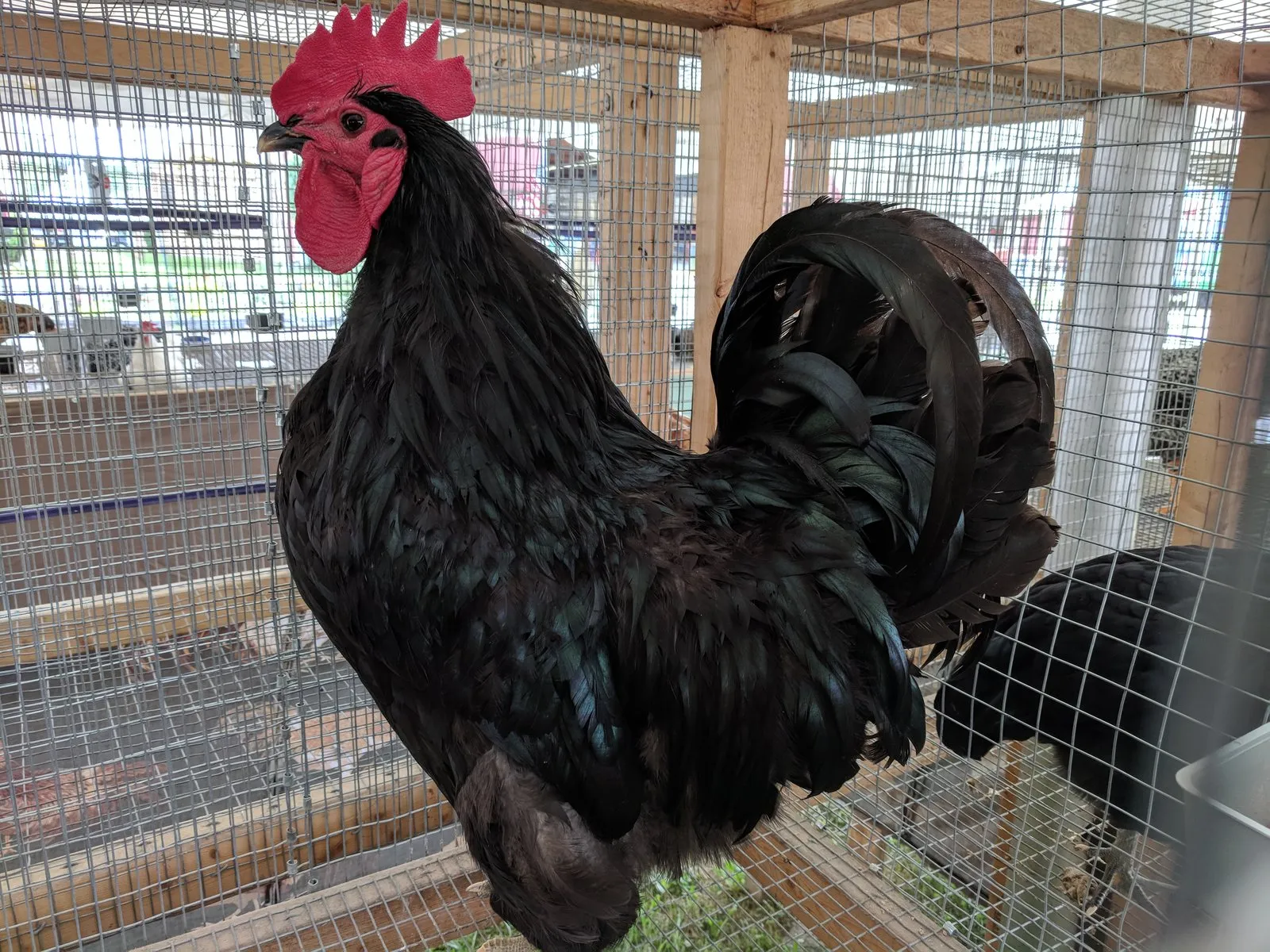
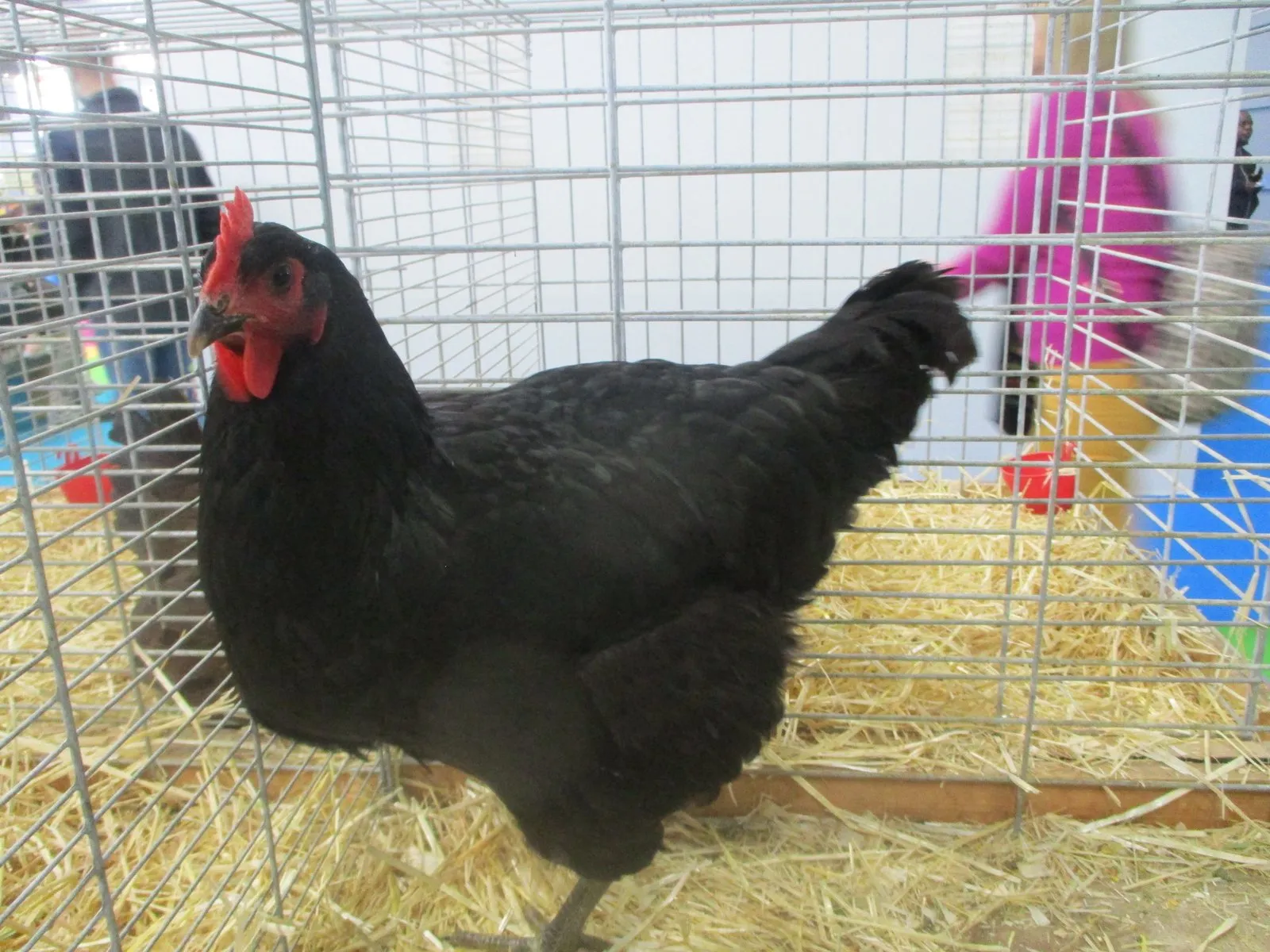
The largest breed in the American Class. Docile, slow-growing, and surprisingly steady layers of large brown eggs — even through cold winters.
| Size class | heavy |
|---|---|
| Weight (hen) | 10 lb (4.54 kg) |
| Weight (rooster) | 13 lb (5.90 kg) |
| Eggs per year | 180 |
| Egg color | brown |
| Egg size | large |
| Climate tolerance | cold |
| Temperament | docile |
| Goes broody | occasionally |
| Noise level | quiet |
| Beginner-friendly | Yes |
| Origin | USA |
Is the Jersey Giant right for your flock?
The Jersey Giant is a heavy breed that's well-suited to first-time keepers. Hens lay around 180 brown eggs per year and tolerate cold climates well.
Temperament: docile. Broodiness: occasionally. Noise level: quiet. A reasonable choice for suburban yards.
What this breed needs
- Coop space: about 5 sq ft per bird inside the coop. Run the numbers for your specific flock size in the coop size calculator.
- Climate fit: particularly comfortable in cold climates with good winter laying.
- Eggs: a steady, reliable producer — a good general-purpose layer. For a month-by-month breakdown, see Jersey Giant Egg Production: How Many Eggs Per Year?.


History
The Jersey Giant is the one breed on this site that was built to replace a different species. John and Thomas Black developed it “sometime between 1870 and 1890 in Burlington County, near the town of Jobstown, New Jersey,” according to the National Jersey Giant Club’s own compiled history. The club explains the commercial logic plainly: “The Black brothers as well as others in that vicinity specialized in growing market poultry and did a considerable amount of caponizing. Orders mainly from New York City and Philadelphia called for heavy roasting birds, the heavier the better.” The Livestock Conservancy puts the same intention more directly — “the original intention of the Black brothers was to create a chicken that could potentially replace turkeys as a premium table bird.”
The ancestry is genuinely disputed, three ways. The National Jersey Giant Club states that “to obtain the desired heavy carcasses, the Black brothers used a series of crosses with Black Javas, Black Langshans, and Dark Brahmas,” and the Livestock Conservancy names exactly those three. Oklahoma State instead writes that “Giants were bred from crosses of Orpingtons, Javas, and Langshans” — substituting Orpington for the Dark Brahma. The Poultry Club of Great Britain gives a fourth ingredient again, listing “black Java, dark Brahma, black Langshan and Indian Game.” We follow the breed club and the Conservancy on the three-breed version, but all three lists are on the record. One possible explanation for OSU’s outlier, and this is our inference rather than anyone’s claim: the club notes that when the White variety was later developed, “some early strains contained crosses with White Rocks, White Orpingtons, or other white breeds, but these crosses were not successful.” An Orpington cross does belong to this breed’s story — just to the White variety’s failed experiments, not to the foundation stock. The Light Brahma sits in this pedigree either way, via the Dark variety.
The name has nothing to do with the colour. The club records that “about 1895, the name ‘Giants’ was first bestowed upon these birds,” after an expert caponizer was asked to find the largest birds available and located them at the Black brothers’ farm. He “suggested that they be named ‘Black’s Giants’ after the Black brothers, not because of their color, though they were predominately black.” Dexter P. Upham of Belmar, New Jersey “is credited with adding the name Jersey to the Giant name in about 1917 in honor of the state in which they originated.” In 1921 the American Association of Jersey Black Giant Breeders Clubs was formed and adopted the name Jersey Black Giant.
The commercial window closed almost as soon as it opened. The club describes the moment: “The turkey industry was dwindling, a substitute was needed, and Jersey Black Giants appeared to be their rival as a roasting table bird. Of course, commercial broad breasted turkeys soon were to come on the scene and retained superiority as the premier table bird.” The bird designed to replace the turkey was beaten by a better turkey.
The APA recognised Jersey Black Giants in 1922. The White variety came from white “sports” out of black flocks in the late 1920s and early 1930s — the club stresses that “true White Giant’s are white ‘sports’ from Black Giants with no other breeds crossed in” — and was accepted in 1947. The Blue traces to a single bird: in 1981, on the farm of Mrs. R. E. (Golda) Miller near Bern, Kansas, a White Giant pullet showed “some gray dusting on the feathers on her back.” Miller passed her to Leo Prokop in Nebraska, who mated her to a Black Jersey Giant male; the Blue variety was established from that nucleus and accepted by the APA in 2003. The Conservancy gives the same three dates.
One disambiguation the club makes and we will repeat: in the 1890s the APA recognised a separate breed called Jersey Blues, dropped from the Standard by the early 1900s. “There is no indication that the Jersey Blues had any connection in the development of the Jersey Giant breed,” and their standard weight was three pounds lighter. They “should not be confused with the Jersey Giants as we know them today.”
On the Conservancy’s 2026 Conservation Priority List the breed is Recovering (R) — matching both its breed page and its 2026 comparison chart, with no internal disagreement this time.
Care
Is it really the largest? Here is exactly what the sources say. breeds.json calls the Jersey Giant “the largest standard chicken breed,” and that superlative deserves testing rather than repeating. UW–Madison Extension’s Skinner (A2880) states: “Jersey Giants are the largest breed in the American Class.” Oklahoma State says the breed is “becoming and remaining the largest chickens developed in America,” and separately that “Jersey Giants are the largest breed in the American Class” — the identical Skinner sentence, since OSU lists A2880 among its references. The Poultry Club of Great Britain reports that “when introduced into this country it was claimed that birds from this breed were heavier than those of any other breed” — note that the UK club presents this as a claim made on the breed’s introduction, not as its own finding.
So: every institutional source that endorses the superlative scopes it — to the American Class, or to breeds developed in America. The one source that states it unscoped attributes it to marketing. No page we fetched calls the Jersey Giant the largest chicken breed outright. Within Flockmath’s own catalogue the ranking does hold: at 13 lb and 10 lb it is the heaviest of the thirty, ahead of the Light Brahma at 12 and 9.5 and the Cochin at 11 and 8.5.
Both places on Flockmath that carried the unscoped claim have since been corrected to match this profile’s finding. breeds.json’s description now reads “the largest breed in the American Class” (commit e05f378), and the Jersey Giant guide’s FAQ answer was reworded the same way.
Weights. Oklahoma State, Skinner, and the 2026 chart all give the APA standard: cock 13 lb, hen 10 lb (OSU and Skinner add cockerel 11 lb, pullet 8 lb), matching Flockmath’s table exactly. The Conservancy quotes a heavier live range — “mature roosters weighing 13-15 lbs. and the mature hens weighing 10-11 lbs.” — plus heights of 22–26 inches for males and 16–20 for females. The two are not really in conflict: 13/10 is the standard minimum, and the Conservancy is describing what mature birds actually reach. Set against both, Hoover’s Hatchery lists its Black Jersey Giant mature weight as 8–9 lb, well under the standard hen — the same hatchery-versus-standard gap found on the Brahma. Size costs feed; use the coop size calculator and budget accordingly.
Slow growth is the defining management fact. OSU: the birds “grow a large frame first and have little meat until about six months,” and “the meat yield is disappointing until they are six months or older” — the reason “they have not been used in industry, which prizes a rapidly growing bird.” Skinner repeats the frame-first point almost verbatim. The Conservancy says “most take up to 8 to 9 months to reach a harvestable size with good body proportions,” and that hens “start to lay between 8 months and a year of age.” Hoover’s agrees it “can take up to nine months for this bird to fill out its meat proportions.” The club’s historical performance record is faster — cockerels at 9 lb by 6 months, capons 12 lb at 7 months, pullets laying from 6 months — but that describes the breed at its 1917–1922 peak, not stock you can buy now.
Cold, and the comb problem. The Conservancy calls Jersey Giants “a very cold-hardy breed” and the 2026 chart says they “will do better in cooler climates,” supporting Flockmath’s cold field. But this is a single-combed breed (OSU, Skinner, and Hoover’s all specify single comb), and the Conservancy flags frostbite risk on that comb directly. Poultry Extension (Dr. Jacquie Jacob, University of Kentucky) notes that frostbite incidence “in chickens with the smaller comb types, such as pea and strawberry, is much less” — the protection a Brahma has and this bird does not, the same gap identified on the Cochin. Prevention is housing: University of Minnesota Extension ties frostbite to coop moisture and recommends wooden roosts over metal or plastic “that retain the cold,” and Poultry Extension advises more ventilation if there is morning condensation. Honest gap: UMN’s cold-weather page names Plymouth Rock, Wyandotte, Ameraucana, and Orpington as heavy breeds that over-winter well, and does not name Jersey Giant.
Heat splits the sources the same way it did on the Brahma. The Conservancy states plainly that Jersey Giants “do not do well in the heat.” Hoover’s Hatchery rates the same breed “Cold and Heat Hardy.” We follow the Conservancy. General thresholds only, since nothing Jersey-Giant-specific was published: UMN puts the poultry thermoneutral zone at 60–75°F, notes reduced intake and production toward 85°F, warns of lethal core temperatures toward 100°F without relief, and reports water intake rising 2–4× under heat stress, with airflow at bird level the first priority.
Temperament
The institutional read is consistently calm. The Conservancy: “They are calm and docile and get along with other chicken breeds,” and many are “friendly birds and many like to cuddle with their owners.” The 2026 chart tags temperament Docile. Hoover’s calls them “Docile, Easy Going.” Flockmath’s docile field is well supported.
Beginner suitability needs one correction of emphasis. The chart’s owner-experience column reads “Novice - Intermediate” — not the flat “Novice” that Cochin gets. Flockmath’s good_for_beginners: true sits at the easier end of what the Conservancy actually published. Given the docility that is defensible, but the chart is hedging, and the likely reason is size: a 13 lb bird is a lot of chicken for a first-timer to handle, house, and feed.
Broodiness is a three-way split, and the chart contains the most useful warning on the page. The 2026 chart classes Jersey Giants as Setters — and adds that they “can be awkward setters that break eggs.” Oklahoma State agrees on both halves: “The Jersey Giant will go broody but is not the best choice for incubating and brooding because of their size.” The Conservancy is the loosest: “Some hens go broody; others don’t.” Flockmath records occasionally, which tracks the Conservancy but sits below the chart’s “Setters.”
This is the third consecutive breed in this series where the broody field and the institutional sources point different ways, and it is worth stating what makes this one different: with Jersey Giants the question is not only whether she sits but whether you should let her. Two sources independently say a hen this heavy is a poor incubator of her own eggs. If you want hatching done reliably, the Cochin is the breed the Conservancy rates as having “no equal” for it, or use the incubation calendar.
Noise: no Conservancy, extension, or club page we fetched rates Jersey Giant noise. Flockmath’s quiet is unsourced — the same gap recorded for Brahma and Cochin.
Health
No Conservancy, extension, or club page we fetched names a disease or genetic condition specific to Jersey Giants. That gap is now consistent across every heavy breed profiled in this series.
The documented risks all follow from size and comb rather than pathology. Frostbite on the single comb is the first, and it is a housing problem — covered under Care. If it occurs, Poultry Extension advises soaking frostbitten feet in slightly warm water to restore temperature slowly, and UMN recommends veterinary advice; severe frostbite can mean permanent loss of comb, wattle, or toes.
Heat is the second, and on a bird the Conservancy says does not do well in it, shade, cool water, and airflow are health measures rather than comfort measures.
The third is specific to this breed and comes from the Conservancy’s own chart: hens “can be awkward setters that break eggs.” OSU’s version is that the breed “is not the best choice for incubating and brooding because of their size.” Broken eggs under a sitting hen are a sanitation problem as much as a lost hatch — and the practical consequence is that a Jersey Giant who decides to sit is worth managing rather than trusting.
One honest limit worth stating: heavy breeds are often said to need low roosts to spare their legs on landing, and UMN does give general roost guidance (start at least 12 inches above the floor, 9 inches of space per bird, wooden rather than metal or plastic). But no source we fetched makes a Jersey-Giant-specific roost-height recommendation, so we are not inventing a number for the largest bird in the catalogue.
Slow-Grown American Heavyweight: The Bottom Line
If you want the biggest bird in the yard and you are willing to wait most of a year for it, the Jersey Giant is a Recovering American breed built to put a roasting chicken where a turkey used to be — 13 lb and 10 lb at standard, calm, cold-hardy, and rated Novice-to-Intermediate by the Conservancy rather than a flat beginner bird.
On eggs, four sources give four figures and they sort neatly by type. The National Jersey Giant Club records 135–160 per hen per year, but in a passage describing the breed’s 1917–1922 heyday, so it is a historical record and not current guidance. The Conservancy breed page and OSU both say 150–200. The Conservancy’s 2026 chart is the most precise and the most optimistic among the institutional sources: “Very Good; 175-185.” Hoover’s Hatchery is the outlier at 240, well above every non-commercial figure. Flockmath’s planning number of 180 sits almost exactly in the middle of the chart’s band and inside the Conservancy’s and OSU’s, which is the best agreement between our data and a published figure that this series has found. It matches our Jersey Giant egg guide at ~180 Normal. Model your flock with the egg production calculator.
Two footnotes on the eggs. breeds.json records egg_size: large, but the Conservancy calls them “extra-large” and the chart says “Extra Large” — large is simply the top value our schema offers, not a disagreement. And the Conservancy describes shell colours “ranging from dark brown to light cream,” a wider range than our flat brown; the chart and OSU both say brown, so brown is right for planning, but do not be surprised by a pale egg.
Expect a bird that eats like the largest breed in the catalogue for eight or nine months before it looks like one, lays a genuinely good number of very large brown eggs for a heavy breed, tolerates cold on feathering and body mass while carrying a comb that needs dry, ventilated housing, and struggles in summer heat whatever the hatchery listing says. What you should not expect is the unqualified title on the tin: the sources that back “largest” all say largest in the American Class, or largest developed in America — and the one that says it flat out is quoting a sales pitch from the 1900s.
Sources
- History (Black brothers 1870–1890, Burlington County, turkey-replacement intent); ancestry Black Javas / Black Langshans / Dark Brahmas; APA Black 1922, White 1947, Blue 2003; live weights 13–15 lb males and 10–11 lb females, heights 22–26 in / 16–20 in; “extra-large” eggs “ranging from dark brown to light cream,” 150–200 per year; calm and docile, get along with other breeds, friendly and cuddly; “a very cold-hardy breed” with single-comb frostbite risk; “they do not do well in the heat”; some hens broody and some not; laying from 8 months to a year; 8–9 months to harvestable size; Recovering: The Livestock Conservancy — Jersey Giant Chicken
- Chart row (Recovering; Meat, Eggs; M 13 / F 10; Brown; Extra Large; “Very Good; 175-185”; Docile; Setters; “Will do better in cooler climates”; “Novice - Intermediate”; “Originally envisioned to take the place of the turkey on the table; can be awkward setters that break eggs”): Heritage Chicken Breed Comparison Chart (2026)
- Conservation status: 2026 Conservation Priority List — Poultry —
Jersey Giant (R). - Breed club — development at Jobstown; market poultry and caponizing for New York and Philadelphia; the three foundation crosses; “very little attention was given to color”; the 1895 naming after the Black brothers “not because of their color”; Dexter P. Upham adding “Jersey” about 1917; the 1921 American Association of Jersey Black Giant Breeders Clubs; U. L. Meloney and the 1917–1919 refinement; the turkey-rivalry passage; the historical performance record (cockerels 9 lb at 6 months, capons 12 lb at 7 months, pullets laying at 6 months, 135–160 eggs); White variety from “sports” and the unsuccessful White Rock / White Orpington crosses; Blue variety from Mrs. R. E. Miller’s 1981 pullet and Leo Prokop; the Jersey Blues disambiguation; APA dates: National Jersey Giant Club — breed history (compiled by the club, revised February 2013 by Secretary Robert L. Vaughn).
- Breed club (UK) — “Originated in New Jersey in about 1880… took the name of ‘Giant’ because of the extra heavy weights that specimens could record”; ancestry “black Java, dark Brahma, black Langshan and Indian Game”; “when introduced into this country it was claimed that birds from this breed were heavier than those of any other breed”; “Earlier specimens were of exceptional weights”: The Poultry Club of Great Britain — Jersey Giant
- American Class; varieties Black, Blue, White; standard weights cock 13 / hen 10 / cockerel 11 / pullet 8; yellow skin; brown eggs; single comb; “a very heavy meat-type fowl for heavy roaster and capon production. Fairly good layers”; frame-first growth and disappointing meat yield before 6 months; “Jersey Giants are the largest breed in the American Class”; broody but a poor incubator for its size: UW–Madison Extension — Chicken Breeds and Varieties (A2880), John L. Skinner
- Origin 1870s New Jersey; “crosses of Orpingtons, Javas, and Langshans”; “the largest chickens developed in America”; “largest breed in the American Class”; rugged angular shape, single comb, black willow-tinged shanks in the Black variety and dark willow in the White; broody but poor for incubating because of size; frame-first growth; the black-plumage market observation; weights 13 / 10 / 11 / 8; varieties Black and White; yellow skin; brown eggshell; 150–200 eggs per year: Oklahoma State University — Jersey Giant Chickens (fetched directly with a browser user-agent). Note: OSU lists Skinner’s A2880 and the Livestock Conservancy among its own references and reproduces Skinner’s “largest breed in the American Class” sentence verbatim — it is not an independent source, the same disclosure made on Cochin, Light Brahma, and Hamburg. Its variety list also omits Blue, which post-dates the page.
- Comb-type frostbite incidence; combs, wattles and toes most vulnerable; ventilation and condensation; warm-water soaking: Poultry Extension — Frostbite in Chickens, Dr. Jacquie Jacob, University of Kentucky.
- Cold-weather moisture and frostbite; roost height and spacing; wooden roosts; heavy breeds that over-winter well (Jersey Giant not among them): University of Minnesota Extension — Caring for Chickens in Cold Weather
- Heat-stress thresholds and management: University of Minnesota Extension — Preventing Heat Stress in Poultry. General guidance; does not name Jersey Giant.
- Hatchery (labelled): Hoover’s Hatchery — Black Jersey Giant — Production 240 X-Large Brown Eggs/Year; Temperament Docile, Easy Going; Mature Weight 8–9 lb; Hardiness “Cold and Heat Hardy”; Broodiness Occasionally; Comb Type Single Comb; “they grow slowly but eventually are a third larger than most other heavy breeds”; “it can take up to nine months for this bird to fill out its meat proportions.” Cackle Hatchery’s Jersey Giant page returned 403 and is not cited.
Ours: the finding that every institutional source endorsing “largest” scopes it to the American Class or to American-developed breeds, while the only unscoped version is the Poultry Club of Great Britain reporting a claim made at introduction — and the resulting judgment that breeds.json’s unqualified “largest standard chicken breed” overstates its sources even though the ranking holds inside our own catalogue; reconciling the Conservancy’s 13–15 / 10–11 with the 13 / 10 standard as live weight versus standard minimum rather than a disagreement; treating the club’s 135–160 as a historical 1917–1922 record because of the passage it sits in, rather than as current guidance; the suggestion that OSU’s “Orpingtons” may trace to the White variety’s unsuccessful White Orpington crosses (our inference, made by no source); following the Conservancy’s heat intolerance over Hoover’s “Heat Hardy”; naming broody: occasionally as tracking the Conservancy while sitting below the chart’s “Setters,” and framing the real question as whether to let a bird this heavy sit; noting good_for_beginners: true against the chart’s hedged “Novice - Intermediate”; explaining egg_size: large as a schema ceiling rather than a conflict with “Extra Large”; declining to invent a roost height for the heaviest breed in the catalogue; and leaving breeds.json unchanged in this pass. (Update: breeds.json and the guide FAQ were both subsequently corrected to the American Class scoping this profile established — commit e05f378 for breeds.json, plus a matching guide-FAQ edit.)