
standard breed · USA
Delaware
A conservation-priority American breed that briefly dominated the Delmarva Peninsula's broiler industry in the mid-20th century. Mellow temperament, fast feathering, and reliable year-round egg production.
| Size class | standard |
|---|---|
| Weight (hen) | 6.5 lb (2.95 kg) |
| Weight (rooster) | 8.5 lb (3.86 kg) |
| Eggs per year | 200 |
| Egg color | brown |
| Egg size | large |
| Climate tolerance | All climates |
| Temperament | calm |
| Goes broody | rarely |
| Noise level | moderate |
| Beginner-friendly | Yes |
| Origin | USA |
Is the Delaware right for your flock?
The Delaware is a standard breed that's well-suited to first-time keepers. Hens lay around 200 brown eggs per year and tolerate most climates well.
Temperament: calm. Broodiness: rarely. Noise level: moderate.
What this breed needs
- Coop space: about 4 sq ft per bird inside the coop. Run the numbers for your specific flock size in the coop size calculator.
- Climate fit: adapts to a wide range of climates with no special accommodations.
- Eggs: a steady, reliable producer — a good general-purpose layer. For a month-by-month breakdown, see Delaware Egg Production: How Many Eggs Per Year?.


History
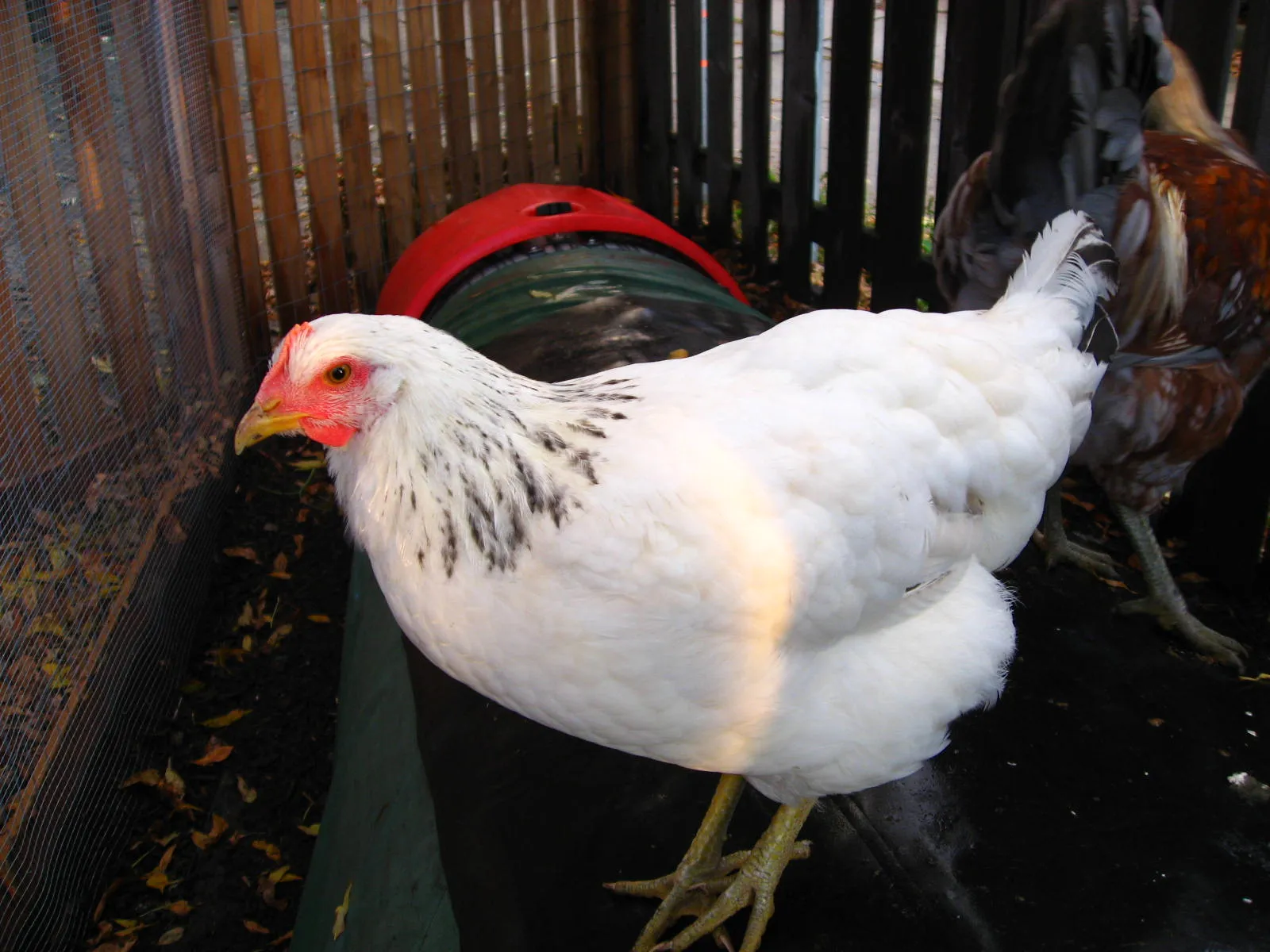
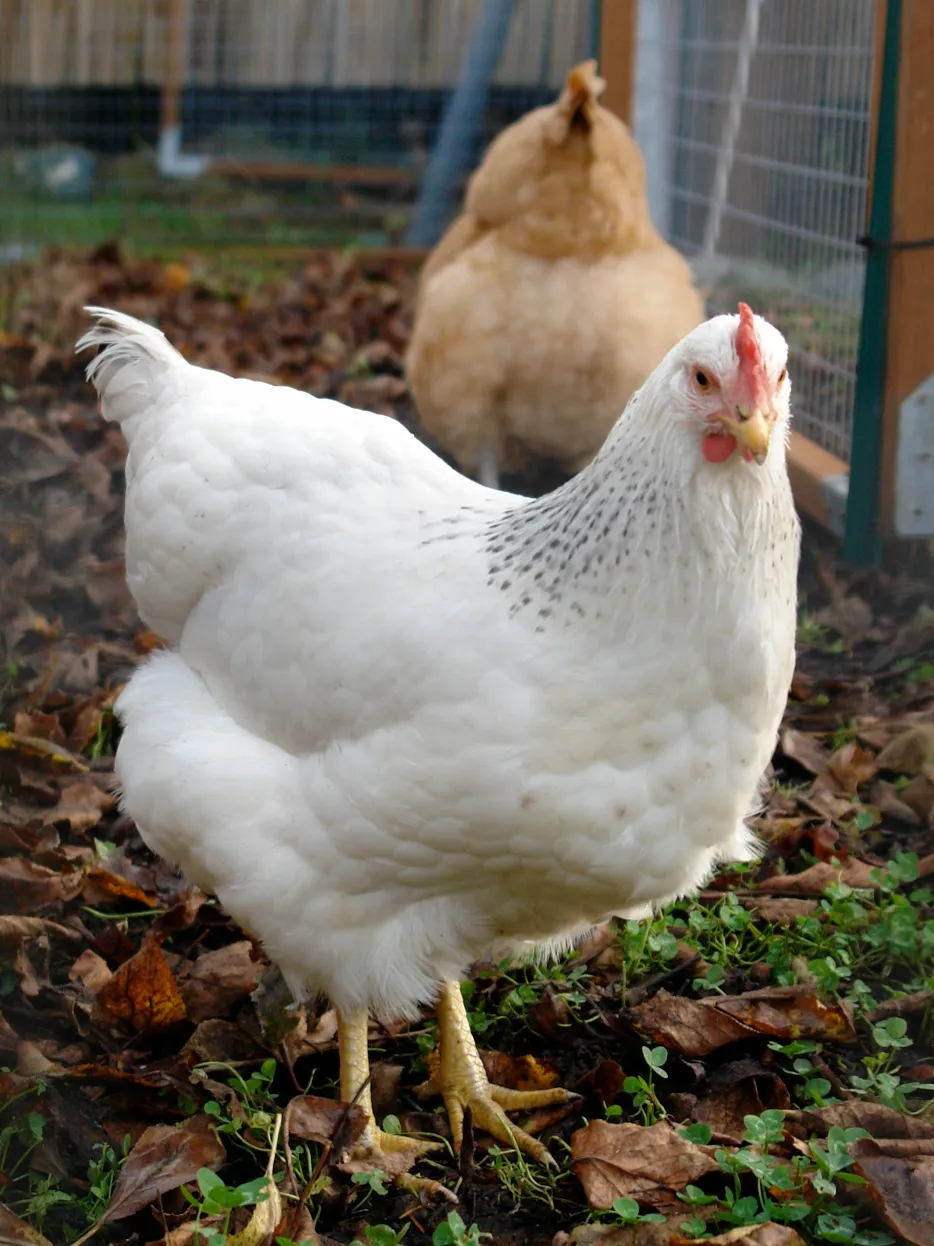
Delaware is an American dual-purpose breed from the Delmarva broiler belt — white-bodied with black barring on the hackle, primaries/secondaries, and tail — and it is a Livestock Conservancy Recovering breed, not a forgotten hatchery novelty.
The Conservancy’s breed page is the primary institutional history. George Ellis of Indian River, Delaware, was crossing Barred Plymouth Rock roosters to New Hampshire hens in the 1940s to build a fast-maturing layer/broiler. Occasional “sports” appeared: mostly white birds with black barring where a Columbian pattern would put solid black. Ellis selected those sports into what was first called the Indian River, later the Delaware. For about twenty years, Delawares and Delaware/New Hampshire crosses were the most popular broiler chickens on the Delmarva Peninsula because white feathering left a cleaner dressed carcass than dark feathers. In the late 1950s, solid-white Cornish/Plymouth Rock crosses took over commercial broilers; because Delaware had been bred for that industry and was little known on small farms, its popularity collapsed fast. The Conservancy today: still an excellent dual-purpose bird for small farms — low maintenance, healthy, rapid growth and fast feathering; medium size with a deep, broad, inverted-triangle body; single comb (five points); red comb/wattles/earlobes; reddish-bay eyes; yellow shanks and toes. Sex-link utility remains: Delaware males × New Hampshire or Rhode Island Red females keep Delaware color; Delaware females × NH/RIR males produce sex-linked chicks (Delaware-pattern males, solid-red females) that can be sexed by down color.
Oklahoma State University (Wayback capture 5 March 2026, timestamp 20260305135524, page slug misspelled delware-chickens): U.S. origin; Rock × New Hampshire; George Ellis ~1940s; broiler purpose; white with black-barred neck and tail; single comb; yellow shanks; feathers fast; meaty body. OSU still prints population status as threatened and cites Conservancy material dated 2015 in its references — stale against the live Conservancy Recovering listing and the Conservancy Quick Reference chart row (fetched 2025 watermarked Pick-a-Breed PDF): Recovering, dual-purpose, novice-friendly, bred to grow quickly for broiler production. Cackle Hatchery (hatchery): APA Standard of Perfection 1952; American class; TLC Recovering; same Ellis / Barred Rock × New Hampshire origin story; notes near-disappearance by the 1980s–1990s and backyard/hatchery recovery.
University of Kentucky Extension (ASC-190) places Delaware among winter-hardy dual-purpose choices and documents the Delaware hen × New Hampshire/Rhode Island Red rooster sex-link (and the reverse mating’s non-sex-link outcome) — extension corroboration of the Conservancy’s sex-link notes, not a second origin story.
Breed club. A Delaware Poultry Club / Delaware Club of America presence exists online, but the club sites fetched this pass were thin, redirecting, or returned 502/404. Conservancy + APA dates from Conservancy/Cackle carry the institutional load.
Conservation. Live Conservancy breed page: Recovering. Pick-a-Breed chart: Recovering. Cackle: TLC Recovering. That is a real status — not an invented Watch label.
Care
Eggs. Planning numbers disagree across Conservancy materials and hatcheries:
- Conservancy breed page: about 4 large-to-jumbo light brown eggs/week — up to ~200/year.
- Conservancy Pick-a-Breed chart: Very Good; 150–200; brown; large to jumbo.
- Cackle: 200–280 (estimates only); light brown; large–jumbo.
- OSU: about 100–150/year — treated here as neglected-line / outdated context (and paired with stale “threatened” status), not current planning Normal.
Flockmath’s 200 matches the Conservancy breed-page ceiling and sits at the top of the chart’s 150–200 band, below Cackle’s hatchery 280. Matching production detail: Delaware egg guide. UKY Table 2 lists Delawares among yellow-skinned dual-purpose breeds laying brown eggs (no annual count).
Weights & type. Conservancy materials disagree with themselves and with hatchery/APA-facing figures:
- Breed-page facts box: male 7.5 / female 5.5.
- Breed-page body: males up to 8 / females 6.
- Pick-a-Breed chart: male 8.5 / female 6.5.
- OSU / Flockmath: cock 8.5 / hen 6.5.
- Cackle: hen 6½–7, rooster 8½.
This profile names that spread and treats Flockmath’s 6.5 / 8.5 as aligned with the Conservancy chart and OSU, not the lighter facts-box pair. Plumage: mostly white with black barring on neck/wings/tail (Columbian-like with barring). OSU prints egg color “Dark brown” while Conservancy says light brown — named disagreement; Flockmath’s generic brown sits between those adjectives.
Climate. Conservancy chart: does well in both hot and cold. UKY: Delaware among breeds for harsh winters. Cackle lists the breed among hot-weather chick categories. Flockmath all fits that dual-climate framing. Single comb: Poultry Extension — large single combs frostbite more than pea/strawberry; Conservancy notes they dislike damp neglect less than they need dry shelter. UMN still ties frostbite to moisture + cold. Conservancy: four-foot fence holds them (non-flyers); prefer ranging but tolerate confinement with enrichment.
Sex-link use (not the pure breed). Conservancy and UKY: Delaware hens are a classic “silver” parent in red sex-link programs with New Hampshire or Rhode Island Red roosters. Offspring of those crosses are hybrids — useful layers, not pure Delawares.
For coop sizing / egg modeling: coop size calculator and egg production calculator. Related parent/neighbor profiles: Barred Plymouth Rock, New Hampshire Red, Rhode Island Red.
Temperament
Conservancy: curious explorers; calm and friendly; chatter and follow people; generally not cuddly; assertive with other chickens but not bullies; can be loud (neighbor caveat); predator-savvy despite white plumage. Chart temperament: Docile. OSU: gentle, not aggressive. Cackle Breed Facts: Docile. Flockmath calm / beginner-friendly aligns with Conservancy calm/friendly and chart/Cackle docile. Conservancy’s loud warning sits against Flockmath’s moderate noise — named, not papered over.
Health
No fetched Conservancy or extension page flags a Delaware-specific infectious disease. Honest gap. Management points that are sourced:
- Broodiness (Conservancy disagrees with itself): breed page — not generally broody (use another broody or an incubator); Pick-a-Breed chart — Setters; OSU — broody on occasion; Cackle — Broody: No. Flockmath rarely follows the breed page / Cackle non-setter line while naming the chart’s Setters cell.
- Single-comb frostbite in damp cold (Poultry Extension; UMN moisture rule; UKY winter list still assumes dry housing).
- Buyer/conservation risk: rare heritage stock — ask for APA-type Delaware, not a random white bird; support Recovering status by buying from breeders who select for type and utility.
If frostbite occurs, UMN recommends a veterinarian; severe untreated frostbite can mean permanent tissue loss and may require isolation from pecking.
Delmarva Dual-Purpose: The Bottom Line
If you want a Recovering American dual-purpose bird with a real broiler-belt paper trail, Delaware is the breed the Conservancy describes: Indian River sports from Barred Rock × New Hampshire, briefly the Delmarva broiler favorite, then nearly lost when Cornish/Rock took over. Flockmath’s 200 eggs/year matches the Conservancy’s ~200 ceiling and the chart’s 150–200 band, below Cackle’s hatchery 200–280. Expect large-to-jumbo brown eggs, fast feathering, and meat value that still reflects broiler-era selection.
Expect APA recognition (1952), Conservancy Recovering status (not OSU’s stale “threatened”), temperament that is calm/docile but talkative enough for a neighbor warning, and broodiness language that splits Conservancy’s own breed page from its comparison chart. Ask whether you are buying pure Delaware or a sex-link project that uses Delaware as a parent. You are buying white Delmarva utility with a conservation listing — short commercial reign, long small-farm second act — not a Cornish Cross and not an unverified national “dominated all broiler markets” slogan. As of commit 3a8086a, breeds.json’s description was reworded to match this scoped claim — “dominated the Delmarva Peninsula’s broiler industry” — replacing the old unscoped “dominated broiler markets” framing.
Sources
- Recovering status; Indian River / George Ellis 1940s; Barred Rock × New Hampshire; ~20 years Delmarva broiler popularity; late-1950s Cornish/Rock replacement; ~4 large–jumbo light brown eggs/week up to ~200/year; not generally broody; temperament (calm/friendly/assertive/loud); weights facts-box 7.5/5.5 and body 8/6; yellow shanks; sex-link notes; confinement/fence: The Livestock Conservancy — Delaware Chicken
- Chart: Recovering; M 8.5 / F 6.5; brown large–jumbo; Very Good 150–200; Docile; Setters; hot and cold; novice; broiler-growth note: The Livestock Conservancy — Quick Reference Guide to Heritage Chickens (2025 watermarked Pick-a-Breed PDF)
- Recovering on 2026 CPL: 2026 Conservation Priority List — Poultry (
Delaware (R)). - OSU (stale threatened; 100–150 eggs; dark brown shells; broody on occasion; 8.5/6.5; white skin claim; 1940s origin): Oklahoma State University — “Delware Chickens.” (Fetched via Wayback Machine capture 5 March 2026, timestamp
20260305135524.) - Winter-hardy list includes Delaware; dual-purpose brown eggs; Delaware hen sex-link with NH/RIR: University of Kentucky Cooperative Extension — ASC-190
- Frostbite moisture/ventilation: University of Minnesota Extension — “Caring for Chickens in Cold Weather.”
- Single vs pea comb frostbite incidence: Poultry Extension — “Frostbite in Chickens,” Dr. Jacquie Jacob, University of Kentucky.
- Hatchery guidance (labelled): Cackle Hatchery — Delaware — 200–280 eggs; APA 1952; TLC Recovering; Broody No; Temperament Docile; weights ~6.5–7 / 8.5; Ellis / Rock × NH history; 1980s–90s rarity note.
- Breed club gap this pass: Delaware Club of America / legacy Delaware Poultry Club pages returned thin content, redirects, or 502/404 when fetched.
Ours: framing Flockmath’s 200 against Conservancy ~200 / chart 150–200 while naming Cackle 200–280 and OSU’s 100–150 as outdated context; naming Conservancy weight and broodiness internal disagreements; naming OSU threatened/dark-brown/broody-on-occasion vs Conservancy Recovering/light-brown/not-generally-broody; naming Conservancy “loud” vs Flockmath moderate; tightening the broiler-history claim to Conservancy’s Delmarva scope; cross-linking Rock / New Hampshire / RIR profiles; and leaving breeds.json numbers unchanged this pass while flagging the description’s “dominated … broiler markets” wording for a future description audit. (Update, commit 3a8086a: the description was reworded to Conservancy’s Delmarva-scoped claim.)