
Chicken Anatomy Diagram: Labeled Parts of a Hen and Rooster
A labeled chicken anatomy diagram: the external parts of a hen, how a rooster differs, and what each part tells a keeper, with sourced notes.
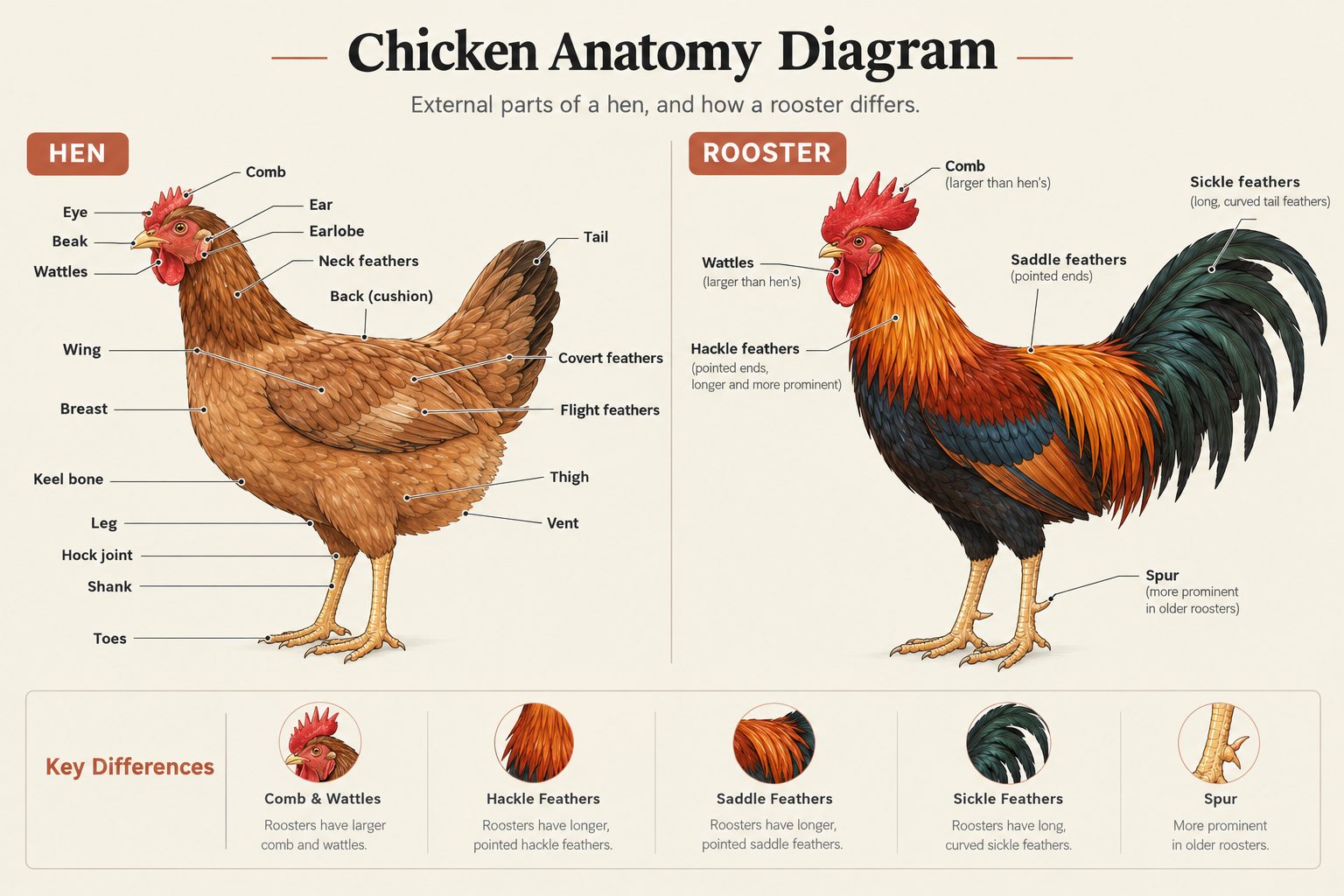
A chicken's basic external parts are the comb, beak, wattles, ears, earlobes, eyes, eye rings, wings, tail, thighs, hocks, shanks, spurs, claws and toes, and both hens and roosters have them (Poultry Extension, University of Kentucky). The sexes differ in the size of the comb and wattles, the size of the spurs in older birds, and the hackle and cape feathers, which have pointed ends on a rooster and rounded ends on a hen. Only roosters grow the long sickle feathers in the tail. Most chickens have four toes, three pointing forward and one back; a few breeds have five.
The diagram below labels the parts a keeper, a 4-H member or a show judge talks about, on a hen and on a rooster. The part names and positions follow Washington State University’s 4-H Poultry Science guide and the Poultry Extension network, and the hen and rooster differences follow Poultry Extension and The Open Sanctuary Project.
Parts of a chicken’s head
- Comb: the red, soft, fleshy crest on top of the head. Its size and redness vary, and they say something useful: Washington State’s 4-H guide notes that a hen not in lay has a small, dull comb, while a laying hen has a large, bright red one.
- Beak: the mouthpiece. The lower part is hinged at the jaw and moves; the upper part is attached to the skull.
- Wattles: the red, fleshy flaps hanging from the lower edge of the head. Like the comb, they get their red color from a rich blood supply, and the comb and wattles help a chicken lose heat, since birds cannot sweat.
- Eye and eye ring: chickens see in color and are slightly farsighted, seeing better at a distance than up close. When the eye is open, the eye ring shows as a ring of skin around it.
- Ear: there is no outer ear. Each ear is just an opening into the ear canal on the side of the head, covered by small feathers.
- Earlobe: a patch of smooth skin below the ear. It is red or white depending on the breed, and breeders use it to tell breeds apart.
Body, wings and tail
- Neck feathers: on a hen these are simply the neck feathers. On a rooster they are called hackles.
- Breast and keel bone: the breast is the front of the bird, and the keel bone is the lower part of the skeleton beneath it.
- Back: the back is called the cushion on a hen and the saddle on a rooster. A rooster’s saddle feathers flow from the back down each side of the body.
- Wing: with the wing folded, the feather groups are hard to tell apart. Spread it and you can see the long flight feathers and the covert feathers covering their base. One feather, the axial feather, separates the primary flight feathers from the secondaries. When a hen molts, she drops feathers from the axial feather outward, which is worth knowing if you are reading the molt.
- Tail: the main tail feathers grow from the tail head on both sexes. Roosters also grow long, flowing sickle feathers.
Legs and feet
- Thigh: the upper leg, along each side of the body and hidden under feathers.
- Leg (drumstick): the lower leg, also feathered, which ends at the hock.
- Hock joint: the joint between the drumstick and the shank, the chicken’s equivalent of an ankle.
- Shank: the scaly part below the hock, which works as the chicken’s foot. It is clean or feathered depending on the breed.
- Spur: a bony growth from the rear inside of the shank. The 4-H guide places it on the male; Poultry Extension lists spur size, in older birds, as one of the differences between the sexes.
- Toes: chickens stand and walk on their toes. Most have four, three pointing forward and one back, and a few breeds have five.
The vent
The vent is the opening just below the tail, and a hen passes both droppings and eggs through it (My Pet Chicken, a hatchery). Inside, the digestive tract ends at the cloaca. There, digestive waste mixes with waste from the urinary system, so chickens do not urinate separately; the white, pasty coating on droppings is uric acid, the bird’s form of urine, and it is normal. The reproductive tract exits through the same opening: when a hen lays, the vagina folds over so the egg leaves without touching feces or urine (Poultry Extension).
Reading a hen’s laying from the outside
Several external parts change when a hen is laying, which is how keepers and judges check a hen without waiting for eggs:
- Comb and wattles: large and bright red in a laying hen, small and dull in one that is not laying (Washington State 4-H).
- Vent: large, moist and bleached in a layer; small, dry, puckered and yellow in a non-layer. The two small bones at the sides of the vent, the pubic bones, are flexible and wide apart in a layer (Mississippi State University Extension).
- Color fading: a laying hen moves yellow pigment into her yolks, so the color fades from her body in a set order. It is easiest to see in yellow-skinned breeds such as the White Leghorn. The vent fades first (4 to 7 days after the first egg), then the eye ring (7 to 10 days), the earlobes in White Leghorns (14 to 21 days), the beak (4 to 8 weeks) and last the shanks. When she stops laying, the color comes back in the same order, vent first and shanks last, and a hen whose beak is fully colored has not laid for at least four weeks (Mississippi State University Extension).
A small, dull comb on a hen that used to lay is one sign she has stopped. The guide to why chickens stop laying works through the causes.
Hen or rooster: what to look at
Hens and roosters have the same basic parts. To tell them apart from the outside, Poultry Extension and The Open Sanctuary Project point to:
- Comb and wattles: a rooster’s are typically larger, and often redder, than a hen’s of the same breed. Compare within one breed, since a Leghorn hen can have a bigger comb than a rooster of another breed.
- Hackle and cape feathers: a rooster’s have pointed ends, and his hackles are longer; a hen’s are shorter and rounded.
- Saddle feathers: long saddle feathers with pointed tips, draping down from the base of the tail, are a clear sign of a male.
- Sickle feathers: in most breeds, roosters have long, sickle-shaped tail feathers and hens a shorter, straighter tail. A rooster can lose them for a while in a molt.
- Spurs: they differ in size in older birds. Some hens grow spurs too, but they tend to be much smaller.
The names change too. A hen’s neck feathers are a rooster’s hackles, and a hen’s cushion is a rooster’s saddle.
Comb types
The single comb, the one drawn in the diagram, is the most common. Other common types are the rose, pea and V-shaped comb. Comb type is inherited, so it is one of the features used to identify breeds and varieties, along with earlobe color. The breed chart compares the 30 breeds on this site.
Frequently asked questions
What are the parts of a hen?
The comb, beak, wattles, eyes and eye rings, ears and earlobes on the head; the neck feathers, breast, keel bone, back (called the cushion on a hen), wings and tail on the body; and the thighs, legs, hock joints, shanks and toes below. The vent sits under the tail. The diagram above labels each one.
How do you know a male from a female chicken?
Compare the comb and wattles within one breed: a rooster’s are typically larger. Look at the hackle and cape feathers, which have pointed ends on a rooster and rounded ends on a hen, and at the saddle feathers, which are long and pointed on a rooster. Only a rooster has long, flowing sickle feathers in the tail, and an older rooster’s spurs are larger.
What is a cloaca on a chicken?
It is where a chicken’s digestive tract ends, and where digestive waste mixes with urinary waste before leaving the body. The reproductive tract exits there too, so eggs and droppings leave through the same opening, the vent just below the tail. When a hen lays, the vagina folds over so the egg does not touch the waste.
Where is a chicken’s ear?
On the side of the head, just above the earlobe. A chicken has no outer ear, just an opening into the ear canal covered by small feathers. The earlobe is the patch of smooth skin below it, and it is red or white depending on the breed.
How many toes does a chicken have?
Most chickens have four toes on each foot, three pointing forward and one back. A few breeds have five.
Sources
- Parts, positions and what they do; hen and rooster terms; comb types; laying-hen comb; heat loss through the comb and wattles: Washington State University Extension, 4-H Poultry Science Level I, Leader Guide (EM081E), “Parts of a Chicken”.
- Basic parts, differences between the sexes, axial feather and molt, legs and toes, ears, earlobes and eye ring: Poultry Extension, “External Anatomy of Chickens,” Jacquie Jacob, University of Kentucky.
- Cloaca: Poultry Extension, “Avian Digestive System,” Jacquie Jacob, University of Kentucky.
- Vent position and use (hatchery guidance, not research): My Pet Chicken, “What is a chicken’s vent?”.
- Hen and rooster differences (comb and wattle size within a breed, hackle length, pointed saddle feathers, sickle-shaped tail, spurs on some hens): The Open Sanctuary Project, “Distinguishing Hens From Roosters”.
- Laying signs: vent, pubic bones and color fading: Mississippi State University Extension, “Culling Hens”.
Published October 2026.