
Chick Growth Chart: Week-by-Week Weight and Development
A week-by-week chick growth chart from hatch to point of lay: target weight, feed and water a day, and feathering and comb milestones, all sourced.
A layer chick weighs about 65–76 g at one week, about 649–725 g (1.4–1.6 lb) at eight weeks and 1,526–1,609 g (3.4–3.5 lb) at 20 weeks, when about half the flock is laying. These are Hy-Line's targets for its Brown commercial layer pullet in alternative (non-cage) systems (May 2026 guide), not figures for every breed. Wing feathers start at about 3 days and the body is covered by week 3 (Nebraska Extension); most chicks are fully feathered at 6 to 8 weeks (VCA). Cockerels' combs and wattles outgrow pullets' from about week 4. A meat chicken grows far faster: Nebraska's Cornish Cross cockerel weighs about 9 pounds at 8 weeks.
Raising chicks now? The brooder heat lamp calculator gives the temperature and space for each week, and the feed transition calculator tells you when to change feed. This page covers how the chicks themselves grow.
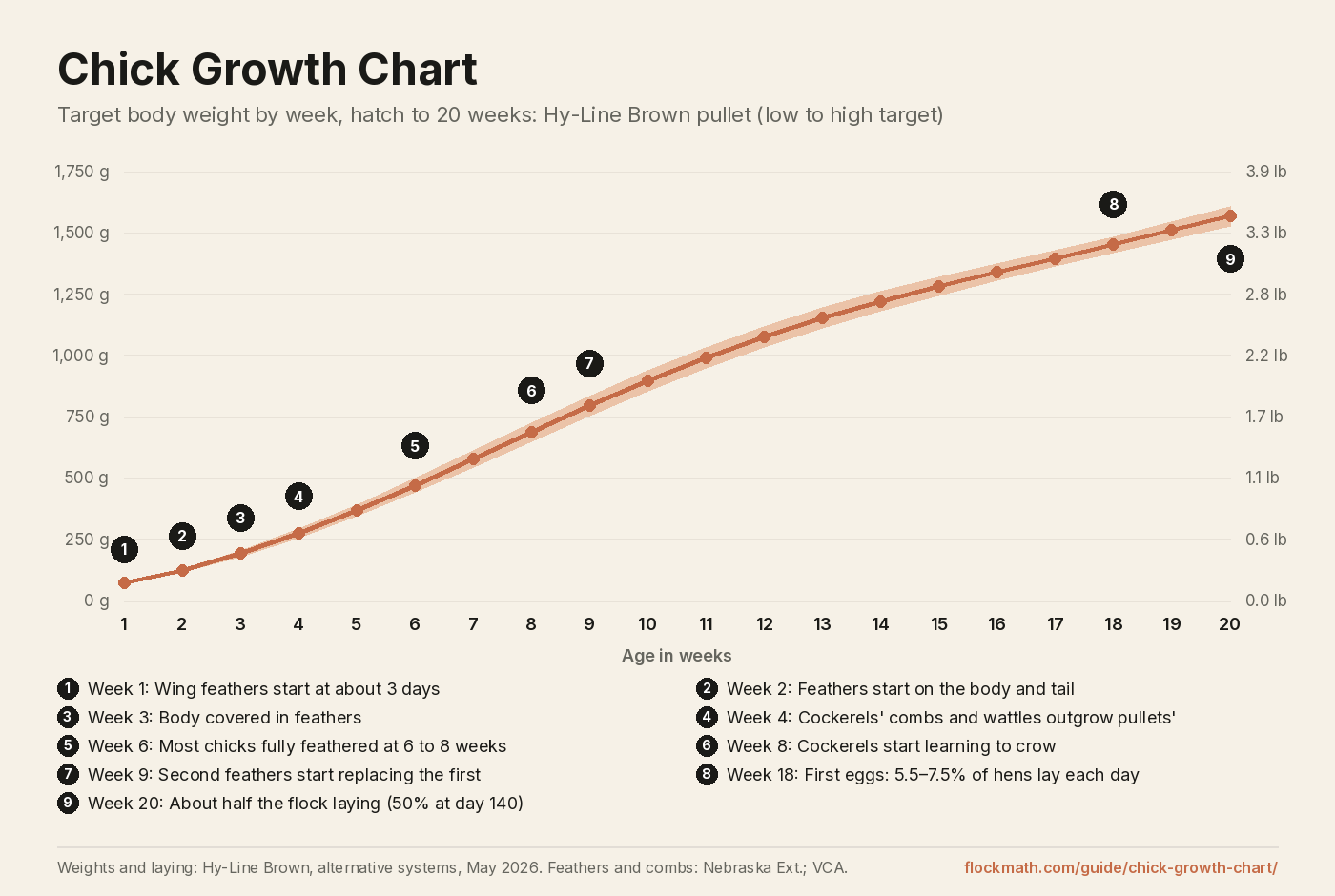
Chick growth chart by week
Weight, feed and water are Hy-Line’s low and high targets per bird for its Brown commercial layer in alternative (non-cage) systems: its rearing table to week 17 and its production table from week 18. The feather and comb milestones come from Nebraska Extension’s photographs of a White Leghorn hybrid pullet, full feathering from VCA Animal Hospitals, and the laying milestones from Hy-Line.
| Week | Weight (g) | Weight (lb) | Feed per day | Water per day | What you will see |
|---|---|---|---|---|---|
| 1 | 65–76 | 0.14–0.17 | 17–19 g (0.6–0.7 oz) | 26–29 ml | Wing feathers start at about 3 days |
| 2 | 113–132 | 0.25–0.29 | 20–21 g (0.7 oz) | 29–32 ml | Feathers start on the body and tail |
| 3 | 177–205 | 0.39–0.45 | 23–25 g (0.8–0.9 oz) | 35–38 ml | Body covered in feathers |
| 4 | 254–292 | 0.56–0.64 | 28–31 g (1.0–1.1 oz) | 42–46 ml | Cockerels’ combs and wattles outgrow pullets’ |
| 5 | 343–391 | 0.76–0.86 | 35–38 g (1.2–1.3 oz) | 52–56 ml | |
| 6 | 440–499 | 0.97–1.10 | 41–45 g (1.4–1.6 oz) | 62–67 ml | Most chicks fully feathered at 6 to 8 weeks |
| 7 | 543–611 | 1.20–1.35 | 47–51 g (1.7–1.8 oz) | 71–77 ml | |
| 8 | 649–725 | 1.43–1.60 | 53–57 g (1.9–2.0 oz) | 79–86 ml | Cockerels start learning to crow |
| 9 | 753–835 | 1.66–1.84 | 58–62 g (2.0–2.2 oz) | 87–94 ml | Second feathers start replacing the first |
| 10 | 853–939 | 1.88–2.07 | 62–67 g (2.2–2.4 oz) | 93–100 ml | |
| 11 | 946–1,034 | 2.09–2.28 | 66–71 g (2.3–2.5 oz) | 99–106 ml | |
| 12 | 1,032–1,119 | 2.28–2.47 | 69–73 g (2.4–2.6 oz) | 103–109 ml | |
| 13 | 1,109–1,195 | 2.44–2.63 | 71–75 g (2.5–2.6 oz) | 106–113 ml | |
| 14 | 1,179–1,261 | 2.60–2.78 | 73–78 g (2.6–2.8 oz) | 110–116 ml | |
| 15 | 1,243–1,320 | 2.74–2.91 | 75–79 g (2.6–2.8 oz) | 113–119 ml | |
| 16 | 1,304–1,375 | 2.87–3.03 | 78–82 g (2.8–2.9 oz) | 117–123 ml | |
| 17 | 1,363–1,428 | 3.00–3.15 | 82–86 g (2.9–3.0 oz) | 123–129 ml | |
| 18 | 1,418–1,485 | 3.13–3.27 | 87–91 g (3.1–3.2 oz) | 130–136 ml | First eggs: 5.5–7.5% of hens lay each day |
| 19 | 1,472–1,546 | 3.25–3.41 | 92–97 g (3.2–3.4 oz) | 139–146 ml | |
| 20 | 1,526–1,609 | 3.36–3.55 | 98–103 g (3.5–3.6 oz) | 146–154 ml | About half the flock laying (50% at day 140) |
Hy-Line itself calls these weights approximate and its ages a guide only, and advises changing feed by body weight rather than by age.
What the numbers describe
The weights are the published targets for one bird: the Hy-Line Brown, a commercial laying hybrid, in alternative (non-cage) housing. Hy-Line publishes them week by week, with a low and a high target, which is why this chart uses them. They are not a standard for every breed, and no comparable published figures were found for heritage breeds, so this page does not guess at them. If your chicks are a different breed, use the chart for the shape of growth, not as a target to hit.
Weight keeps rising after 20 weeks. Hy-Line’s targets for the same hen are 1,821–1,903 g at 26 weeks and 1,891–1,970 g at 32 weeks, so a pullet is not full grown when she starts laying.
Feathers, week by week
Nebraska Extension photographed a White Leghorn hybrid pullet each week to 12 weeks, then each month to 6 months. What it shows:
- Day 1: down covers the body. The egg tooth on the beak falls off in about a day.
- Week 1: at around 3 days, the first wing feathers (primary feathers) start to grow.
- Week 2: feathers start growing on the body and tail.
- Week 3: the body is covered by feathers.
- Week 9: a second set of feathers starts replacing the first.
Covered is not the same as fully feathered. VCA Animal Hospitals puts full feathering for most chickens at six to eight weeks, the point at which they can manage normal daytime temperatures, and that is the age the brooder calculator works to. Until then, keep the heat schedule going even if the chicks look feathered.
Cockerel or pullet: what changes with age
- Week 4: cockerels’ combs and wattles start to grow larger than pullets’.
- Week 8: cockerels start learning to crow.
- Month 5: pullets’ combs get larger and turn red; some flop over.
- Month 6: the Leghorn pullet in Nebraska’s photographs is fully grown and starts to lay.
The chicken anatomy diagram shows the comb, wattles, hackles and other parts that tell an adult hen from a rooster.
Feed and heat by age
This site’s feed schedule keeps chicks on starter until week 8, then grower until week 18 or the first egg, whichever comes first; for heavy breeds it uses weeks 10 and 20. VCA gives a similar window for starter, the first four to eight weeks. The feed transition calculator works out the change for your flock’s age.
Feed intake climbs fast. In Hy-Line’s table a pullet eats 17–19 g a day in week 1 and 98–103 g a day by week 20, and drinks about 1.5 ml of water for every gram of feed, week after week.
The brooder calculator plans with the upper end of these targets: 19 g (0.7 oz) of feed and 29 ml of water a day in week 1, rising to 57 g (2.0 oz) of feed and 86 ml of water in week 8. Over the first eight weeks Hy-Line’s targets add up to about 4.1 to 4.4 pounds of feed per chick. Neither figure is a ration: keep feed and water available all day.
For heat, start the brooder hot and lower it each week; the brooder heat lamp calculator gives the schedule and the space each chick needs.
Meat chickens grow far faster
Nebraska Extension made the same photo series for a Cornish Cross (Cornish/Rock) market broiler cockerel, a bird bred for meat. Its feathering follows the same early steps, but at 8 weeks it weighs about 9 pounds, ready to eat. The layer pullet in this chart weighs about 1.4 to 1.6 pounds at the same age. Do not use this chart for meat birds.
When do pullets start laying?
Hy-Line’s Brown flock reaches 50 percent production at 140 days, about 20 weeks, from hatch. In its production table, 5.5–7.5 percent of the hens lay on an average day in week 18, and 46.7–55.9 percent in week 20. Nebraska’s White Leghorn pullet starts to lay at about six months. This site’s feed transition calculator puts most standard laying breeds at 18 to 22 weeks, lighter breeds such as Leghorns from 16 to 18 weeks, and heavy and dual-purpose breeds often at 24 weeks or later. It moves pullets to layer feed at the first egg or at 18 to 20 weeks, whichever comes first.
Frequently asked questions
How fast does a chick grow?
Very fast at first. In Hy-Line’s targets a Brown pullet goes from about 65–76 g at one week to 649–725 g at eight weeks, roughly ten times heavier, and to 1,526–1,609 g at 20 weeks. Weekly gain is largest in the middle weeks: about 100 to 110 g a week from weeks 5 to 10, slowing after that.
How big is a chick at 3 weeks?
About 177–205 g (0.39–0.45 lb) in Hy-Line’s targets for a Brown layer pullet. At this age its body is covered by feathers, though it is not yet fully feathered.
How big is a chick at 8 weeks?
About 649–725 g (1.4–1.6 lb) for a Hy-Line Brown pullet. Most chicks are fully feathered between six and eight weeks, cockerels start learning to crow, and this site’s feed schedule moves them from starter to grower. A meat-breed Cornish Cross cockerel weighs about 9 pounds at the same age.
How can I tell how old a baby chick is?
Look at the feathers. A chick in its first days is all down. Wing feathers appear at around 3 days, body and tail feathers start in week 2, the body is covered by week 3, and most chicks are fully feathered at six to eight weeks. Size helps too, but it varies with breed.
What does a 1 week chick look like?
Small and still mostly down. In Nebraska Extension’s photographs the first wing feathers start to grow at around 3 days, and feathers on the body and tail only start in week 2. Hy-Line’s target weight for a Brown pullet at one week is 65–76 g, about 2.3 to 2.7 ounces.
How soon can you tell if a chick is male or female?
In Nebraska Extension’s photographs, cockerels’ combs and wattles start to grow larger than pullets’ at about four weeks, and cockerels start learning to crow at about eight weeks. Pullets’ combs grow and turn red much later, at around five months.
How long does it take a chick to grow to full size?
Longer than it takes to start laying. Nebraska’s White Leghorn pullet is fully grown at about six months. Hy-Line’s Brown hen is still gaining weight after she starts laying: 1,526–1,609 g at 20 weeks, when about half the flock is laying, 1,821–1,903 g at 26 weeks and 1,891–1,970 g at 32 weeks.
Are chickens full grown at 4 months?
Not yet. At 17 weeks, just under four months, a Hy-Line Brown pullet weighs 1,363–1,428 g, and she gains several hundred grams more over the next months. Nebraska’s Leghorn pullet is fully grown at about six months.
Sources
- Weekly body weight, feed and water; the share of hens laying in weeks 18 and 20; adult weights; 50 percent production at 140 days: Hy-Line International, Hy-Line Brown Commercial Layers, Alternative Systems Performance Standards Guide (May 2026), Rearing Period and Production Period Performance Tables and Summary of Performance Standards. Weights approximate, ages a guide only, feed changed by body weight rather than age: the same guide, note 1 to the Rearing Period Nutritional Recommendations.
- Feathering, comb and crowing milestones, a White Leghorn hybrid pullet: Nebraska Extension in Lancaster County, “Chicken Growth & Development” poster.
- Cornish Cross broiler at 8 weeks: Nebraska Extension in Lancaster County, “Chicken Growth & Development,” Cornish/Rock market broiler cockerel.
- Full feathering at six to eight weeks; starter for the first four to eight weeks: VCA Animal Hospitals, “Caring for Baby Chickens”.
- Feed stages and laying ages used across this site: the feed transition calculator, which lists its own sources.
Published October 2026.