
standard breed · USA (hybrid)
Golden Comet
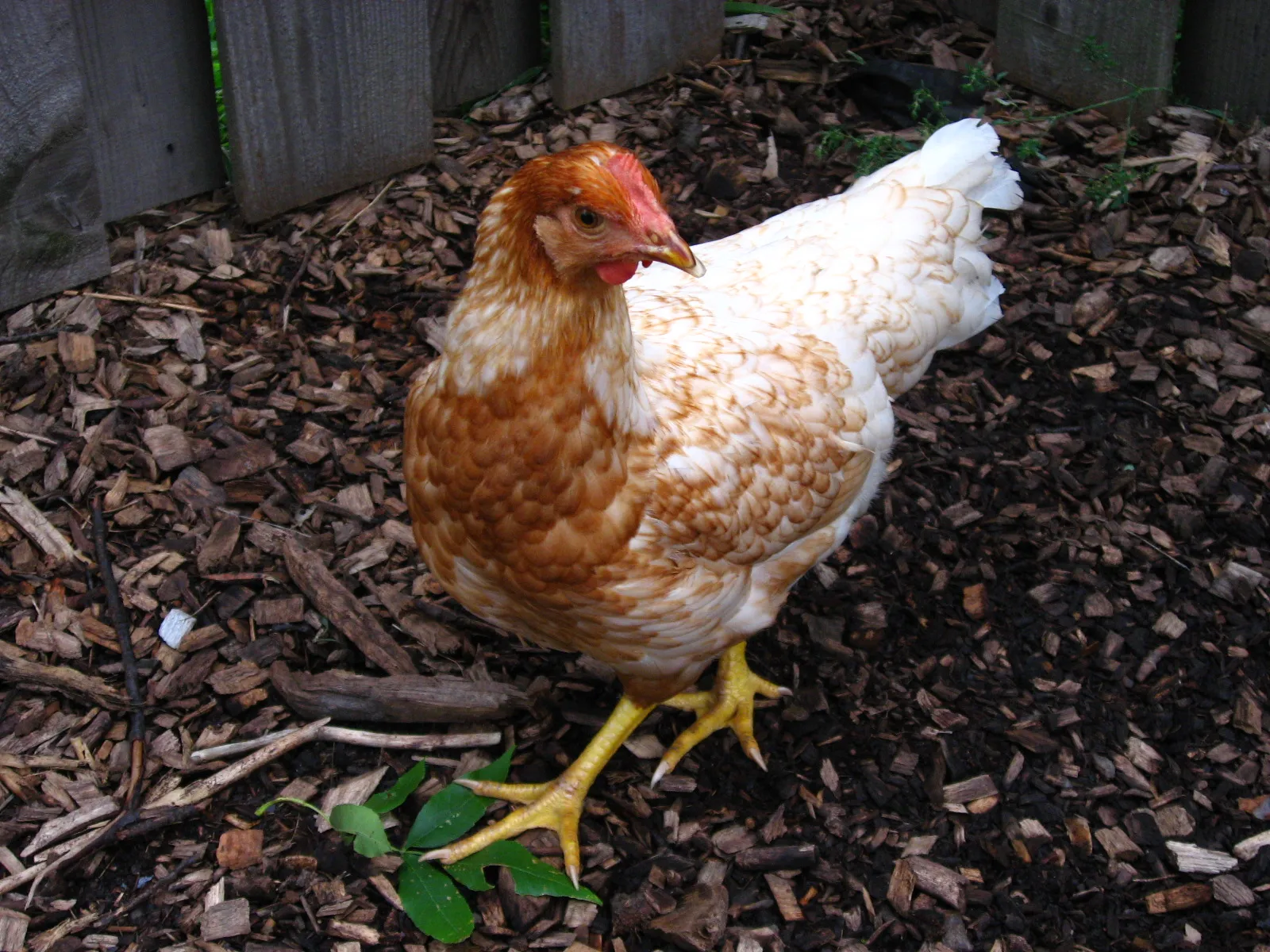
A red sex-link hybrid prized by small-flock keepers for early laying (around 16 weeks) and consistent production. Mellow, social, and well-suited to mixed flocks.
| Size class | standard |
|---|---|
| Weight (hen) | 4 lb (1.81 kg) |
| Weight (rooster) | 6 lb (2.72 kg) |
| Eggs per year | 280 |
| Egg color | brown |
| Egg size | large |
| Climate tolerance | All climates |
| Temperament | friendly |
| Goes broody | rarely |
| Noise level | quiet |
| Beginner-friendly | Yes |
| Origin | USA (hybrid) |
Is the Golden Comet right for your flock?
The Golden Comet is a standard breed that's well-suited to first-time keepers. Hens lay around 280 brown eggs per year and tolerate most climates well.
Temperament: friendly. Broodiness: rarely. Noise level: quiet. A reasonable choice for suburban yards.
What this breed needs
- Coop space: about 4 sq ft per bird inside the coop. Run the numbers for your specific flock size in the coop size calculator.
- Climate fit: adapts to a wide range of climates with no special accommodations.
- Eggs: a top-tier producer — among the most productive backyard breeds. For a month-by-month breakdown, see Golden Comet Egg Production: How Many Eggs Per Year?.

History
A Golden Comet is not an American Poultry Association–recognized breed and is not a Livestock Conservancy heritage chicken. It is a shared trade name for a red sex-link hybrid — a first-generation production cross sold under several labels — not a single company’s trademarked product line like ISA Brown. That framing matches Flockmath’s Black Star treatment of the black sex-link class: closer to Easter Egger / Olive Egger “recipe, not one pedigree” honesty than to ISA’s single-brand industrial sheet.
What extension calls the class. Mississippi State University Extension (P3036, fetched): sex-links are crossbreds whose hatch color differs by sex; “extremely good egg layers” that can produce 300 eggs per year or more; common varieties are black sex-links (Black Stars) and red sex-links (Red Stars). Red Stars are “a cross between a Rhode Island Red or New Hampshire rooster and a White Rock, Silver Laced Wyandotte, Rhode Island White, or Delaware hen.” University of Kentucky Extension ASC-190 (Jacob & Pescatore, fetched) and UKY’s sex-linked-crosses page / Poultry Extension’s sex-linked-traits article (Jacob, fetched): the red sex-link (also known as Golden Comet, Gold Star, or Cinnamon Queen depending on the specific cross used) is produced by a number of different crosses. Specifically:
- Gold Comet: White Plymouth Rock hens carrying the silver factor × a New Hampshire male. The silver gene is on the sex chromosome and inhibits red pigmentation.
- Cinnamon Queen: Silver Laced Wyandotte hen × New Hampshire rooster.
- Additional red sex-link combinations: Rhode Island White hen × Rhode Island Red rooster, or Delaware hen × Rhode Island Red rooster.
Males hatch white (and may feather white or with some black, depending on the cross); females hatch buff or red and feather buff or red. Offspring of a sex-linked cross cannot themselves be used to remake a reliable sex-link. Hybrids will not breed true.
Name collision — Golden Comet vs Gold Comet vs Red Star vs Cinnamon Queen. Extension treats Golden Comet / Gold Comet as a common name inside the red sex-link class, sometimes reserved for one disclosed pairing (UKY’s White Rock × New Hampshire “Gold Comet”) and sometimes used as an umbrella label. Hatcheries disagree on the sticker and on how much parentage they disclose:
- Cackle Hatchery (labelled): sells Golden Comet; proprietary Cherry Egger male × Rhode Island White female; APA No; TLC No; strain developed since 1997; FAQ states Golden Comets are not the same as Cackle’s Cinnamon Queen strain.
- Hoover’s Hatchery (labelled): Golden Comet; “another top red sex-link”; parents not named.
- Mount Healthy Hatcheries (labelled; Maine 4-H page adapted from this hatchery): Golden Comet; AKA Gold Sex Link, Red Sex Link, Red Star; parents not named on the product page fetched this pass; broody No; claims 325 brown eggs/year.
So “Golden Comet” on a box is not automatically UKY’s White Rock × New Hampshire recipe, and it is not automatically Cackle’s Cherry Egger × Rhode Island White line. Read the SKU. Black sex-links (Black Star) are the sister class using barring for day-old sexing; red sex-links use silver/gold colour sexing. Proprietary commercial brown layers such as ISA Brown are a different product category even when some hatcheries blur “Red Star” language across the aisle.
Early-maturity claim in breeds.json. The site description’s “early laying (around 16 weeks)” is only partly checkable from fetched bodies this pass. USU Extension’s breed table tags Golden Comet (hybrid) with “Early maturity” as a notable trait — without printing a week number for first egg. University of Maine 4-H (adapted from Mount Healthy / Cackle): “mature early.” Mount Healthy: “mature early.” Cackle: “starts laying younger than many standard breeds” / “early laying.” Soft finding: no fetched institutional page body printed “16 weeks” as a Golden-Comet-specific first-lay age. USU’s generic layer life-stage table puts a pre-lay phase at 16–20 weeks for chickens as a class — useful context, not a Golden Comet closed figure. Treat “around 16 weeks” as site planning language pending a hatchery/extension sentence that actually prints it, not as a verified extension fact.
What it is not. Livestock Conservancy /golden-comet/ and /golden-comet-chicken/ both 404 this pass. Conservancy Heritage FAQ (fetched): sex-links and other commercial chickens are not Heritage. Parent breeds — Rhode Island Red, New Hampshire Red, Plymouth Rock (White Rock parent stock), Delaware, Silver Laced Wyandotte — may have Conservancy or APA documentation; the cross does not.
Care
There is no Conservancy or APA closed backyard standard for “the Golden Comet.” Planning numbers are extension class language plus labelled hatchery SKUs — and hatcheries disagree.
Eggs.
- USU Extension table: Golden Comet (hybrid) — 280–320 brown eggs/year; size medium.
- University of Maine 4-H: 250–320/year (estimated); brown; dual-purpose purpose tag on that page.
- UF/IFAS AN239 (fetched): Golden Comet “produce as many as 300 eggs per year” in breed-choice prose; separate table rows for Brown / Gold / Red Sex-Link list excellent rate of lay with different parentage cells (RIR × White Plymouth Rock; RIR × Rhode Island Whites; RIR × Delaware) — not a single “Golden Comet” parentage cell.
- MSU: red sex-links as a class often 300+/year.
- Cackle Golden Comet: 250–320/year (estimates only); large brown.
- Hoover Golden Comet: 260 large brown eggs/year.
- Mount Healthy Golden Comet: 325 brown eggs/year.
Flockmath’s 280 matches the sibling Golden Comet egg guide Normal and sits at the floor of USU’s 280–320, inside Maine/Cackle’s 250–320, above Hoover’s 260, and below Mount Healthy’s 325 and MSU’s open-ended class 300+. There is no company “hen-housed to 100 weeks” sheet for this shared name the way ISA Brown has — do not invent one. Age decline for hard layers still follows general UF/IFAS backyard-layer guidance used on the ISA profile (significant drop often after two or three years) rather than a Golden-Comet-specific product curve. USU also groups Golden Comet with ISA Brown as hybrids delivering high egg yield but shorter lifespan.
Weights. Maine 4-H: hen 5–6 / rooster 7–8. Cackle: hen 5–7 / rooster 8–9. Hoover: mature 5–6. Flockmath: hen 4.0 / rooster 6.0. Named mismatch — no APA closed weights.
Climate & housing. Maine (from Mount Healthy adaptation): quiet bird that “seems to be able to withstand the colder, non-insulated, laying houses of the small flock owner, better than most breeds.” Mount Healthy product page: robust; colder non-insulated houses. Hoover: cold and heat hardy. Flockmath climate all is usable planning language for this production hybrid class. Single combs still need ordinary damp-cold frostbite care (Poultry Extension / UMN general guidance used elsewhere on this site).
For modeling: egg production calculator, coop size calculator, feed consumption calculator. Sister hybrid: Black Star; proprietary commercial peer: ISA Brown. Parent-stock profiles (depending on the seller’s recipe): Rhode Island Red, New Hampshire Red, Delaware, Wyandotte.
Temperament
Extension language is calm and production-oriented rather than long farmyard personality prose.
- USU: Calm, friendly; listed among beginner high-production choices with ISA Brown and Plymouth Rock.
- Maine 4-H: “extremely quiet bird.”
- Mount Healthy: “quiet bird.”
- Hoover: Docile, Calm, Friendly.
- Cackle: temperament facts table Active; body copy still pitches backyard/farm egg flocks and beginner suitability.
Flockmath friendly / beginners true / noise quiet aligns with USU calm/friendly, Maine/Mount Healthy quiet, and Hoover docile — and against Cackle’s facts-table Active alone. Named spread. Quiet here has real hatchery/4-H support (Maine; Mount Healthy), unlike some hybrid profiles where quiet is purely site planning.
Broodiness. Mount Healthy: No. Cackle: Variable. Hoover: Occasionally. Flockmath rarely. Soft finding: broody language is not unanimous across labelled SKUs — Flockmath’s rarely sits nearer Mount Healthy’s No than Cackle’s Variable. Consistent enough with hybrid layers selected away from sitting (Conservancy FAQ’s general broodiness note for egg-focused birds) that rarely remains usable planning language if the Sources section names the hatchery spread.
Health
No fetched extension page names a Golden-Comet–specific infectious disease. Honest gap.
Management points that are sourced:
- Buyer expectation: you are buying an F1 sex-link product, not a breed that breeds true (UKY; Poultry Extension; Cackle). Hatch Golden Comet × Golden Comet and you lose reliable colour sexing and uniform production.
- SKU variation: UKY’s disclosed White Rock (silver) × New Hampshire “Gold Comet” vs Cackle’s Cherry Egger × Rhode Island White vs Hoover/Mount Healthy undisclosed “Golden Comet” / “Red Star” stickers — appearance and performance can differ by seller. Mount Healthy’s AKA list overlapping Red Star language is a buyer-education risk next to ISA Brown / other red sex-link SKUs.
- Hybrid production lifespan: USU — high egg yield but shorter lifespan for hybrids such as ISA Brown and Golden Comet. Plan replacements; pair with UF/IFAS general age-decline framing (significant productivity drop often after two or three years).
- Frostbite / moisture: single-comb birds in damp cold — Poultry Extension + UMN general care.
- Nutrition: production layers need correct layer calcium/protein; Conservancy notes many store rations are formulated for commercial hybrids.
If egg binding, prolapse, sudden crash with illness signs, or injury occurs, consult a licensed poultry veterinarian or local extension.
Red Sex-Link Without One Pedigree: The Bottom Line
If you want easy day-old colour sexing, large brown eggs, and an early-starting backyard production hen — and you can live without a breed standard or chicks that breed true — Golden Comet is the trade-name face of the American red sex-link recipe class that MSU and UKY both describe: usually a red/gold sire line (Rhode Island Red, New Hampshire, or a proprietary “Cherry Egger”-type male) on a silver-factor white dam line (White Rock, Rhode Island White, Silver Laced Wyandotte, or Delaware), pullets buff/red, cockerels white. Flockmath’s 280 eggs/year is a planning Normal at the floor of USU’s 280–320, inside Maine/Cackle’s 250–320, above Hoover’s 260, and below Mount Healthy’s 325.
Expect calm-to-active manners depending on the hatchery sheet, quiet small-flock reputation on Maine/Mount Healthy copy, broodiness ranging from Mount Healthy’s No to Cackle’s Variable, and a bird whose parent breeds may be Conservancy-documented even though the cross is not. Ask what is in the box: disclosed White Rock × New Hampshire (UKY’s Gold Comet wording), Cackle’s Cherry Egger × Rhode Island White, or an undisclosed “Golden Comet / Red Star” SKU. You are buying a sex-link recipe with many labels, sibling to Black Star and cousin in spirit to ISA Brown — not a heritage breed and not a second generation of the same “Golden Comet.” Soft finding on first lay: treat “around 16 weeks” as early-maturity planning language, not as a closed extension number, until a fetched page body prints it for this hybrid by name.
Sources
- Sex-links as class; red sex-links (Red Stars) = RIR or NH rooster × White Rock / SL Wyandotte / RI White / Delaware hen; 300+ eggs class language: Mississippi State University Extension — P3036 Choosing the Right Breed for Your Backyard Flock
- Red sex-link aka Golden Comet / Gold Star / Cinnamon Queen depending on cross; Gold Comet = White Plymouth Rock (silver) × New Hampshire; Cinnamon Queen = SL Wyandotte × NH; other RI White × RIR and Delaware × RIR; males white / females buff-red; hybrids don’t breed true: University of Kentucky Cooperative Extension — ASC-190; University of Kentucky — Sex-Linked Crosses; Poultry Extension — Sex-Linked Traits in Poultry (Jacquie Jacob)
- Golden Comet hybrid 280–320 brown; calm/friendly; early maturity; beginners; hybrids high yield / shorter lifespan: Utah State University Extension — Managing Chickens From Chicks to Peak Egg Production
- Golden Comet mature early; quiet; cold small-flock houses; buff sex-link; pullets red / roosters white; eggs 250–320; weights 5–6 / 7–8; dual-purpose tag; adapted from Mount Healthy / Cackle: University of Maine Cooperative Extension 4-H — Golden Comets
- Golden Comet “as many as 300”; Brown/Gold/Red Sex-Link table parentages: UF/IFAS — AN239 Common Poultry Breeds
- UF/IFAS general layer cycle & age decline (not Golden-Comet-named): UF/IFAS — PS029 Factors Affecting Egg Production in Backyard Chicken Flocks
- Not Heritage; sex-links excluded: The Livestock Conservancy — Heritage Chicken FAQ
- Conservancy gap:
/golden-comet/and/golden-comet-chicken/404 (fetched this pass). - Hatchery (labelled): Cackle — Golden Comet — Cherry Egger ♂ × Rhode Island White ♀; 250–320 eggs; APA No; TLC No; Active; Broody Variable; weights 5–7/8–9; gender accuracy 95–100%; since 1997; ≠ Cinnamon Queen.
- Hatchery (labelled): Hoover’s — Golden Comet — red sex-link; 260 eggs; Docile/Calm/Friendly; Occasionally broody; 5–6 lb; cold/heat hardy; parents undisclosed.
- Hatchery (labelled): Mount Healthy — Golden Comet — mature early; quiet; cold houses; AKA Gold Sex Link / Red Sex Link / Red Star; 325 eggs; Broody No; parents undisclosed.
Ours: framing Golden Comet as a shared trade name for the red sex-link class rather than one proprietary brand; naming the UKY White Rock × New Hampshire “Gold Comet” recipe against Cackle’s Cherry Egger × Rhode Island White disclosure and against Hoover/Mount Healthy silence; separating Golden Comet from Cinnamon Queen / ISA Brown / Black Star; placing Flockmath 280 at USU’s floor without inventing a commercial hen-housed cycle metric; naming egg-count, weight, and broodiness disagreements; flagging breeds.json’s “around 16 weeks” as unverified as a closed institutional number this pass (early maturity yes; exact weeks no); and leaving breeds.json numbers unchanged this pass.