
light breed · Italy
Leghorn (White)
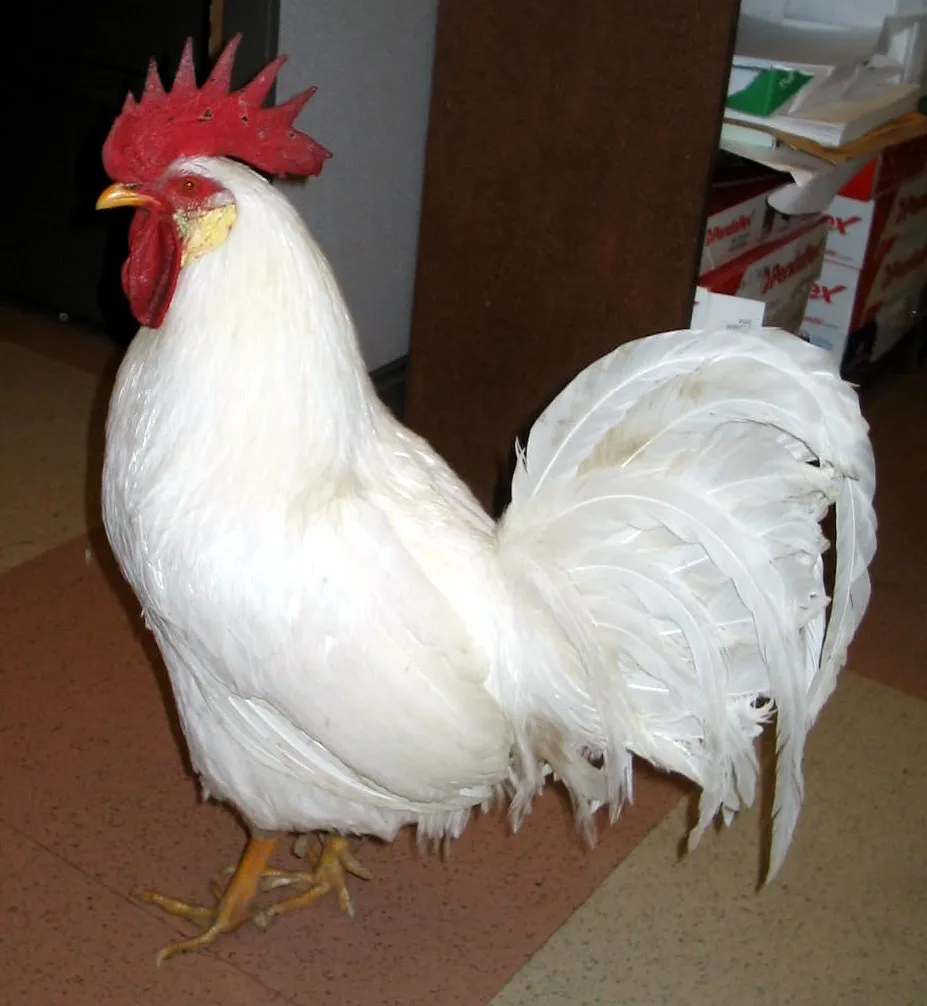
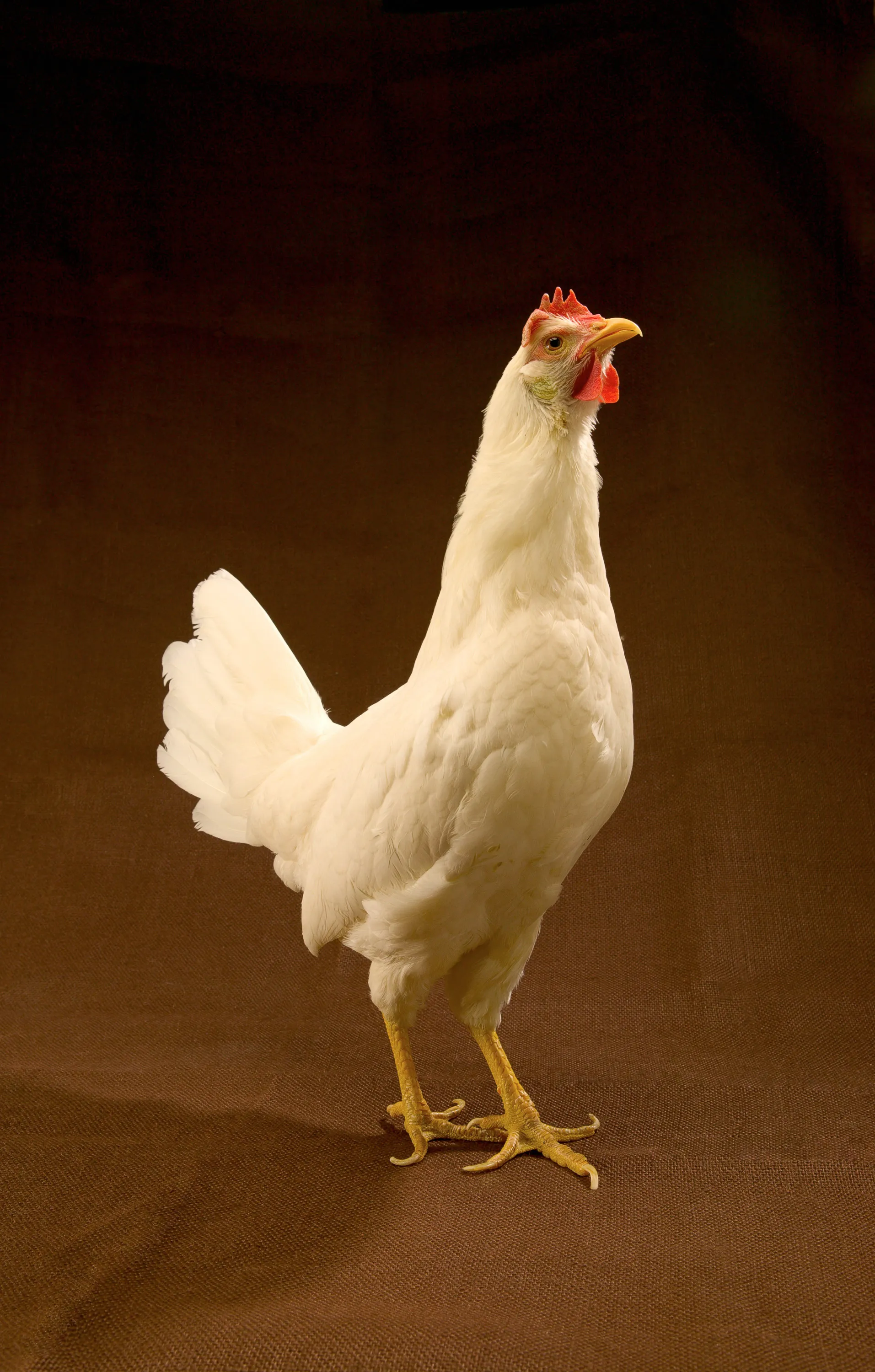
The world's most prolific white-egg layer and the foundation of most commercial laying flocks. Active, alert, and heat-tolerant — but flighty and not fond of being held.
| Size class | light |
|---|---|
| Weight (hen) | 4.5 lb (2.04 kg) |
| Weight (rooster) | 6 lb (2.72 kg) |
| Eggs per year | 290 |
| Egg color | white |
| Egg size | large |
| Climate tolerance | hot |
| Temperament | flighty |
| Goes broody | rarely |
| Noise level | loud |
| Beginner-friendly | No |
| Origin | Italy |
Is the Leghorn (White) right for your flock?
The Leghorn (White) is a light breed that's better suited to experienced keepers. Hens lay around 290 white eggs per year and tolerate hot climates well.
Temperament: flighty. Broodiness: rarely. Noise level: loud. Worth keeping in mind if you have close neighbors.
What this breed needs
- Coop space: about 3 sq ft per bird inside the coop. Run the numbers for your specific flock size in the coop size calculator.
- Climate fit: particularly heat-tolerant; less ideal in long, snowy winters without extra shelter.
- Eggs: a top-tier producer — among the most productive backyard breeds. For a month-by-month breakdown, see Leghorn Egg Production: How Many Eggs Per Year?.


History
The Leghorn is a Mediterranean-class egg breed from Tuscany, Italy, and it is the bird behind the commercial white-egg industry worldwide — but the “non-industrial” and “industrial” Leghorns are effectively two different stories, and keeping them straight matters on this page.
The Livestock Conservancy states that the exact origins are unknown, but Leghorns were likely developed from one of the small landrace chickens in the Tuscan region — birds called Livornese (“from Livorno”) that were small but prolific layers requiring little feed. “Leghorn” is an Anglicization of Livorno, the Italian port city from which birds were first exported to America around 1828, and again in 1830–31. The white variety was initially called “Italian Fowls” or “White Spanish” and was described in the Poultry Bulletin in 1881 as “…white with disproportionately large combs and as precocious layers.” Brown Leghorns were imported separately by Mr. N.P. Ward around 1835; those early birds seem to have disappeared before the next importation (Conservancy).
The institutional import story picks up in 1852, when Captain Gates arrived in Mystic, Connecticut, with Brown Leghorns that the Conservancy calls “direct ancestors of today’s non-industrial flocks.” In 1853, F.J. Kinney received Brown Leghorns at Boston Harbor while a Mr. Simpson received White Leghorns. American fanciers began refining for color, refinement, and rose combs; a White Leghorn won the New York show in 1868. The breed’s egg-laying reputation was already established by this point — and it was around 1870 that “the combination of hardiness, rate-of-lay, and small appetite… turned American poultrymen’s heads” (Conservancy).
White Leghorns were exported from America to England by Mr. Tegetmeier around 1870; Lewis Wright imported Brown Leghorns in 1872. English breeders embraced the laying ability but crossed them with other breeds to increase size (Conservancy). Oklahoma State University’s breed page, referencing John L. Skinner’s UW–Madison circular A2880, does not elaborate on the English cross details.
The American Poultry Association recognized Leghorns in stages, all dates confirmed on the Conservancy breed page: Single Comb White (among the first recognized) in 1874, along with Black and Brown; Rose Comb Light Brown and Dark Brown in 1883; Rose Comb White in 1886; Single Comb Buff and Silver in 1894; Red, Black-Tailed Red, and Columbian in 1929; and Rose Comb Black, Buff, Silver, and Golden Duckwing in 1981. Oklahoma State University lists twelve APA-recognized varieties for large fowl, covering both single-comb and rose-comb forms in multiple colors. The Conservancy notes that the British Poultry Club recognizes additional Leghorn colors, but no institutional page fetched this pass publishes a specific count for British-standard colors — that detail is not claimed here.
Here is where the breed forks. Beginning around 1910, hybridized English Leghorns re-crossed the Atlantic and helped fuel the transition from farm fowl to the commercial poultry industry. The Conservancy states plainly: “Today a majority of Leghorns are of the industrial type and dominate white-egg production in America. The remaining non-industrial Leghorn chickens, which more closely resemble the original Italian imports, are in the hands of small breeders.” The American Egg Board independently confirms the commercial dominance: “Most U.S. laying hens are Single-Comb White Leghorns.” Colorado Egg Producers makes the same claim for commercial egg farms. Those are industry-fact statements, not breed-club marketing. The breed’s commercial descendants are the genetic backbone of modern Hyline, Dekalb, and other proprietary white-egg hybrid lines — but those hybrids are not pure Leghorns, and the Conservancy explicitly separates them.
On conservation status, the Livestock Conservancy lists Leghorn – Non Industrial as Recovering on its Conservation Priority List, confirmed on the live CPL page (accessed this pass). The Conservancy’s Heritage Chickens in American History page (March 2026) references the “recovering non-industrialized Leghorn.” The North American Leghorn Club, founded in 2015, is a relaxed, primarily web-based networking club for breeders of all Leghorn varieties — bantam and large fowl, single-comb and rose-comb — and hosts Eastern and Western National shows annually. An American Brown Leghorn Club, established in 1901, also exists (Facebook presence found; no full institutional page fetched this pass). Neither club replaces the Conservancy as the primary conservation-status source.
breeds.json description claim check: “The world’s most prolific white-egg layer” — verified through Conservancy (“excellent layer”), OSU (“primarily a layer… 200 or more eggs per year”), and the commercial-industry dominance confirmed by AEB and Colorado Egg Producers. The description’s wording is stronger than any single institutional source uses, but the underlying fact — White Leghorns dominate global white-egg production and top most breed-level egg counts — is well supported. “Foundation of most commercial laying flocks” — the Conservancy’s “dominate white-egg production” and AEB’s “Most U.S. laying hens are Single-Comb White Leghorns” support this. “Not fond of being held” — the Conservancy says Leghorns “are not a good breed for children or as a first breed for beginners who want ‘pets’ that they can cuddle,” and OSU describes them as “noisy” birds that “like to move about.” Consistent.
Care
Eggs. Institutional egg-count ranges span a wide band, reflecting the gap between non-industrial and industrial strains:
- Conservancy breed page: 150–320 large to extra-large white eggs per year.
- Oklahoma State University: “around 200 or more eggs per year.”
- Tractor Supply (commercial guidance): 280–300.
- Kalmbach Feeds (commercial guidance): 250–300.
- FlockGuide (commercial guidance): 280–320.
The Conservancy’s 150–320 band is the widest and most honest, reflecting the full range from underfed or unselected non-industrial birds to well-managed exhibition or light-production strains. OSU’s “200 or more” is a floor for maintained birds, not a ceiling. Tractor Supply, Kalmbach, and FlockGuide cluster in the 250–320 range, all above the Conservancy midpoint. Flockmath’s 290 sits inside every one of those bands — at the Conservancy’s midpoint, above OSU’s floor, and inside all three commercial ranges. For modeling: egg production calculator.
Weights. Conservancy and OSU agree: Male 6 lb, Female 4.5 lb (OSU adds cockerel 5 / pullet 4). Flockmath’s table uses hen 4.5 and rooster 6.0 — a clean match with no discrepancy to resolve.
Climate. breeds.json rates climate tolerance as hot, which is a partial truth. The Conservancy says Leghorns “are both cold and heat tolerant, though the rose-comb variety is better suited for cold locations as the large single comb is prone to frostbite.” OSU does not publish a temperature-range claim on its breed page. Freedom Ranger Hatchery (commercial) notes Mediterranean breeds like White Leghorns “handle dry Western heat well because they shed heat efficiently.” Multiple commercial guides confirm single-comb Leghorns’ large combs are frostbite-prone in cold, while the breed’s light body and active metabolism handle heat effectively. Flockmath’s hot field captures the breed’s Mediterranean heritage and heat strength, but it does not mean Leghorns cannot survive cold — it means single-comb birds need frostbite management in damp freezing conditions that breeds with pea or rose combs do not. The Conservancy explicitly says “both cold and heat tolerant.” That is a wider claim than breeds.json’s single “hot” tag. Rose-comb varieties genuinely shift the cold-tolerance equation; keeping that distinction visible is better than a one-word climate field.
Housing and foraging. The Conservancy warns that Leghorns “can fly” and “often roost in trees if given the opportunity.” They “tolerate confinement” but “can become bored if kept in too small an area” and “ideally need plenty of room to roam and a large coop.” OSU echoes: “Leghorns are capable of considerable flight and often roost in trees if given the opportunity.” For coop space by flock size, use the coop size calculator; for feed planning, see the feed consumption calculator.
Single-comb frostbite management. The Conservancy’s own sentence is the practical rule: single-comb Leghorns are frostbite-prone; rose-comb birds are better for cold. Extension frostbite guidance for single-comb breeds applies: Poultry Extension (Dr. Jacquie Jacob, University of Kentucky) flags combs, wattles, toes, damp bedding, and poorly ventilated coops; University of Minnesota Extension ties frostbite to moisture plus cold and recommends wooden roosts over metal or plastic. Leghorn hardiness does not cancel comb care on hard-freeze, damp nights — it just means the body handles cold fine while the comb does not.
Temperament
Institutional temperament language for Leghorns is consistent and blunt: active, flighty, noisy, not cuddly.
The Conservancy calls them “very active,” notes some strains “are known to be flighty and easily startled,” describes them as “busy, active chickens who prefer to hunt and scratch,” and states directly that they “are not a good breed for children or as a first breed for beginners who want ‘pets’ that they can cuddle.” The Conservancy adds: “They are noisy, so they are not good for an urban or suburban neighborhood.” OSU agrees: “A small, spritely, noisy bird with great style, Leghorns like to move about.” Flockmath’s fields — flighty temperament, loud noise, good_for_beginners: false — sit squarely inside that institutional band.
Broodiness. Both the Conservancy and OSU state Leghorns “rarely” or “not” go broody. The Conservancy adds they “aren’t the best mothers.” Flockmath’s rarely is consistent.
Foraging and mixed-flock dynamics. The Conservancy says non-industrial Leghorns “are not aggressive by nature, but if you want a mixed flock, they should be kept with breeds with similar temperaments rather than more docile breeds.” This is the institutional version of Flockmath’s flighty/not-beginner framing: Leghorns can work in a flock, but putting them with very calm, docile breeds creates a mismatch where the active Leghorns dominate resources and the quiet birds lose out. The Conservancy’s scratching/foraging emphasis is the positive side of the same active temperament: these are birds that want to work the ground, not sit in a nesting box.
No “pet” bird. The Conservancy’s language is the most explicit institutional statement on this point, and it is worth quoting directly rather than paraphrasing: Leghorns are “not a good breed for children or as a first breed for beginners who want ‘pets’ that they can cuddle.” This is not a flaw — it is the honest description of a breed built for production efficiency, not lap time. Flockmath’s good_for_beginners: false captures that accurately.
Health
No fetched Conservancy or extension page flags a Leghorn-specific infectious disease unique to the breed beyond ordinary chicken-keeping risks. Stating that gap is better than inventing a health chapter. One institutional lead does exist:
Marek’s disease vulnerability. Penn State Extension (Dr. Eva Wallner-Pendleton, DVM, ACPV) states explicitly: “Leghorns and light egg-type breeds tend to be more vulnerable to disease than meat-type breeds” when discussing Marek’s disease susceptibility. Marek’s is a herpes virus causing tumors and paralysis, preventable by day-old vaccination. This is an institutional, Leghorn-named vulnerability, not a generic chicken-keeping point. Vaccination at the hatchery is the standard preventive; the Penn State article details why and how. If purchasing Leghorn chicks, Marek’s vaccination status should be confirmed.
Comb frostbite (repeated from Care because it is a health outcome). Single-comb Leghorns’ large combs are frostbite-prone in damp cold (Conservancy; Tractor Supply; FlockGuide). If frostbite occurs, University of Minnesota Extension recommends consulting a veterinarian; severe untreated frostbite can mean permanent loss of comb, wattle, or foot, and pecking of injured tissue may require isolation.
Lifespan and laying intensity. The Conservancy notes that because Leghorns “are such prolific layers, the average life span of a laying hen is only 4–6 years.” This is the institutional version of the same production-vs-longevity tradeoff that extension sources describe for ISA Brown and other high-output layers (USU: “hybrids such as ISA Brown… high yield, shorter lifespan”). A heavy-laying Leghorn is not broken — she is doing what she was bred to do — but keepers should plan for a shorter laying career than with a dual-purpose heritage breed like Orpington or Sussex.
Nutrition. Hard layers need correct layer calcium and protein ratios. Conservancy Heritage FAQ context (used on this site’s ISA Brown profile): common store rations are often formulated for commercial hybrid birds, which includes Leghorn-class genetics. Follow label and extension feed guidance; do not assume bagged feed automatically balances for an active, high-output single-comb bird.
Beyond these management points, the breed’s documented hardiness, vigor, high fertility, and rapid feathering are resilience signals in the sourced literature — not immunity to parasites, respiratory problems from damp coops, or other husbandry-dependent risks.
Production Bird With a Heritage Face: The Bottom Line
If you want maximum white eggs from a lightweight, active bird with a genuine Italian paper trail and a Conservancy Recovering listing, the White Leghorn is the most institutionally documented choice available. Flockmath’s 290 eggs/year is inside the Conservancy’s 150–320 band, above OSU’s 200+ floor, and aligned with Tractor Supply’s 280–300, Kalmbach’s 250–300, and FlockGuide’s 280–320. 290 is not the commercial hybrid ceiling — that number belongs to Hyline and Dekalb lines built from Leghorn genetics but no longer pure Leghorns. It is a realistic target for a well-managed non-industrial single-comb White Leghorn.
Expect a bird that is very active, flighty, noisy, and not a lap pet (Conservancy; OSU). It can fly, will roost in trees if allowed, and should not be housed with very docile breeds. It thrives on range as a forager and is a small eater relative to output — the same hardiness-to-appetite ratio that made it commercially dominant. It is heat-tolerant by Mediterranean heritage, but single-comb birds need frostbite management in wet cold (rose-comb Leghorns shift that equation). Marek’s vaccination matters for this breed class specifically (Penn State Extension).
You are buying a Recovering heritage bird — not the industrial hybrid it spawned, and not a hybrid you can breed true — with APA White recognition since 1874, non-industrial lines that still resemble the original Italian imports, and a documented commercial legacy that no other single breed can match. The breeds.json description’s “world’s most prolific white-egg layer” and “foundation of most commercial laying flocks” claims are institutionally supported when scoped correctly: White Leghorns dominate U.S. white-egg production (American Egg Board; Colorado Egg Producers), but the commercial birds are industrial-selected descendants, not the same non-industrial heritage birds the Conservancy lists as Recovering.
Sources
- Recovering status; Tuscan origin / Livornese landrace; export 1828 and 1830–31; Captain Gates 1852; Kinney/Simpson 1853; 1868 NY show; English import ~1870; APA varieties and years (1874–1981); 150–320 eggs/year; “not good for children”; “not a good first breed for beginners”; noisy/flighty; rose-comb cold note; foraging/scratching; “both cold and heat tolerant”; can fly/roost in trees; confinement tolerance; weights 6/4.5; short laying lifespan 4–6 years; non-industrial vs industrial split: The Livestock Conservancy — “Leghorn – Non Industrial – Chicken”
- Recovering status confirmed on live CPL: The Livestock Conservancy — Conservation Priority List
- “Recovering non-industrialized Leghorn” referenced in heritage-chickens article: The Livestock Conservancy — “Heritage Chickens in American History”
- Origin Italy/northern Italy; Captain Gates mid-1800s; “most numerous breed in America”; single or rose comb; rarely broody; “200 or more eggs per year”; weights 6/4.5/5/4; twelve APA varieties listed; yellow skin; foragers; “capable of considerable flight”; “noisy”: Oklahoma State University — “Leghorn Chickens”
- “Most U.S. laying hens are Single-Comb White Leghorns”; early 1900s egg-farm history: American Egg Board — “Egg Farming History”
- “Leghorns and light egg-type breeds tend to be more vulnerable to disease than meat-type breeds” (Marek’s susceptibility); vaccination guidance; disease details: Penn State Extension — “Marek’s Disease in Chickens” Dr. Eva Wallner-Pendleton, DVM, MS, ACPV.
- North American Leghorn Club — founded 2015, all varieties, Eastern/Western Nationals: North American Leghorn Club
- “Most commercial egg farms use the Single Comb White Leghorn breed”: Colorado Egg Producers — Colorado Egg Reader (2016) (PDF, fetched this pass.)
- Hatchery guidance (labelled): Cackle Hatchery — White Leghorn (page returned 403 this pass; URL recorded for reference: https://www.cacklehatchery.com/product/white-leghorn/)
- Commercial guidance (labelled): Tractor Supply — Leghorn Breed Guide (280–300 eggs; frostbite/comb warning; active/flighty temperament): https://www.tractorsupply.com/tsc/cms/life-out-here/the-coop/poultry-breeds/leghorn-breed-guide
- Commercial guidance (labelled): Kalmbach Feeds — “Leghorn Chickens: Beginner Care Tips & Egg-Laying Guide” (250–300 eggs): https://www.kalmbachfeeds.com/blogs/chickens/leghorn-chickens-a-beginners-guide
- Commercial guidance (labelled): FlockGuide — “Leghorn Chicken Breed Guide” (280–320 eggs; cold tolerance as weak spot; rose comb better for cold): https://www.flockguide.com/articles/leghorn-chicken-complete-breed-guide
- Frostbite moisture/ventilation (single-comb breeds generally): University of Minnesota Extension — “Caring for Chickens in Cold Weather”
- Comb frostbite risk and prevention: Poultry Extension — “Frostbite in Chickens” Dr. Jacquie Jacob, University of Kentucky.
Ours: framing Flockmath’s 290 as inside Conservancy 150–320 / OSU 200+ / Tractor Supply 280–300 / Kalmbach 250–300 / FlockGuide 280–320; distinguishing “non-industrial heritage Leghorn” from “industrial descendants that dominate commercial flocks” as the structural framing device; treating breeds.json’s climate hot as a partial truth against Conservancy’s explicit “both cold and heat tolerant” while explaining the single-comb frostbite nuance; noting the Cackle Hatchery page returned 403 this pass; naming Penn State Extension’s Leghorn-named Marek’s vulnerability as an institutional, breed-specific health lead; identifying the Conservancy description’s “world’s most prolific” and “foundation of most commercial” claims as institutionally supported when scoped to U.S. white-egg production dominance (AEB, Colorado Egg Producers) rather than as a global breed-level absolute; dropping Wikipedia as a source per site source-hierarchy rules (no tertiary encyclopedia used in any of the 23 existing profiles); noting that the British Leghorn Club’s “eighteen colors” count was only available from a Wikipedia-cited reference (Roberts 2008 / Leghorn Club standards page) and could not be independently verified from a fetched institutional page this pass, so it is not claimed; and leaving breeds.json (290 eggs, hot, flighty, rarely, loud, false for beginners, 4.5/6.0) unchanged this pass.