
bantam breed · United Kingdom
Sebright
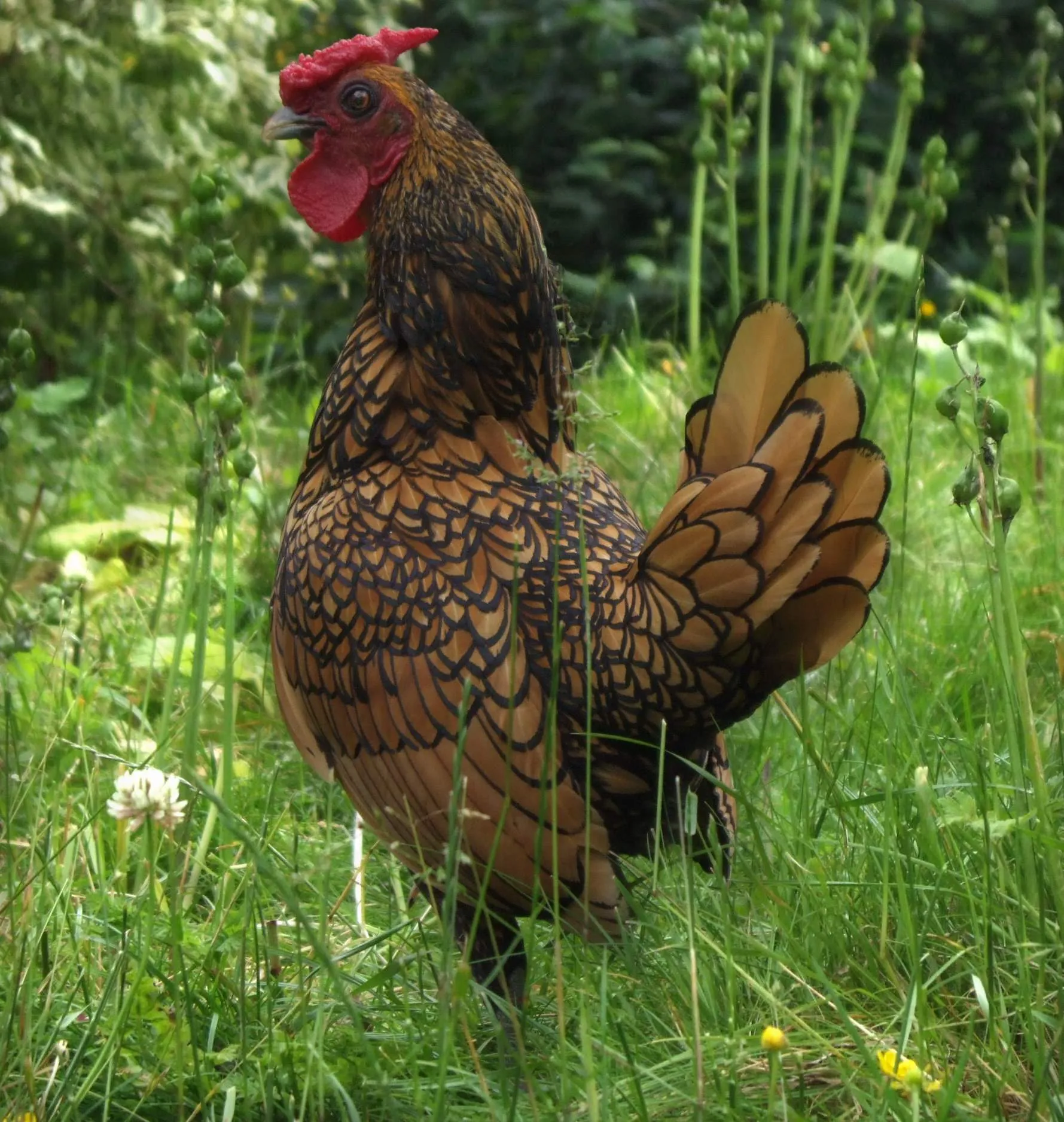
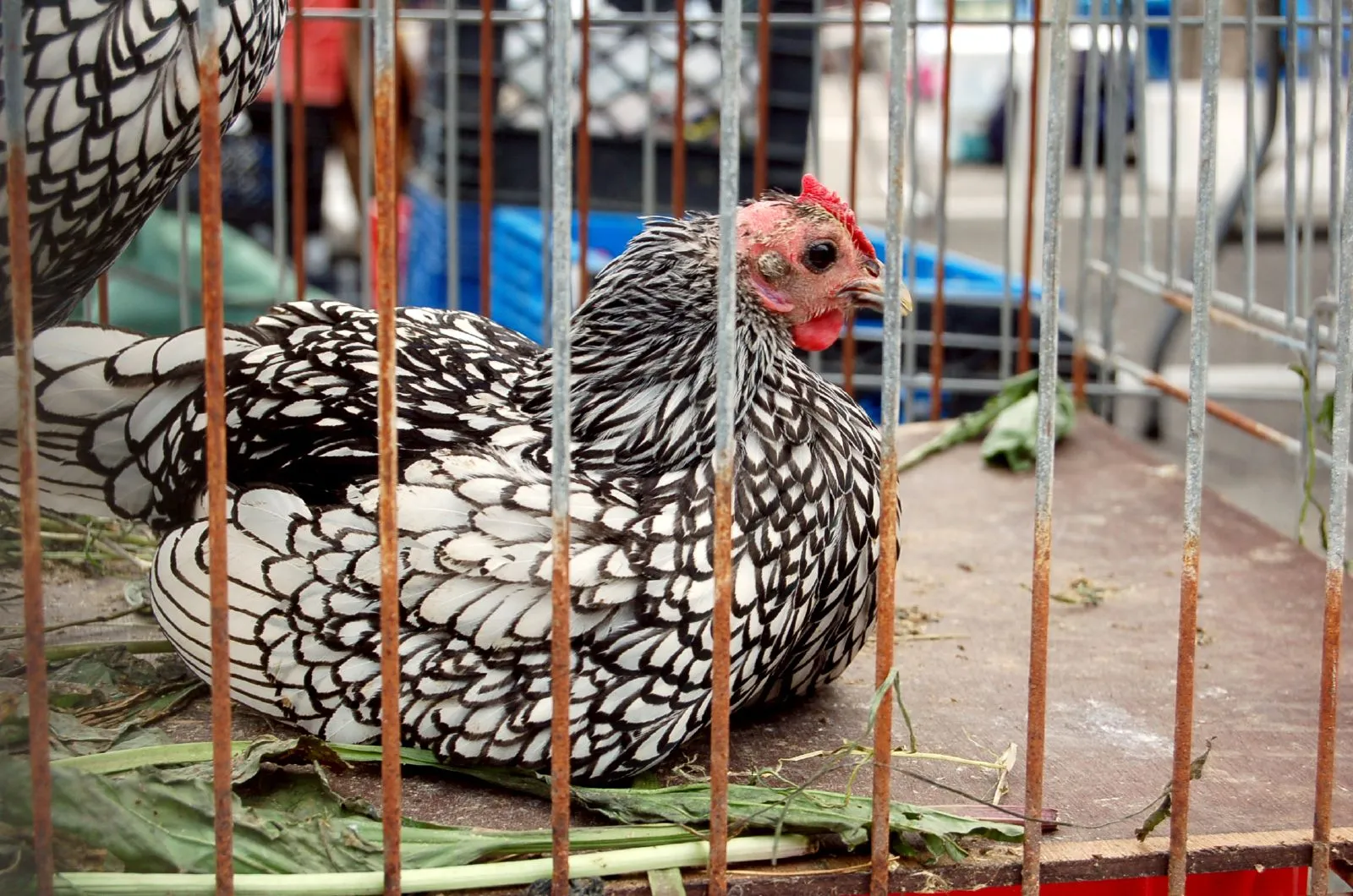
A true bantam (no large counterpart) with elegant laced plumage. Mostly an ornamental breed; sparse layers but striking show birds.
| Size class | bantam |
|---|---|
| Weight (hen) | 1.25 lb (0.57 kg) |
| Weight (rooster) | 1.375 lb (0.62 kg) |
| Eggs per year | 80 |
| Egg color | cream |
| Egg size | small |
| Climate tolerance | temperate |
| Temperament | active |
| Goes broody | rarely |
| Noise level | moderate |
| Beginner-friendly | No |
| Origin | United Kingdom |
Is the Sebright right for your flock?
The Sebright is a bantam breed that's better suited to experienced keepers. Hens lay around 80 cream eggs per year and tolerate temperate climates well.
Temperament: active. Broodiness: rarely. Noise level: moderate.
What this breed needs
- Coop space: about 2 sq ft per bird inside the coop. Run the numbers for your specific flock size in the coop size calculator.
- Climate fit: best in moderate climates without temperature extremes.
- Eggs: a moderate layer — picked more for personality or looks than raw output. For a month-by-month breakdown, see How Many Eggs Does a Sebright Lay Per Year?.


History
The Sebright is one of the oldest British bantams, and its origin is unusually well-documented for a chicken breed — because its creator was a named historical figure with a public record. The Livestock Conservancy states: “The Sebright was developed by Sir John Saunders Sebright, the 7th Baronet of Besford, Worcestershire and a Member of Parliament for Herefordshire in the early 1800s, and is one of the oldest British bantams.” Oklahoma State University confirms: “Developed in approximately 1800 by Sir John Sebright, 7th Baronet of Besford, Worcestershire, this breed was designed to be a small bantam with laced plumage.”
Sir John Saunders Sebright was a “gentleman farmer” who wanted to create a bantam breed with well-defined lacing (Conservancy). His recipe for creating the breed is unknown, but in the process, “he traveled the countryside collecting ‘odd’ and ‘gamey’ birds from the local poultry flocks, and may have imported birds from other countries” (Conservancy). OSU is more specific about the likely foundation stock: “It is believed that this selective breeding process took Sebright twenty years of mixing Nankin and Rosecomb chickens with native bantams and Polish breeds. It is believed the golden colored Sebrights was produced from a buff bantam Nankin hen, and the silver produced from a white Rosecomb cockerel.” The Conservancy adds that “some believe he may have used the Nankin, Polish, and Hamburg chickens.”
The most difficult part of the creation was getting the bird to breed true with the desired lacing. “The Sebright was finally introduced in 1810 – after about 20-30 years of work!” (Conservancy). The Sebright Club of Great Britain — which describes itself as “probably the oldest poultry breed club in the world” and notes it is celebrating 213 years — confirms the breed’s early-19th-century origin and its status as “one of the oldest recorded British ‘true bantams’ — meaning it is a miniature bird with no corresponding large version of the breed.”
The Sebright was admitted to both the Poultry Club of Great Britain Standard and the American Poultry Association Standard of Perfection in 1874 (Conservancy; OSU). There are two accepted colors: Gold Laced and Silver Laced — “gold or silver almond-shaped, short, tight feathers edged sharply in black (‘laced’)” (Conservancy). The color is the same on both males and females, “which is unusual in most breeds of chicken” (Conservancy). This is the hen-feathering trait, discussed under Health.
The Sebright Club of Great Britain traces its own founding to approximately 1813, making it, by its own account, the first single-breed poultry club. The club’s website notes: “This year we celebrate 213 years of The Sebright Club — which was the very first poultry club of its kind.” The Poultry Club of Great Britain’s breed-club directory lists the Sebright Club with a contact in Cornwall. No U.S.-based Sebright breed club was found with a fetchable institutional page; the Sebright Club of America is mentioned on FeatherSite but has no active website.
Conservation status. The Livestock Conservancy lists Sebright as Watch on its Conservation Priority List. The breed page’s own “Breed Facts” box at the bottom also says Watch, so the CPL and the breed page agree on this one — no internal contradiction, unlike some other breeds in this series.
Care
Eggs. Institutional egg-count ranges:
Livestock Conservancy: “only lay about 60-80 small (bantam-size small) eggs per year.” Oklahoma State University: “They lay small and very few white eggs, from 50 to 80 a year.” Cackle Hatchery (fetched via Wayback Machine, capture 28 April 2025): Egg Production “Fair”; Egg Size “Small”; Cream or Tinted.
No institutional source provides a specific annual integer above 80. Flockmath’s 80 sits at the ceiling of every fetched range. This is honest for a breed where the Conservancy explicitly calls laying “poor” and OSU calls it “an even poorer egg breed” than it is a meat breed. For modeling: egg production calculator.
The hens have “poor brooding instincts” (OSU), and the Conservancy notes they are “not broody” and “do not have good maternal instinct, so if you want to hatch eggs you would do better with a surrogate mother.” Cackle Hatchery classifies them as “Non Setters.” The breeds.json tag broody: “rarely” is institutionally supported — this is a breed where broodiness is essentially absent.
Fertility and breeding. Cackle Hatchery (fetched directly, Golden Sebright Bantam page) reports fertility at 40–55%, which is lower than most breeds. The Conservancy notes that “some strains are more fertile than others.” OSU adds a specific management constraint: “Due to males needing warmth for breeding, the Sebright is ideally bred in April, May or June.” Cackle Hatchery lists a mating ratio of 8 females to 1 male, suggesting male fertility is a known challenge. The Sebright Club offers “support and advice — whether you may have a welfare concern you may have, problems with breeding and hatching, housing, genetics or anything else.”
Weights. OSU lists males at 22 oz (1.375 lb) and females at 20 oz (1.25 lb). The Conservancy confirms: “Males weigh 22 oz. and females 20 oz.” The Poultry Club of Great Britain’s own Sebright breed standard sets cocks at 620g (22 oz). Flockmath’s table uses hen 1.25 lb and rooster 1.375 lb, matching both figures exactly.
Climate. The Conservancy states: “They do not handle cold and damp well, and do better overall in warm climates, so care must be taken if you want to keep them in cooler climates.” Flockmath rates climate tolerance as “temperate.” The Conservancy’s language suggests the breed is better suited to warm than cold — “temperate” is generous for a breed the Conservancy explicitly warns about in cold/damp conditions. The rose comb (discussed under Health) reduces frostbite risk relative to a large single comb, but the breed’s small body mass and the Conservancy’s cold-weather warning mean that keepers in cold climates need to provide extra shelter.
Housing. The Conservancy warns: “They can fly into trees to roost, so although they like to forage, it is best to keep them in a way that they can’t get out of reach as they can be difficult to catch!” This is a genuine containment consideration — Sebrights are active flyers for bantams. Cackle Hatchery (fetched directly) lists roost height at 2–4 feet, suggesting they roost at moderate height by preference. For coop space by flock size, use the coop size calculator; for feed planning, see the feed consumption calculator.
Temperament
The Conservancy describes Sebrights as “Active, spunky, and easily tamed” — but adds the important qualification that “they are curious and prefer to be active. They are not a cuddly breed.” OSU notes they are “easily tamed” but lists them as “a poor choice for beginners.” Cackle Hatchery rates temperament as “Docile/Flighty” — a split rating that captures the breed’s dual nature: tameable but not docile in the Orpington/Cochin sense.
Flockmath’s temperament: “active” and good_for_beginners: false sit squarely inside that institutional band. The Conservancy explicitly warns that Sebrights are “challenging for a beginner due to poor laying” — the good_for_beginners: false flag reflects production difficulty and temperament, not aggression.
The Conservancy adds that Sebrights “make good birds for 4H as show birds” — this is a practical endorsement for young handlers who want exhibition experience, even though the breed isn’t beginner-friendly for egg production. The Sebright Club’s own welcome message reinforces this: the club exists to support both “just two little Sebrights in the garden as companions” and those who have “bred and shown with great success.”
Noise. The Conservancy notes: “This breed can be very vocal if agitated.” Flockmath rates noise as “moderate.” No institutional source directly contradicts “moderate,” but the Conservancy’s “very vocal if agitated” language suggests that noise can spike above moderate under stress. The Sebright is not a quiet breed when disturbed.
Flight. The Conservancy’s tree-roosting warning (discussed under Care) indicates that Sebrights can fly effectively for bantams. This is unusual — most bantam breeds in this catalog (Silkie, Cochin) are poor flyers. The Sebright’s large wings relative to body size (“Their wings are large for the size of the bird and angle towards the ground,” Conservancy) explain this capability. It affects containment, predator evasion, and flock management.
Health
The Conservancy states plainly: “They are susceptible to Marek’s disease, so should be vaccinated.” OSU confirms: “They’re a poor meat breed, and an even poorer egg breed” — but does not elaborate on disease susceptibility. The Marek’s susceptibility is the breed’s primary institutional health flag. No other breed-specific infectious disease was found in any fetched source.
Hen-feathering. This is the Sebright’s most genetically distinctive trait, and the institutional mechanism is well-characterized. Poultry Extension (Dr. Jacquie Jacob, University of Kentucky) states: “The two breeds with hen-feathered males have a single gene mutation that results in excess production of the enzyme aromatase in several tissues, including feather follicles. Aromatase is the enzyme responsible for the conversion of androgens to estrogens. As a result, the feather follicles of male Sebrights and Campines have excess estrogen. The level of estrogen in the feather follicles is sufficient to feminize the growing feathers.”
In plain terms: the mutation causes male Sebrights to produce too much aromatase, which converts their androgens to estrogens in the feather follicles, producing rounded (hen-like) feathers instead of the pointed hackle and saddle feathers that normally distinguish roosters. The mutation is autosomal — it is present in both sexes — but the effect is only visible in males because females already have estrogen-dominated feather follicles. Somes (1984, Poultry Science) concluded that the trait “is inherited as an autosomal codominant” based on a study of 383 offspring from controlled matings. The OMIA (Online Mendelian Inheritance in Animals) database entry for henny feathering (OMIA:000452-9031) lists the Sebright and Campine as the two affected breeds and references the aromatase mechanism.
The practical consequence: Sebright roosters look strikingly similar to hens in plumage. Sexing Sebrights relies on comb size (males have larger rose combs ending in a “leader” spike), wattles (larger in males), and body shape (males are stockier with shorter legs) rather than feather shape. The Conservancy notes that “males have shorter, stockier legs than the females” and that both sexes have rose combs, “but much smaller” in females. For keepers acquiring unsexed chicks, this is a genuine identification challenge — the same hen-feathering that makes the breed visually distinctive also makes visual sexing harder than for any other breed in this catalog.
Rose comb. The Conservancy describes the Sebright’s comb as a “mulberry (desired) or deep red color rose comb that ends in a straight, horizontal point called a ‘leader’ on the males, and a similar but smaller comb on the females.” The rose comb sits flat against the head, reducing frostbite risk compared to a large single comb. This is relevant given the breed’s cold-weather vulnerability noted by the Conservancy — the comb type partially offsets the climate concern, but does not eliminate it.
Slate blue legs and skin. The Conservancy notes: “Legs and skin are slate blue in color.” This is a breed-standard characteristic, not a health concern, but it is distinctive and worth noting for identification.
Lifespan. No institutional source provides a specific lifespan figure for Sebrights. This is an honest gap, same as for Silkie.
Ornamental by Design, Not by Default
The Sebright is the breed where ornamental poultry began — not as a modern hobby, but as a deliberate 19th-century creation by a named geneticist-breeder who spent 20+ years engineering a specific aesthetic. Sir John Sebright didn’t discover this bird; he invented it. The laced plumage, the pigeon-like compact body, the rose comb with its horizontal leader — these are designed features, not natural ones.
The tradeoff is real and institutionally documented: 60–80 small eggs per year (Conservancy), poor broodiness (OSU; Cackle: “Non Setters”), low fertility (Cackle: 40–55%), Marek’s susceptibility (Conservancy; OSU), cold-weather vulnerability (Conservancy), and a hen-feathering mutation that makes sexing a genuine skill challenge. The breed is “challenging for a beginner due to poor laying” (Conservancy) — not because it is aggressive or fragile, but because it is optimized for show, not utility.
For the right keeper — someone who wants the oldest documented bantam breed in the English-speaking world, with a traced lineage to a specific 19th-century breeder, a breed club that predates most national poultry organizations, and laced plumage that genetically feminizes the rooster’s feathers — the Sebright is unmatched. For someone wanting eggs, meat, or a self-sufficient flock, it is the wrong breed entirely. The Conservancy’s Watch status is not a crisis — the breed has a dedicated club and global exhibition community — but it is a reminder that ornamental breeds survive because people choose to maintain them, not because they are economically self-sustaining.
Sources
- Developed by Sir John Saunders Sebright, 7th Baronet, early 1800s; 20–30 years of selective breeding; Nankin/Polish/Hamburg foundation stock; introduced 1810; admitted to Poultry Club of Great Britain and APA Standard 1874; Gold Laced and Silver Laced; same color on both sexes; compact pigeon-like body; large wings angling toward ground; rose comb with horizontal leader; slate blue legs and skin; large round black eyes; 60–80 small eggs/year; poor laying; not broody; good maternal instinct absent; can fly into trees to roost; active/spunky/easily tamed/not cuddly; vocal if agitated; good 4H show birds; Watch status; do not handle cold/damp well; warm climates preferred; susceptible to Marek’s — vaccinate: The Livestock Conservancy — “Sebright Chicken”
- One of oldest British bantams; developed ~1800 by Sir John Sebright; 7th Baronet of Besford; selective breeding mixing Nankin and Rosecomb with native bantams and Polish; golden from buff bantam Nankin hen; silver from white Rosecomb cockerel; APA recognized 1874 Golden and Silver; true bantam; males 22 oz / females 20 oz; hens and cocks look very similar; short backs, full convex breasts, large hanging wings, full tails above horizontal; males large combs ending in spike; both sexes red rounded wattles; easily tamed; poor choice for beginners; susceptibility to Marek’s disease; poor meat breed, even poorer egg breed; small white eggs 50–80/year; poor brooding instincts; primarily ornamental; males need warmth for breeding — April/May/June: Oklahoma State University — “Sebright Chickens”
- Founded ~1813; “probably the oldest poultry breed club in the world”; celebrating 213 years; Sir John Saunders Sebright named; oldest recorded British true bantams; selective breeding for ornamental beauty; membership; breeders directory; show dates and results; support and advice on welfare, breeding, hatching, housing, genetics: The Sebright Club of Great Britain
- Hen-feathering: single gene mutation causing excess aromatase production in feather follicles; aromatase converts androgens to estrogens; excess estrogen feminizes growing feathers in males; Sebright and Campine are the two affected breeds; autosomal mutation present in both sexes; also affects comb/wattle growth (androgens) but spur growth is androgen-independent: Poultry Extension — “Causes of Hen-Feathering in Male Chickens” Dr. Jacquie Jacob, University of Kentucky.
- Henny-feathering inheritance: autosomal codominant; enhanced estrogen synthesis in extragonadal tissues; 383 offspring studied from Sebright matings: Somes, R.G. Jr. (1984). “Inheritance of the henny-feathering trait of the Sebright bantam chicken.” Poultry Science, 63(1):5–10. PMID: 6715868. (Abstract fetched from PubMed; full text not directly accessed — journal paywalled.)
- OMIA entry for henny feathering (OMIA:000452-9031): autosomal; Sebright and Campine breeds; aromatase mechanism; references Morgan 1920 and Somes 1984: Online Mendelian Inheritance in Animals (OMIA)
- Hatchery guidance (labelled; fetched via Wayback Machine, capture 28 April 2025): Cackle Hatchery — Golden Sebright Bantam — Egg Production: Fair; Egg Size: Small; Egg Shell: Cream or Tinted; Temperament: Docile/Flighty; Fertility: 40–55%; Broody: Non Setters; Mating Ratio: 8 Females to 1 Male; Roost Height: 2–4 feet; Weights Hen 20 oz / Rooster 22 oz; APA 1874; TLC Watch; “developed our bloodline or strain of pure Sebright Bantams since 1979”; description notes males “do not have sickle feathers” and birds “love to pose and are very spirited.”
- Watch status confirmed on CPL: The Livestock Conservancy — Conservation Priority List
Ours: The synthesis connecting Sebright’s hen-feathering to the breed’s unusual sexing challenge (roosters look like hens, making visual identification harder than for any other breed in this catalog); framing the breed as “where ornamental poultry began” by connecting Sir John Sebright’s deliberate 20+ year breeding program to the modern exhibition tradition; noting the 40–55% fertility rate as unusually low and connecting it to the Sebright Club’s breeding-support mission; and flagging Flockmath’s rooster weight (1.5 lb = 24 oz) as slightly above the institutional standard (22 oz) while noting the hen weight matches exactly.