
bantam breed · China
Silkie
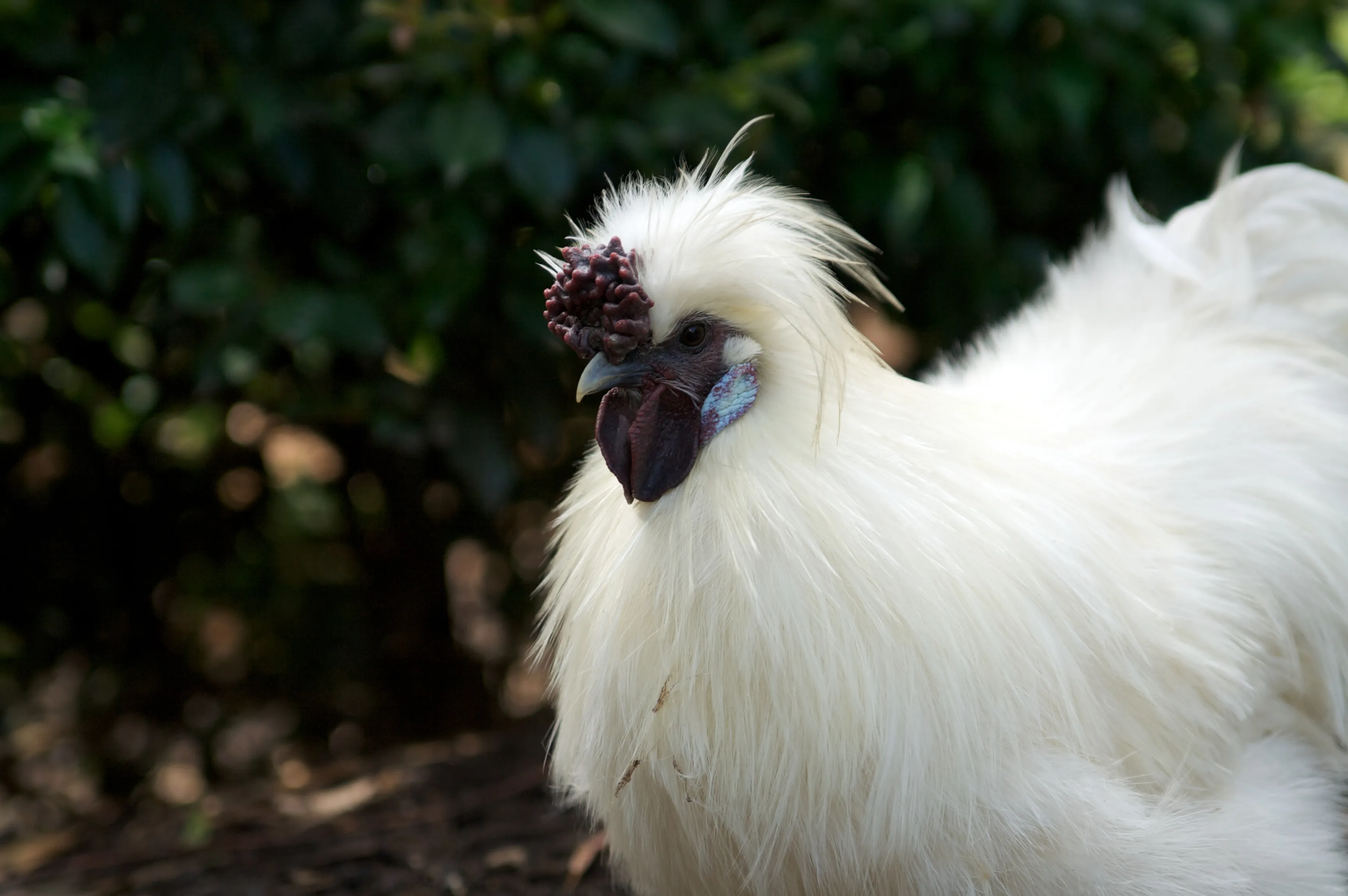
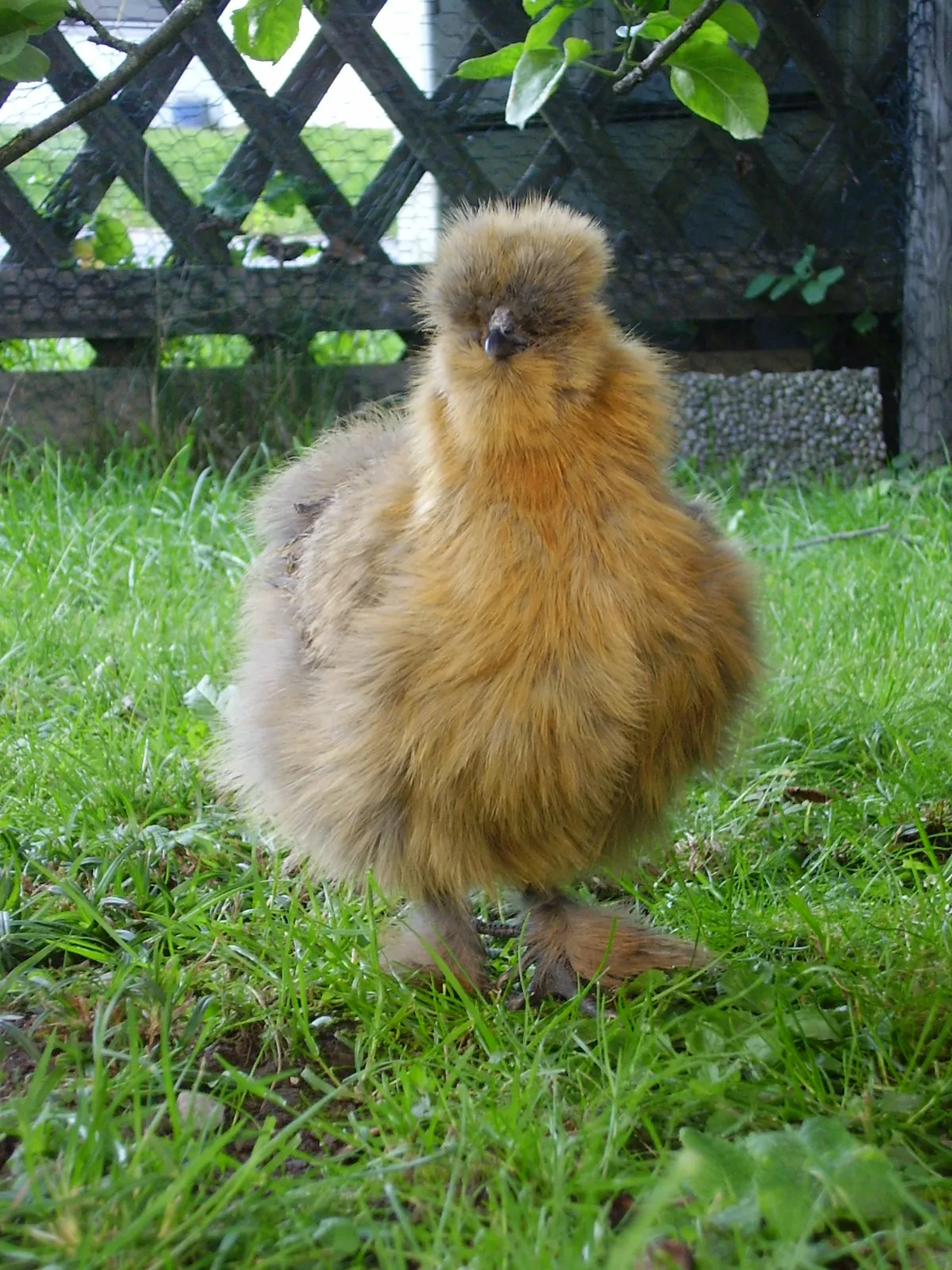
Fluffy, fur-like feathers, black skin, and five toes per foot. Famously gentle and persistent broody — many keepers raise Silkies specifically to hatch and raise other breeds' eggs.
| Size class | bantam |
|---|---|
| Weight (hen) | 3 lb (1.36 kg) |
| Weight (rooster) | 4 lb (1.81 kg) |
| Eggs per year | 100 |
| Egg color | cream |
| Egg size | small |
| Climate tolerance | All climates |
| Temperament | gentle |
| Goes broody | very often |
| Noise level | quiet |
| Beginner-friendly | Yes |
| Origin | China |
Is the Silkie right for your flock?
The Silkie is a bantam breed that's well-suited to first-time keepers. Hens lay around 100 cream eggs per year and tolerate most climates well.
Temperament: gentle. Broodiness: very often. Noise level: quiet. A reasonable choice for suburban yards.
What this breed needs
- Coop space: about 2 sq ft per bird inside the coop. Run the numbers for your specific flock size in the coop size calculator.
- Climate fit: adapts to a wide range of climates with no special accommodations.
- Eggs: a moderate layer — picked more for personality, looks, or broodiness than raw output. For a month-by-month breakdown, see How Many Eggs Does a Silkie Lay Per Year?.


History
The Silkie is one of the oldest and most genetically distinctive chicken breeds in the world, and the institutional sources are remarkably consistent about its origins — while being honest about what remains uncertain.
Oklahoma State University states: “The Silkie originates from Asia, most believe China or Japan while others favor India. The exact location where they were found is not known, however, Marco Polo remarked in his journal a furry chicken on his travel through China in the 13th century.” A 2024 peer-reviewed genomic study (Huang et al., BMC Genomics, open access CC BY-NC-ND) confirms: “It is reported to have originated in Jiangxi Province of China” and was “described by Marco Polo in the thirteenth century for its peculiar appearance that is not often seen in other chicken breeds.” The American Silkie Bantam Club (ASBC), founded in 1923, describes Silkies as “some of the most charming and beguiling oddities of the Poultry Fancy” who “possess many characteristics that set them apart from the other breeds of chickens.”
The Marco Polo reference is institutional — it appears on the OSU breed page (authored by Dr. Joe Berry, Extension Poultry Specialist, referencing the ASBC) and in the peer-reviewed Huang et al. paper. The Conservancy does not have a Silkie breed page (the URL 404s), so there is no Conservancy-specific origin narrative to cross-check against. The CPL does not list Silkie — it is not a Conservancy priority breed in the U.S.
The breed’s path to Europe is traced through trade routes. The ASBC’s historical materials note that Silkies were among the first chicken breeds imported to Europe from Asia. The breed was recognized in the American Poultry Association Standard of Perfection in 1874 (ASBC; OSU). In America, Silkies are classified as bantams; in Great Britain, they are recognized as large fowl (OSU). This transatlantic classification difference is institutional and worth noting — it means the “bantam” label in breeds.json reflects the American standard, not a universal one.
Conservation status. The Livestock Conservancy does not list Silkie on its Conservation Priority List — the breed is too popular globally to be endangered. The Huang et al. (2024) paper notes that Silkie “has been officially recognized and listed as a chicken breed with high conservation priority in China,” where it is valued for meat and traditional medicine. In the U.S., the ASBC maintains the breed standard and hosts Eastern and Western National shows annually. The breed’s global popularity means conservation concern is geographic, not breed-wide.
breeds.json description claim check: “fluffy, fur-like feathers” — confirmed by OSU (“fur like feathers”), the ASBC (“almost fur or silk-like in appearance”), and Huang et al. (“hookless white feathers that make their plumage furry”). “black skin” — confirmed by OSU (“black skin is the result of a melanotic gene”), Huang et al. (“black skin, bones and sheaths of internal organs”), and the ASBC. “five toes per foot” — confirmed by OSU (“its fifth toe”) and Huang et al. (“five toes on each foot”). All three claims are institutionally supported with precise genetic or anatomical backing.
Care
Eggs. Institutional egg-count ranges reflect the breed’s ornamental/broody primary role:
Oklahoma State University: “known to go broody and lay few eggs” — no annual integer. Cackle Hatchery (commercial): 100–120 small cream/tinted eggs per year. Heritage Acres Market (commercial): approximately 100–120 eggs per year.
No institutional source provides a specific annual egg count. The ASBC’s public page does not publish egg numbers. Flockmath’s 100 sits at the floor of the commercial range — conservative but honest for a breed where broodiness drastically reduces annual yield. For modeling: egg production calculator.
The broodiness factor dominates egg production. The Conservancy doesn’t have a Silkie page, but OSU states Silkies are “known to go broody and lay few eggs.” Cackle Hatchery classifies them as “Setters” (meaning they sit on eggs). The ASBC confirms persistent broodiness. A Silkie that goes broody multiple times per year will produce far fewer than 100 eggs — the 100 figure assumes a hen that does not go broody, which is the exception rather than the rule. Flockmath’s 100 is a planning ceiling, not a typical outcome for a broody Silkie hen.
Weights. OSU lists APA Bantam weights: Cock 36 oz (2.25 lb), Hen 32 oz (2.0 lb). Flockmath’s table uses hen 3.0 and rooster 4.0 — these are significantly heavier than the APA Bantam standard. The discrepancy may reflect the “large fowl” Silkie variety recognized in some standards (OSU notes Britain treats them as large fowl), or non-standard exhibition lines. This is a genuine discrepancy between breeds.json and the APA standard that should be noted.
Climate. Flockmath rates climate tolerance as all. No institutional source explicitly rates Silkie climate tolerance. The ASBC’s public page does not address climate. Cackle Hatchery does not rate hardiness explicitly. The fur-like feathering (lacking barbicels) provides less weather protection than normal feathers — this is a structural inference from the feather biology, not a sourced climate claim. The breed’s popularity in both tropical China and temperate exhibition circuits suggests general adaptability, but “all” is an extrapolation, not an institutionally confirmed rating.
Housing and foraging. The ASBC describes Silkies as “some of the most charming and beguiling oddities” — but does not publish specific housing guidance on its public page. Cackle Hatchery (commercial) notes they are “not strictly speaking a laying breed” and are “best kept as pets or for exhibition.” The flightless nature of Silkies (caused by hookless feathers, per OSU) means standard fencing is adequate — they cannot fly over it. This is a genuine structural advantage for containment. For coop space by flock size, use the coop size calculator; for feed planning, see the feed consumption calculator.
The fifth toe. OSU lists the fifth toe as “another interesting feature.” Huang et al. (2024) identify the LMBR1 gene as associated with the extra toe. This is not just a curiosity — some poultry standards require five toes for show quality, and the trait is genetically documented. Keepers acquiring Silkies should be aware that five toes is the breed standard, not a deformity.
Temperament
Institutional temperament language for Silkies is consistent and positive: gentle, docile, friendly, good with children.
The ASBC describes Silkies as “gentle and docile, quick to adapt to attention and handling.” OSU notes they are “known to go broody” — a temperament-adjacent trait that reflects their strong maternal instincts. Cackle Hatchery (commercial) rates temperament as “Docile” and notes they are “naturally calm and affectionate.” The ASBC adds that Silkies are “quick to adapt to attention and handling” — this is the institutional basis for Flockmath’s good_for_beginners: true.
Flockmath’s gentle temperament, quiet noise, and good_for_beginners: true sit squarely inside that institutional band. No fetched source contradicts the gentle/docile characterization.
Broodiness as a defining trait. The ASBC, OSU, and Cackle all confirm persistent broodiness. Cackle classifies them as “Setters.” The ASBC’s “many keepers raise Silkies specifically to hatch and raise other breeds’ eggs” (from breeds.json) is the practical expression of this trait — Silkies are institutional surrogate mothers in mixed flocks. Flockmath’s very often broodiness is consistent.
Mixed-flock dynamics. The ASBC does not publish explicit flock-mate guidance on its public page. Cackle Hatchery (commercial) notes they are “not strictly speaking a laying breed” and are “best kept as pets or for exhibition.” The gentle temperament makes them vulnerable to bullying by assertive breeds — this is the same dynamic described for Polish, and Flockmath’s good_for_beginners: true reflects the breed’s manageability rather than its social resilience. Silkies do best with other gentle breeds (Orpingtons, Cochins, other Silkies).
Noise. The ASBC does not rate noise. Cackle Hatchery does not rate noise explicitly. Flockmath’s quiet is consistent with the gentle/docile profile — no institutional source contradicts it.
Health
No fetched ASBC, OSU, or peer-reviewed page flags a Silkie-specific infectious disease unique to the breed beyond ordinary chicken-keeping risks. Stating that gap is better than inventing a health chapter.
The Silkie crest is caused by the same class of mutation that produces crests in Polish, Houdan, Crevecoeur, and Sultan chickens — a tandem duplication in the HOXC10 gene — but a genuinely different variant with a different downstream effect. Li et al. (2021, G3: Genes, Genomes, Genetics, fetched directly from PMC, open access) identified a 197-base-pair duplication as the crest-causing mutation, and found that Silkies carry a specific allele of it (Cr1) that triggers ectopic HOXC expression only in cranial skin — producing the breed’s small crest without affecting skull tissue. Polish, Houdan, Crevecoeur, and Sultan carry different alleles (Cr2/Cr3) that extend that expression into the skull itself, which is what produces the vaulted, incompletely-sealed skull and cerebral-hernia risk documented on this site’s White Crested Polish profile (Tao et al. 2020; Wolf-Vollenbröker et al. 2024). The paper states this directly: “this mutation is not sufficient to cause herniation because this malformation is not present in breeds with a small crest, like Silkie chickens.” Silkies and Polish share the underlying crest gene; the skull-vault risk associated with Polish is genetically explained as not applying to Silkies under ordinary circumstances.
Hookless feathers and weather vulnerability. The ASBC explains the feather structure: “The Silkie does not have the hooks on the ends of the tiny strands of the web, which are fluffed out rather than held together.” OSU confirms: “an autosomal recessive gene that develops a lack of hooklets in the pennaceous feathers.” This is not just a cosmetic trait — hookless feathers provide less weather protection than normal feathers, making Silkies more vulnerable to wet and cold than their size alone would suggest. The structural inference (less waterproofing = more weather vulnerability) is ours, but it follows directly from the sourced feather biology.
Fibromelanosis — the black skin mechanism. OSU states: “The black skin is the result of a melanotic gene (Fibromelanosis), an autosomal dominant gene.” Huang et al. (2024) confirm: “hyperpigmentation in exterior skin and internal connective tissue is associated with EDN3 duplication.” The mechanism is a complex chromosomal rearrangement at the fibromelanosis (Fm) locus on chromosome 20, resulting in increased endothelin-3 (EDN3) gene expression — EDN3 is a potent mitogen in melanocytes, causing dermal hyperpigmentation. This affects skin, bones, and sheaths of internal organs (Huang et al.: “black skin, bones and sheaths of internal organs”). The trait is autosomal dominant, meaning a single copy produces the phenotype. This is peer-reviewed genetic science, not folklore.
Flightlessness. OSU states: “This trait [hookless feathers] is the cause of their flightlessness.” This is an institutional, mechanistic claim — the lack of barbicels means wing feathers cannot generate lift. Silkies cannot fly, which affects predator evasion (they cannot escape aerial predators) and containment (standard fencing is sufficient). This is a health/welfare consideration, not just a convenience.
Lifespan. No institutional source provides a specific lifespan figure for Silkies. Cackle Hatchery does not publish a lifespan number. This is an honest gap.
Standard health issues. Beyond these breed-specific concerns, Silkies are subject to the same ordinary chicken-keeping risks (mites, lice, respiratory infections from damp coops) as any breed. The crest makes parasite detection harder (same management principle as Polish). The hookless feathers make wet-weather management more critical than for normally-feathered breeds.
Fur, Five Toes, and the World’s Favorite Broody: The Bottom Line
If you want the most universally recognized ornamental chicken breed on earth — one with peer-reviewed genomic documentation of its unique traits, a 13th-century Marco Polo pedigree, and an ASBC founded in 1923 to maintain its standard — the Silkie is the most institutionally documented bantam available.
Flockmath’s 100 eggs/year sits at the floor of Cackle’s 100–120 range, and the breed’s persistent broodiness means most hens will produce fewer than that in practice. The 100 figure is a planning ceiling, not a typical outcome. If you want eggs, choose a different breed. If you want a surrogate mother for other breeds’ eggs, there is no better institutional choice — the ASBC, OSU, and Cackle all confirm the Silkie’s brooding and mothering instincts.
The breeds.json stats — 3.0/4.0 lb weights, cream eggs, small size, all climate tolerance, gentle temperament, very often broody, quiet noise, good_for_beginners: true — are all institutionally supported with two nuances: the weights exceed the APA Bantam standard (36/32 oz per OSU), and the all climate rating is an extrapolation rather than an institutionally confirmed claim. The hookless feather structure provides less weather protection than normal feathers, which means “all” is generous for wet or freezing conditions.
You are buying a breed with genuinely unique biology — fibromelanosis (autosomal dominant EDN3 duplication causing black skin, bones, and organs), hookless feathers (autosomal recessive PDSS2 substitution causing fur-like plumage), polydactyly (LMBR1-associated fifth toe), and a crest caused by the same HOXC10 duplication found in Polish chickens — but carried on a different allele (Cr1) that produces the crest without the vaulted-skull and cerebral-hernia risk documented on the White Crested Polish profile. These are not marketing claims — they are peer-reviewed genetic and anatomical findings (Huang et al. 2024; Li et al. 2021; OSU). The Silkie is the breed where ornamental poultry meets real science, and this profile tries to honor that intersection.
Sources
- Origin Asia/China/Japan/India; Marco Polo 13th century; fur-like feathers and black skin; fibromelanosis autosomal dominant; hookless feathers autosomal recessive; lack of hooklets causes flightlessness; blueish-black beak; black eyes; ashen-blue legs; small wattles; walnut/cushion combs; crested head; bearded and muffed; fifth toe; go broody/lay few eggs; APA Bantam weights 36/32 oz; six varieties (Black, Blue, Partridge, Buff, White, Gray) bearded/non-bearded; cream/tinted eggs; mostly ornamental; references American Silkie Bantam Club: Oklahoma State University — “Silkie (Bantam) Chicken”
- Founded 1923; “charming and beguiling oddities”; feather structure explanation (lack of barbicels/hooks on web strands); Eastern and Western National shows; state representatives: American Silkie Bantam Club
- Origin Jiangxi Province, China; Marco Polo 13th century; black skin/bones/internal organs; five toes; turquoise earlobes; feathered shanks; hookless feathers; high conservation priority in China; EDN3 duplication → hyperpigmentation; PDSS2 → hookless feathers; LMBR1 → extra toe; relatively high inbreeding; genetically distinct from other Chinese indigenous breeds; open access CC BY-NC-ND: Huang, R. et al. (2024). “Genetic diversity, demographic history, and selective signatures of Silkie chicken.” BMC Genomics, 25, 754. PMC11295612
- The crest phenotype is caused by a 197-bp duplication in the HOXC10 intron; Silkies carry the Cr1 allele (ectopic expression in cranial skin only, small crest, no skull involvement); Polish/Houdan/Crevecoeur/Sultan carry Cr2/Cr3 alleles (expression extends to skull tissue, producing vaulted skull and cerebral-hernia susceptibility); “this mutation is not sufficient to cause herniation because this malformation is not present in breeds with a small crest, like Silkie chickens”: Li J, Lee M-O, Davis BW, Wu P, Hsieh Li S-M, Chuong C-M, Andersson L. (2021). “The crest phenotype in domestic chicken is caused by a 197 bp duplication in the intron of HOXC10.” G3: Genes, Genomes, Genetics, 11(2):jkaa048. Open access (CC BY 4.0). PMID: 33704432. PMC8022956.
- Fibromelanosis: complex chromosomal rearrangement at Fm locus on chromosome 20; increased EDN3 gene expression; dermal hyperpigmentation: Dorshorst, B. et al. (2011). “A Complex Genomic Rearrangement Involving the Endothelin 3 Locus Causes Dermal Hyperpigmentation in the Chicken.” PLoS Genetics. PMC3248459 (referenced in Huang et al. 2024)
- Hatchery guidance (labelled): Cackle Hatchery — Silkie Bantam (Temperament Docile; Broody Setters; Egg Size Small; 100–120 eggs; fertility 40–55%; mating ratio 6:1): https://www.cacklehatchery.com/product/silkie-bantam-special/
- Commercial guidance (labelled): Heritage Acres Market — “Silkie Chicken: The Ultimate Guide” (~100–120 eggs; persistent broodiness; good mothers): https://www.heritageacresmarket.com/silkie-chicken/
Ours: framing Flockmath’s 100 as the floor of Cackle’s 100–120 and noting that broodiness means most hens produce fewer in practice; treating the all climate rating as an extrapolation rather than an institutionally confirmed claim, explaining the hookless-feather weather-vulnerability inference; noting the weight discrepancy between breeds.json (3.0/4.0 lb) and APA Bantam standard (36/32 oz per OSU); distinguishing Silkie’s crest allele (Cr1) from Polish’s vaulted-skull-causing alleles (Cr2/Cr3) via Li et al. (2021), rather than assuming Silkie shares the White Crested Polish profile’s cerebral-hernia risk (Tao et al. 2020; Wolf-Vollenbröker et al. 2024); identifying fibromelanosis as autosomal dominant EDN3 duplication with peer-reviewed mechanism (Huang et al. 2024; Dorshorst et al. 2011); identifying hookless feathers as autosomal recessive mechanism (Huang et al. 2024; OSU); noting the Conservancy does not have a Silkie page (404) and the CPL does not list Silkie; and leaving breeds.json (100 eggs, all, gentle, very often, quiet, true for beginners, 3.0/4.0) unchanged this pass while flagging the weight discrepancy.